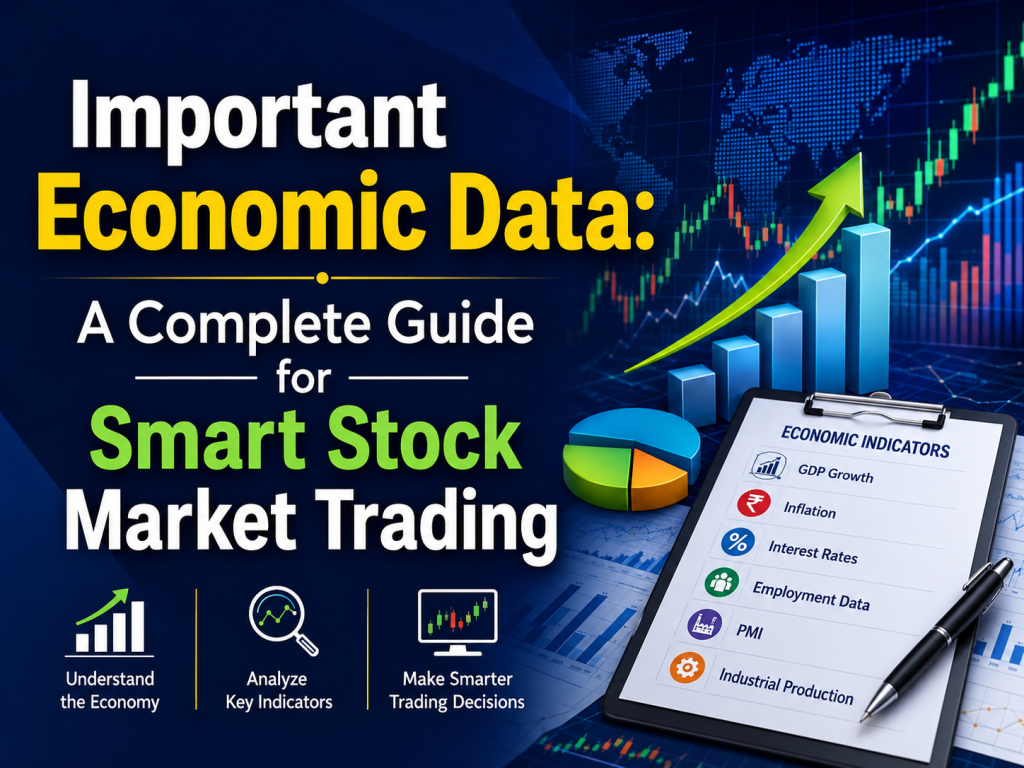

The stock market does not move randomly. Behind every major market rally, correction, or trend, there are economic factors influencing investor sentiment and institutional decisions. Whether you are a beginner investor or an active trader, understanding important economic data can help you make informed decisions and avoid emotional trading.
Many new traders focus only on charts, indicators, and stock tips. However, professional traders and institutional investors closely monitor economic reports before taking large positions. Economic data provides valuable insights into the health of a country’s economy, business growth, inflation levels, employment conditions, and consumer spending patterns.
If you are learning trading through a share market course in Nagpur or looking to improve your understanding of market fundamentals, knowing how economic data affects stock prices is an essential skill.
In this detailed guide, we will explore the most important economic indicators, their impact on the stock market, and how traders can use them effectively.
Why Economic Data Matters in Stock Market Trading
Economic data acts like a report card for the economy. It helps investors understand whether economic conditions are improving or deteriorating.
When economic reports are positive:
- Investor confidence increases
- Corporate profits often improve
- Stock markets generally perform better
- Foreign investments may increase
When economic reports are weak:
- Investor confidence declines
- Companies may face slower growth
- Stock markets can become volatile
- Traders may become cautious
This is why successful traders monitor economic announcements regularly.
Understanding Economic Indicators
Economic indicators are statistical reports that measure various aspects of economic activity.
These indicators help answer questions such as:
- Is the economy growing?
- Are people spending money?
- Is inflation rising?
- Are companies hiring?
- Is industrial production increasing?
The answers to these questions directly influence stock market trends.
Gross Domestic Product (GDP)
What is GDP?
Gross Domestic Product, commonly known as GDP, measures the total value of goods and services produced within a country during a specific period.
GDP is considered one of the most important indicators of economic growth.
Why GDP Matters
A growing GDP generally indicates:
- Strong business activity
- Higher employment opportunities
- Increased consumer spending
- Better corporate earnings
These factors often support stock market growth.
Impact on Stock Market
When GDP growth exceeds expectations:
- Banking stocks may perform well
- Infrastructure companies may benefit
- Manufacturing sectors often gain momentum
When GDP growth slows down:
- Market sentiment may weaken
- Investors become cautious
- Growth-oriented stocks may face pressure
Inflation Data
What is Inflation?
Inflation measures the increase in prices of goods and services over time.
In India, inflation is commonly tracked through:
- Consumer Price Index (CPI)
- Wholesale Price Index (WPI)
Why Traders Watch Inflation
Moderate inflation is generally healthy for an economy.
However, high inflation can create challenges:
- Rising costs for businesses
- Reduced consumer purchasing power
- Potential interest rate hikes
Impact on Stock Market
High inflation may negatively impact:
- Consumer goods companies
- Auto manufacturers
- Real estate sectors
At the same time, some sectors may benefit from inflation depending on market conditions.
Interest Rates and RBI Policy
Understanding RBI’s Role
The Reserve Bank of India (RBI) controls monetary policy and interest rates.
The RBI’s decisions influence:
- Loan costs
- Consumer spending
- Business investments
- Market liquidity
Repo Rate
The Repo Rate is the rate at which banks borrow money from RBI.
When Repo Rate Increases
- Loans become expensive
- Consumer spending may decline
- Business expansion can slow
When Repo Rate Decreases
- Loans become cheaper
- Spending increases
- Businesses may invest more
Impact on Stock Market
Interest rate announcements often create significant market volatility.
Banking, real estate, automobile, and financial sectors are especially sensitive to RBI policy decisions.
Employment Data
Employment data reflects the health of the labor market.
A strong employment market indicates:
- Better income generation
- Higher consumer spending
- Economic stability
Why Traders Monitor Employment Numbers
When more people are employed:
- Demand for products increases
- Company revenues may grow
- Stock market sentiment improves
Weak employment data may indicate slowing economic activity.
Industrial Production Index (IIP)
What is IIP?
The Index of Industrial Production measures industrial activity across sectors such as:
- Manufacturing
- Mining
- Electricity
Why IIP Matters
Manufacturing is a major contributor to economic growth.
Rising industrial production often signals:
- Increased business activity
- Higher demand
- Economic expansion
Market Impact
Positive IIP data can support stocks from:
- Manufacturing companies
- Industrial equipment firms
- Capital goods sectors
Purchasing Managers’ Index (PMI)
PMI is a widely followed economic indicator.
It measures business activity in:
- Manufacturing sector
- Services sector
PMI Above 50
Indicates economic expansion.
PMI Below 50
Indicates contraction.
Why Traders Follow PMI
PMI provides an early signal about economic trends before official GDP numbers are released.
Many institutional investors closely track PMI data to assess future market direction.
Fiscal Deficit
What is Fiscal Deficit?
Fiscal deficit occurs when government expenditure exceeds government revenue.
Why It Matters
A high fiscal deficit may indicate:
- Increased government borrowing
- Potential inflation concerns
- Future financial challenges
Market Impact
Investors closely watch government budget announcements and fiscal deficit targets.
Sectors dependent on government spending often react strongly to these reports.
Current Account Deficit (CAD)
Current Account Deficit measures the difference between imports and exports.
Why It Is Important
A large CAD may indicate:
- Higher dependence on foreign capital
- Currency pressure
- External economic vulnerabilities
Impact on Markets
CAD influences:
- Currency markets
- Foreign investments
- Import-dependent sectors
Traders often analyze CAD trends alongside exchange rate movements.
Foreign Exchange Reserves
Foreign exchange reserves represent the country’s holdings of foreign currencies and assets.
Why They Matter
Strong forex reserves indicate:
- Economic stability
- Ability to manage currency fluctuations
- Improved investor confidence
Market Impact
Healthy reserves often support:
- Foreign investment inflows
- Currency stability
- Positive market sentiment
Consumer Confidence Index
Consumer confidence measures how optimistic people feel about their financial future.
Why It Matters
Confident consumers tend to:
- Spend more money
- Purchase homes
- Buy vehicles
- Invest in businesses
Impact on Stocks
Consumer-focused sectors often benefit from rising confidence levels.
Examples include:
- Retail companies
- Automobile manufacturers
- Consumer goods firms
Housing Market Data
The housing sector plays a major role in economic growth.
Important housing indicators include:
- Property sales
- Housing starts
- Construction activity
Why Traders Watch Housing Data
A strong housing market often benefits:
- Cement companies
- Steel manufacturers
- Real estate developers
- Banking institutions
Crude Oil Prices
India imports a significant portion of its crude oil requirements.
Why Oil Prices Matter
Higher oil prices can increase:
- Transportation costs
- Manufacturing costs
- Inflation pressures
Market Impact
Rising oil prices may affect:
- Airlines
- Logistics companies
- Paint manufacturers
- Chemical industries
Meanwhile, energy-related companies may benefit.
Corporate Earnings Reports
Although not strictly economic data, earnings reports are among the most important indicators for traders.
What Earnings Reports Show
They provide information about:
- Revenue growth
- Profitability
- Future outlook
- Management guidance
Impact on Stock Prices
Strong earnings can push stock prices higher.
Weak earnings can result in sharp declines.
Many traders align earnings data with broader economic trends.
How Economic Data Influences Market Sentiment
Stock prices often move based on expectations rather than current conditions.
For example:
If investors expect inflation to fall, markets may rally even before official inflation numbers improve.
Similarly:
If traders expect RBI to cut interest rates, market momentum may begin before the actual announcement.
This is why understanding market expectations is just as important as understanding the data itself.
How Beginners Can Use Economic Data
Many new traders feel overwhelmed by economic reports.
A simple approach is:
Focus on Key Reports
Track:
- GDP
- Inflation
- RBI policy
- PMI
- Employment data
Follow an Economic Calendar
Economic calendars help traders know:
- When reports are released
- Expected values
- Previous readings
Compare Expectations vs Actual Results
Markets react more to surprises than to absolute numbers.
For example:
If inflation is expected at 5% but comes at 6%, markets may react negatively.
Common Mistakes Traders Make
Ignoring Economic News
Many traders focus only on technical analysis and ignore economic events.
This can lead to unexpected losses during major announcements.
Overreacting to One Report
One economic report does not define the entire economy.
Always consider multiple indicators together.
Trading During High Volatility Without Preparation
Major announcements can create sudden price swings.
Risk management becomes essential during such periods.
Combining Economic Data with Technical Analysis
The best traders often combine:
- Economic analysis
- Fundamental analysis
- Technical analysis
- Risk management
For example:
If GDP growth is strong and technical charts show a bullish breakout, the probability of success may improve.
Using multiple forms of analysis helps traders make more balanced decisions.
Learn Market Fundamentals with Stock Market Vidya Nagpur
Understanding economic data is a critical part of becoming a successful trader and investor. While many people focus only on stock tips and trading strategies, true market understanding comes from learning how economic forces influence price movements.
If you want to build a strong foundation in stock market investing and trading, Stock Market Vidya Nagpur provides structured learning programs designed for beginners as well as advanced market participants.
The institute is led by Prashant Sarode, a NISM Certified Trainer who focuses on practical market education and real-world trading concepts.
Students looking for:
- Best share market classes in Nagpur
- Share market course in Nagpur
- Stock market course in Nagpur
- Share market training in Nagpur
- Stock market training institute in Nagpur
- Share market classes in Nagpur
- Stock market training Nagpur
- Trading classes in Nagpur
- Share trading course in Nagpur
- Stock market learning institute Nagpur
can explore the training programs available at:
Tel : 9822718163, 8421893845
The training focuses on understanding market fundamentals, technical analysis, risk management, trading psychology, and practical trading techniques that can help traders make informed decisions.
Final Thoughts
Economic data is one of the most powerful tools available to traders and investors. It helps you understand the broader forces driving stock market movements and provides valuable clues about future trends.
Whether it is GDP growth, inflation numbers, RBI policy decisions, employment statistics, PMI reports, or corporate earnings, each economic indicator offers insights that can improve your market understanding.
Instead of reacting emotionally to market movements, successful traders use economic data to make logical and informed decisions. By regularly following key economic indicators and combining them with technical analysis, you can develop a deeper understanding of market behavior and become a more confident participant in the stock market.
The more you understand the economy, the better prepared you will be to identify opportunities, manage risks, and navigate changing market conditions with confidence.
-

How to Read an Annual Report as a Stock Investor: A Beginner’s Guide
Buying a stock only because someone recommended it on social media or television can be risky. A smart investor tries to understand the business before investing money. One of the best documents available for this purpose is the company’s annual report. But many beginners feel confused when they open a 200-page or 300-page annual report.…
-

10 Smart Questions to Ask Before Your First Stock Investment
Buying your first stock can feel exciting. You open a trading app, search for a company name, see the share price moving up, and think, “Should I buy this stock?” But successful investing should not begin with excitement or a random tip from social media. It should begin with questions. Before investing your hard-earned money,…
-

How to Research a Stock Before Buying It: A Beginner’s Guide for Indian Investors
Buying a stock should not be like buying something because a friend recommended it, a social media post called it a “multibagger”, or its price suddenly started moving upward. A better approach is simple: research first, decide later. For beginners, stock research means understanding the company, its business, financial performance, valuation, industry, management and future…