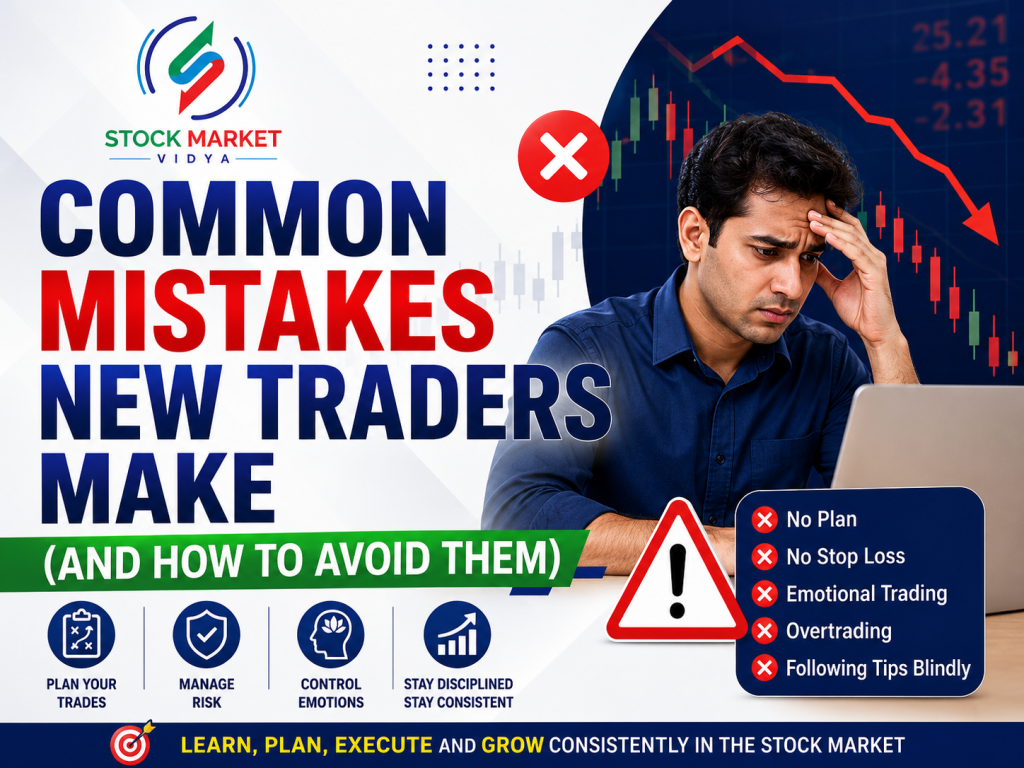
The stock market attracts thousands of new traders every year. Many people enter the market with dreams of earning extra income, achieving financial freedom, or building wealth through smart investing and trading. However, the reality is that a large percentage of beginners struggle in their initial trading journey.
The main reason is not a lack of intelligence or opportunity. The biggest reason is the common mistakes that new traders make. Most beginners enter the market without proper knowledge, risk management, or trading discipline. As a result, they often face losses that could have been avoided.
If you are searching for how to learn stock market trading in India, or looking for the best share market course for beginners in Nagpur, understanding these mistakes can save you time, money, and frustration.
In this detailed guide, we will discuss the most common mistakes new traders make and practical ways to avoid them. Whether you are just starting or have already taken your first trades, this article will help you build a stronger foundation for your trading journey.
Why Beginners Often Struggle in Trading
Many people think trading is simply buying low and selling high. In reality, successful trading requires:
- Knowledge
- Discipline
- Risk management
- Emotional control
- Consistent learning
Without these elements, even a good trading opportunity can become a losing trade.
This is why professional training and proper stock market education play a crucial role in helping beginners understand how markets actually work.

Mistake 1: Entering the Market Without Proper Education
One of the biggest mistakes beginners make is starting trading based on social media tips, YouTube videos, or advice from friends.
Many traders place their first trades without understanding:
- Market structure
- Candlestick patterns
- Technical analysis
- Risk management
- Trading psychology
- Position sizing
As a result, they are essentially trading blindly.
How to Avoid It
Before risking real money, invest time in learning.
A structured stock market course with practical trainingcan help you understand market fundamentals and build confidence.
Instead of depending on random tips, learn:
- Price action
- Chart reading
- Support and resistance
- Trend analysis
- Trading strategies
Knowledge becomes your biggest trading asset.
Mistake 2: Trading Without a Plan
Many beginners enter trades based on emotions.
For example:
- A stock is rising rapidly.
- News channels are discussing it.
- Social media is full of excitement.
Without any analysis, the trader buys the stock.
Later, when the stock falls, panic takes over.
This is not trading. It is guessing.
How to Avoid It
Create a clear trading plan that defines:
- Entry point
- Stop loss
- Profit target
- Risk per trade
- Trading timeframe
Professional traders follow a system. They do not make decisions based on emotions.
A written trading plan helps maintain consistency and discipline.
Mistake 3: Ignoring Risk Management
Many beginners focus only on profits.
They ask:
- Which stock will double?
- Which stock will hit upper circuit?
- Which stock can give quick returns?
Very few ask:
- How much can I lose?
This mindset creates major problems.
Even the best traders experience losing trades. The difference is that professionals control losses while beginners often allow losses to become too large.
How to Avoid It
Follow basic risk management rules:
- Never risk a large portion of your capital on one trade.
- Use stop losses.
- Maintain proper position sizing.
- Protect your trading capital.
Remember:
Capital preservation comes before profit generation.
If you protect your capital, opportunities will always exist in the future.
Mistake 4: Overtrading
Many new traders believe that more trades mean more profits.
They continuously:
- Buy and sell throughout the day
- Enter multiple stocks simultaneously
- Trade every market movement
Eventually, brokerage costs increase and mistakes multiply.
How to Avoid It
Quality matters more than quantity.
Wait for high-probability setups.
Ask yourself:
- Does this trade fit my strategy?
- Is the risk-reward ratio favorable?
- Am I trading because of opportunity or boredom?
Professional traders often make fewer but better trades.
Mistake 5: Not Using Stop Losses
One of the most dangerous habits among beginners is avoiding stop losses.
Common thoughts include:
- The stock will recover.
- I will wait a little longer.
- It cannot fall further.
Unfortunately, markets do not follow personal opinions.
A small loss can quickly become a large loss.
How to Avoid It
Always define your stop loss before entering a trade.
A stop loss:
- Limits damage
- Protects capital
- Improves discipline
- Reduces emotional stress
Successful traders treat stop losses as a normal part of trading.
Mistake 6: Following Market Tips Blindly
Tip-based trading is one of the fastest ways to lose money.
Many beginners depend on:
- WhatsApp groups
- Telegram channels
- Social media influencers
- Unverified stock recommendations
The problem is simple.
You do not know:
- Why the trade was suggested
- The risk involved
- The exit strategy
How to Avoid It
Learn to analyze stocks independently.
Develop your own decision-making skills.
The goal should not be to find tips.
The goal should be to understand the market well enough that you no longer need tips.
Mistake 7: Letting Emotions Control Trading Decisions
Trading psychology is often ignored by beginners.
Two emotions dominate the market:
Fear
Fear causes traders to:
- Exit winning trades too early
- Avoid good opportunities
- Panic during market corrections
Greed
Greed causes traders to:
- Hold positions too long
- Ignore targets
- Increase risk unnecessarily
How to Avoid It
Build emotional discipline by:
- Following a trading plan
- Using stop losses
- Maintaining a trading journal
- Focusing on process rather than outcomes
Successful trading is as much about mindset as strategy.
Mistake 8: Trying to Recover Losses Quickly
After facing a loss, many traders immediately try to recover it.
This leads to:
- Larger position sizes
- Emotional decisions
- Poor-quality trades
This behavior is often called revenge trading.
How to Avoid It
Accept losses as part of trading.
Even professional traders experience losing trades.
Instead of chasing losses:
- Review your mistakes
- Learn from them
- Wait for the next valid setup
Patience often saves more money than aggressive trading.
Mistake 9: Expecting Overnight Success
Many beginners enter the market expecting quick riches.
They see success stories online and assume trading is easy.
In reality:
- Trading requires practice
- Skills develop over time
- Experience matters
How to Avoid It
Treat trading like any other profession.
A doctor, engineer, or lawyer spends years learning.
Trading deserves the same level of dedication.
Focus on continuous improvement rather than instant profits.
Mistake 10: Not Maintaining a Trading Journal
Most beginners never record their trades.
As a result, they repeat the same mistakes repeatedly.
How to Avoid It
Maintain a trading journal that records:
- Entry reasons
- Exit reasons
- Profit or loss
- Emotional state
- Lessons learned
Over time, your journal becomes one of the most valuable learning tools.
Mistake 11: Trading Without Understanding Market Trends
Many beginners try to trade against the prevailing trend.
For example:
- Buying in a strong downtrend
- Selling in a strong uptrend
This significantly reduces the probability of success.
How to Avoid It
Learn trend analysis.
Understand:
- Uptrends
- Downtrends
- Sideways markets
Trading in the direction of the trend often increases the chances of success.
Mistake 12: Investing and Trading Without Clear Goals
Some beginners confuse investing and trading.
They buy stocks for long-term investing but react like short-term traders.
This creates confusion and inconsistent decisions.
How to Avoid It
Define your objective clearly.
Ask:
- Am I investing?
- Am I swing trading?
- Am I intraday trading?
Each approach requires different strategies and expectations.
The Role of Trading Psychology in Long-Term Success
Most people think successful traders have secret indicators or magical strategies.
In reality, long-term success often depends on:
- Discipline
- Consistency
- Patience
- Emotional control
Trading psychology helps traders:
- Handle losses calmly
- Avoid impulsive decisions
- Follow plans consistently
- Build confidence
A strong mindset often separates successful traders from unsuccessful ones.
Why Professional Stock Market Education Matters
Learning through trial and error can be expensive.
Many beginners lose significant money before realizing the importance of structured education.
A proper learning environment helps students understand:
- Technical analysis
- Risk management
- Trading psychology
- Market structure
- Practical trading techniques
This is why many aspiring traders search for:
- where to learn stock market trading in Nagpur
- best institute to learn trading in Nagpur
- best share market course for beginners in Nagpur
Professional guidance can shorten the learning curve and help avoid costly mistakes.
Learn Trading with Stock Market Vidya Nagpur
For individuals seeking quality stock market education, Stock Market Vidya Nagpur has become a recognized name among aspiring traders and investors.
Stock Market Vidya is a dedicated share market institute in Nagpur focused on helping students understand the stock market through practical and systematic learning.
The institute is guided by Prashant Sarode stock market trainer, a respected NISM/NSE Certified Trainer who has trained numerous students interested in trading and investing.
His teaching approach focuses on simplifying complex market concepts so that beginners can understand them easily.
Students receive exposure to important areas such as:
- Stock market fundamentals
- Technical analysis
- Trading psychology
- Risk management
- Market behavior
- Practical chart analysis
The objective is not simply to teach theory but to help students develop a structured approach toward trading and investing.
Why Many Students Choose Stock Market Vidya
People looking for stock market education Nagpur often prefer structured learning rather than random online information.
Some reasons students choose Stock Market Vidya share market classes include:
Practical Learning Approach
Concepts are explained using real market examples.
Beginner-Friendly Training
The curriculum is designed for individuals who are completely new to trading.
Focus on Risk Management
Students learn how to protect capital and manage risk effectively.
Trading Psychology Training
Understanding emotions and decision-making forms an important part of the learning process.
Local Accessibility
Students searching for:
- trading classes near Wardha Road Nagpur
- stock market classes near Sonegaon Nagpur
- best trading institute in Nagpur
often consider Stock Market Vidya because of its strong local presence and market-focused training programs.
Building a Successful Trading Mindset
Successful traders understand one important truth:
The market is not a place for shortcuts.
Long-term success comes from:
- Continuous learning
- Patience
- Discipline
- Proper risk management
- Consistent practice
Every successful trader was once a beginner.
The difference is that they learned from mistakes instead of repeating them.
By avoiding the common mistakes discussed in this article, you can significantly improve your chances of becoming a more disciplined and confident trader.
Conclusion
Trading can be an exciting and rewarding journey when approached with the right mindset and education. Unfortunately, many beginners lose money because they make avoidable mistakes such as trading without a plan, ignoring risk management, following tips blindly, and allowing emotions to drive decisions.
The good news is that every mistake can become a valuable lesson.
If you are serious about learning the stock market and want to understand how professional traders approach the market, investing in proper education can make a significant difference.
For individuals searching for the best share market course for beginners in Nagpur, Stock Market Vidya Nagpur offers structured learning under the guidance of Mr. Prashant Sarode, NISM/NSE Certified Trainer.
Whether your goal is trading, investing, or understanding financial markets better, learning from experienced professionals can help you build confidence and develop the skills needed for long-term success.
For more information about courses and training programs, visit StockMarketVidya.com or contact 9822718163 / 8421893845.
The stock market rewards preparation, discipline, and continuous learning. Start your journey with knowledge, and let informed decisions guide your path toward becoming a smarter trader.
Frequently Asked Questions (FAQs)
1. What are the most common mistakes new traders make in the stock market?
New traders often make mistakes such as trading without a plan, ignoring stop losses, following market tips blindly, overtrading, risking too much capital on a single trade, and allowing emotions like fear and greed to influence decisions. These mistakes can lead to unnecessary losses and slow down the learning process.
2. Why do most beginner traders lose money?
Most beginner traders lose money because they enter the market without proper stock market education, risk management knowledge, or trading discipline. Many beginners focus only on profits and underestimate the importance of protecting their capital.
3. How can I avoid losing money as a new trader?
To reduce losses, learn the basics of trading, use stop losses, follow a trading plan, manage risk carefully, and avoid emotional decision-making. Consistent learning and discipline are more important than chasing quick profits.
4. Is trading psychology important for beginners?
Yes. Trading psychology is one of the most important aspects of successful trading. Fear, greed, impatience, and overconfidence often lead to poor trading decisions. Learning emotional discipline helps traders follow their strategy consistently.
5. What is the biggest mistake traders make when starting out?
One of the biggest mistakes is entering trades without understanding why they are buying or selling. Many beginners rely on tips or social media recommendations instead of conducting their own analysis.
6. Why is risk management important in stock market trading?
Risk management helps protect your trading capital. Even experienced traders face losses, but proper risk management ensures that one bad trade does not significantly damage the trading account.
7. Should beginners use stop loss orders?
Yes. Stop losses help limit potential losses and prevent emotional decisions during market fluctuations. Every trader should define a stop loss before entering a trade.
8. How much money should a beginner start trading with?
Beginners should start with an amount they can afford to risk while learning. The focus should be on gaining experience and developing skills rather than making large profits immediately.
9. Is following stock market tips a good trading strategy?
No. Blindly following tips from social media, WhatsApp groups, or unofficial sources can be risky. Successful traders learn how to analyze the market independently and make informed decisions.
10. How can beginners develop trading discipline?
Trading discipline develops through consistent practice, following a trading plan, maintaining a trading journal, and sticking to predefined risk management rules regardless of market emotions.
11. What is overtrading and why should it be avoided?
Overtrading occurs when traders take too many trades without proper analysis. It often results from boredom, greed, or the desire to recover losses quickly. Overtrading increases transaction costs and emotional stress.
12. Why should traders maintain a trading journal?
A trading journal helps track trade performance, identify recurring mistakes, improve decision-making, and build a structured approach to trading. It serves as a valuable learning tool for long-term growth.
13. How long does it take to learn stock market trading?
The learning period varies for each individual. Most traders require several months of consistent study and practice to understand market behavior, trading strategies, and risk management principles effectively.
14. What is the best way to learn stock market trading in India?
The best way is through structured education, practical training, market observation, and guidance from experienced trainers. A stock market course with practical learning can help beginners build a strong foundation.
15. Why do emotions affect trading performance?
Emotions often cause traders to break their own rules. Fear can lead to premature exits, while greed can encourage excessive risk-taking. Successful traders learn to make decisions based on strategy rather than emotions.
16. Can technical analysis help beginners avoid trading mistakes?
Yes. Technical analysis helps traders identify trends, support and resistance levels, entry points, and exit opportunities. Understanding charts can significantly improve trading decisions.
17. What should beginners focus on before making their first trade?
Before placing a trade, beginners should understand market basics, risk management, technical analysis, position sizing, and the importance of having a well-defined trading plan.
18. Where can I learn stock market trading in Nagpur?
Individuals searching for stock market education Nagpur, share market classes, or trading courses can consider Stock Market Vidya Nagpur, which provides structured learning under the guidance of Mr. Prashant Sarode, a NISM/NSE Certified Trainer.
19. Why is professional stock market training beneficial?
Professional training helps traders avoid common beginner mistakes, understand market concepts faster, learn practical trading techniques, and develop a disciplined approach toward investing and trading.
20. Which is the best share market course for beginners in Nagpur?
A good beginner course should cover stock market fundamentals, technical analysis, risk management, trading psychology, and practical market application. Many learners looking for the best share market course for beginners in Nagpur explore Stock Market Vidya for its structured learning approach and practical market-focused training.
-
How to Read an Annual Report as a Stock Investor: A Beginner’s Guide
Buying a stock only because someone recommended it on social media or television can be risky. A smart investor tries to understand the business before investing money. One of the best documents available for this purpose is the company’s annual report. But many beginners feel confused when they open a 200-page or 300-page annual report.…
-

10 Smart Questions to Ask Before Your First Stock Investment
Buying your first stock can feel exciting. You open a trading app, search for a company name, see the share price moving up, and think, “Should I buy this stock?” But successful investing should not begin with excitement or a random tip from social media. It should begin with questions. Before investing your hard-earned money,…
-

How to Research a Stock Before Buying It: A Beginner’s Guide for Indian Investors
Buying a stock should not be like buying something because a friend recommended it, a social media post called it a “multibagger”, or its price suddenly started moving upward. A better approach is simple: research first, decide later. For beginners, stock research means understanding the company, its business, financial performance, valuation, industry, management and future…