
Why Does an Option Have a Price?
Have you ever noticed that two options with different expiry dates can have different prices, even when their strike prices are similar? Or wondered why an option premium decreases when the market is not moving?
The answer lies in two important concepts of options trading: Intrinsic Value and Time Value.
Understanding these concepts is essential for anyone who wants to learn futures and options trading. They help traders understand option pricing, premium movement and the impact of expiry on their positions.
In the stock market, an option’s premium is not just a random price. It represents two different components that work together.
In this article, we will understand intrinsic value vs time value with practical examples, simple calculations and useful trading insights.
1. What Is Option Premium?
Before understanding intrinsic value and time value, let us first understand option premium.
An option premium is the price an option buyer pays to purchase a Call or Put option. The seller of the option receives this premium.
For example:
Suppose Nifty is trading at 25,000, and a trader purchases a 25,100 Call option at a premium of ₹80.
Here:
- Underlying asset: Nifty
- Strike price: 25,100
- Option type: Call
- Premium paid: ₹80
The trader pays ₹80 per unit of the contract.
This premium has two components:
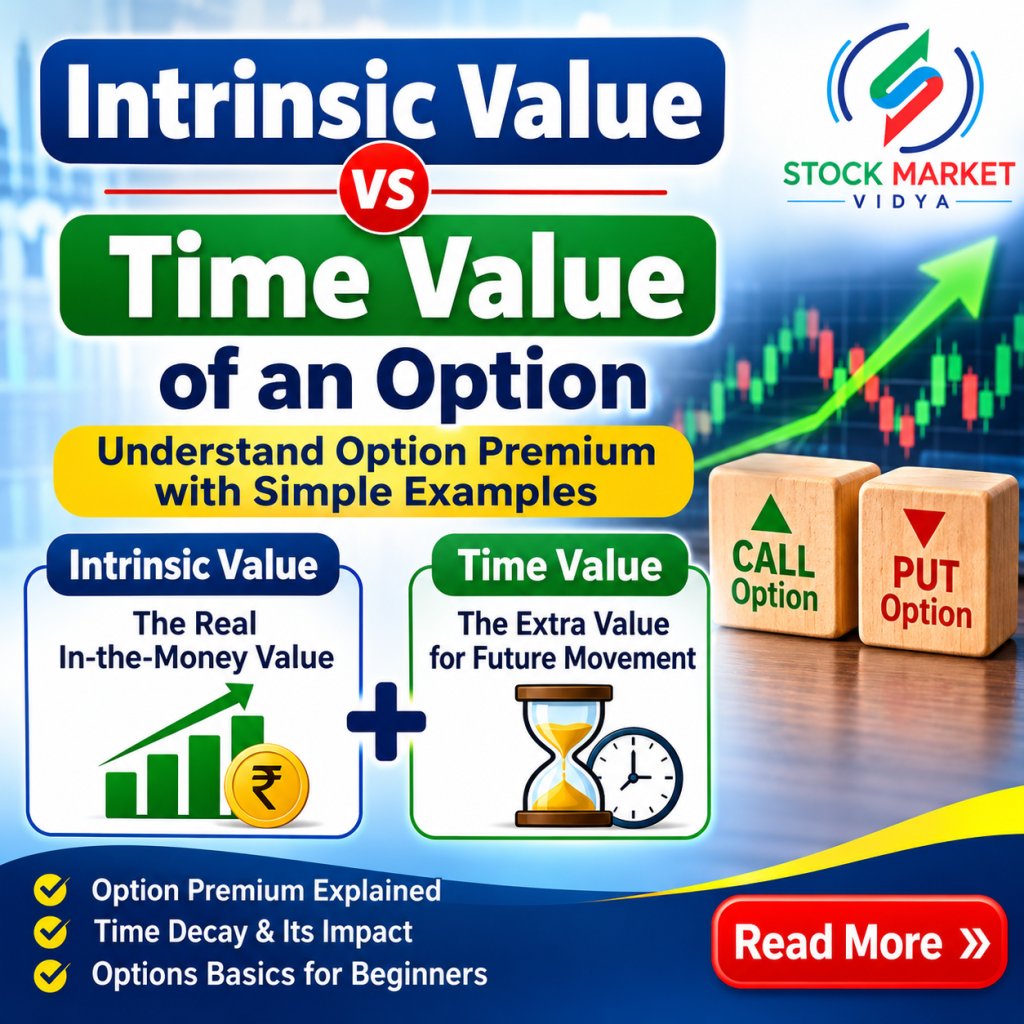
Option Premium = Intrinsic Value + Time Value
Understanding this formula is the foundation of options trading.
2. What Is Intrinsic Value in Options?
Intrinsic value is the actual in-the-money value of an option based on the current market price of its underlying asset.
In simple words, it represents the value an option would have if it were to expire at the current market price.
Intrinsic value is calculated differently for Call and Put options.
Intrinsic Value of a Call Option
Formula:
Intrinsic Value = Market Price – Strike Price (if positive, otherwise zero).
Example:
Suppose:
- Nifty current market price: 25,200
- Call option strike price: 25,000
Calculation:
Intrinsic Value = 25,200 – 25,000 = ₹200.
The Call option has ₹200 intrinsic value because the market price is ₹200 above the strike price.
Intrinsic Value of a Put Option
Formula:
Intrinsic Value = Strike Price – Market Price (if positive, otherwise zero).
Example:
Suppose:
- Nifty current market price: 24,800
- Put option strike price: 25,000
Calculation:
Intrinsic Value = 25,000 – 24,800 = ₹200.
The Put option has ₹200 intrinsic value.
An important point for beginners: At-the-money (ATM) and out-of-the-money (OTM) options have zero intrinsic value. Only in-the-money (ITM) options have positive intrinsic value.
3. What Is Time Value in Options?
Time value is the additional amount an option buyer pays above its intrinsic value.
It represents the possibility that the underlying asset may move in a favourable direction before the option expires.
For example, imagine Nifty is trading at 25,200 and a 25,000 Call option is available at a premium of ₹260.
The calculation is:
- Total option premium: ₹260
- Intrinsic value: ₹200
- Time value: ₹60
Therefore:
Time Value = Option Premium – Intrinsic Value
Time Value = ₹260 – ₹200 = ₹60.
The additional ₹60 represents the time value of the option.
Even if the option already has intrinsic value, its premium may contain additional value because there is still time for the market to move further.
4. Intrinsic Value vs Time Value: Understand the Real Difference
Both components contribute to the option premium, but their behaviour is different.
Intrinsic Value
- Represents the in-the-money value of an option.
- Depends on the relationship between market price and strike price.
- Can increase or decrease when the underlying market price changes.
- Cannot be negative.
- Exists only in ITM options.
Time Value
- Represents the possibility of favourable price movement before expiry.
- Depends on remaining time and expected market volatility.
- Generally decreases as expiry approaches.
- Becomes zero at expiry.
- Exists in ATM and OTM options as well as ITM options before expiry.
The most important lesson is that an option’s premium can decrease even when the underlying market price does not change.
This happens because of time decay.
5. How Does Time Decay Affect Option Premium?
Time decay is one of the most important concepts in options trading.
Every option contract has an expiry date. As the expiry date approaches, the remaining time available for favourable price movement becomes shorter.
As a result, the time value generally decreases. This effect is known as time decay and is represented by Theta in option Greeks.
Consider an example:
A trader purchases a Call option for ₹100.
Initially:
- Intrinsic value: ₹40
- Time value: ₹60
- Total premium: ₹100
After a few trading sessions, suppose the underlying market price remains unchanged.
The time value may reduce from ₹60 to ₹35 due to the passage of time and other pricing changes.
Now the premium becomes:
₹40 + ₹35 = ₹75.
The trader faces a ₹25 reduction in premium even though the underlying market price has not moved.
This is why understanding time decay is important before entering an options trade.
Time decay is generally faster as expiry approaches, although its actual impact depends on market conditions.
6. What Factors Influence Time Value?
Time value is influenced by several factors.
1. Remaining Time Until Expiry
An option with more time remaining generally has greater time value because the underlying asset has more time to move favourably.
2. Implied Volatility
Higher expected volatility generally increases option premiums. Larger expected price movements create more possibilities for an option to become profitable.
3. Market Price Movement
Changes in the underlying asset can change both intrinsic value and time value.
4. Strike Price
The relationship between the current market price and strike price determines whether an option is ITM, ATM or OTM. This affects its premium.
5. Interest Rates and Dividends
Interest rates and expected dividends can also influence option pricing.
Understanding these factors helps traders make more informed decisions instead of selecting options only because their premiums appear cheap.
7. Why Is This Knowledge Important for Options Traders?
Many beginners focus only on predicting whether Nifty or Bank Nifty will move upward or downward.
However, correct market direction alone does not determine the profitability of an options trade.
A trader must also understand:
- How much intrinsic value the option contains.
- How much time value is included in the premium.
- How much time remains until expiry.
- Whether implied volatility is high or low.
- How time decay can affect the position.
This is where trading discipline and trading psychology become important.
Avoid entering a trade simply because an option is available at a low premium. A cheap option may have a low probability of finishing in-the-money.
A professional approach involves analysing market conditions, option chain data, risk and reward before taking a position.
8. Learn Practical Options Trading at Stock Market Vidya Nagpur
Understanding option pricing through theory is only the first step. Applying these concepts to actual market conditions requires proper education and practical market understanding.
Stock Market Vidya Nagpur is a share market training institute established on 3 December 2004 by Mr. Prashant Sarode.
Mr. Prashant Sarode is a NISM and NSE Certified Trainer with extensive experience in stock market trading and education. He has been associated with trading since 2002 and has trained more than 6,000 individuals.
His teaching approach focuses on helping students understand market concepts through practical explanations and structured learning.
The institute provides training in:
- Fundamental analysis and technical analysis.
- Futures and options trading.
- Option chain analysis.
- Option Greeks and option pricing.
- Intraday and short-term trading strategies.
- Hedging and risk management.
- Long-term investment concepts.
- Stock, commodity and currency markets.
Benefits of Joining Stock Market Vidya Share Market Classes
Students joining the institute can benefit from:
Practical Market Understanding: Learn how theoretical concepts work in real market situations.
Options Trading Knowledge: Understand Call and Put options, option premium, intrinsic value, time value and option Greeks.
Trading Strategy Development: Learn different trading approaches and the importance of planning before entering a position.
Risk Management: Understand position sizing, stop-loss planning and the importance of protecting trading capital.
Experienced Trainer: Learn from Mr. Prashant Sarode, a NISM and NSE Certified Trainer with more than two decades of market experience.
Structured Learning: Develop knowledge step by step, from stock market basics to advanced trading concepts.
Whether you are a student, working professional, investor or aspiring trader, structured stock market education can help you develop a better understanding of financial markets.
9. Where to Learn Options Trading in Nagpur?
If you are searching for the best share market course for beginners in Nagpur or want to develop your knowledge of derivatives, selecting an institute with experienced trainers and practical teaching is important.
Stock Market Vidya is located at:
Stock Market Vidya – Share Market Training Institute, Nagpur
Swamikrupa, 86, Kannamwar Nagar, Opposite Sonegaon Police Station, Near Hotel Pride, Wardha Road, Nagpur – 440025.
The institute is conveniently accessible for learners looking for trading classes near Wardha Road Nagpur and stock market classes near Sonegaon Nagpur.
For course details and admission enquiries:
Website: https://www.stockmarketvidya.com/
Mobile: 9822718163, 8421893845
Google Maps Directions: https://maps.app.goo.gl/Kof5Z6LQsxq4BqLt6
Conclusion
Intrinsic value and time value are the two building blocks of an option premium. Intrinsic value represents the current in-the-money value, while time value represents the additional value associated with the remaining opportunity before expiry.
Understanding both concepts helps traders analyse option prices, recognise time decay and develop better trading decisions.
If you want to learn options trading systematically, start with strong fundamentals and gradually develop your analytical skills.
Stock Market Vidya Nagpur, under the guidance of NISM and NSE Certified Trainer Mr. Prashant Sarode, provides structured share market training to help learners understand the stock market with greater clarity.
Visit StockMarketVidya.com to explore the available stock market courses and begin your learning journey.
Frequently Asked Questions (FAQs): Intrinsic Value vs Time Value of an Option
1. What is intrinsic value and time value in options?
Intrinsic value and time value are the two components of an option premium. Intrinsic value represents the actual in-the-money value of an option based on the current market price and strike price. Time value is the additional premium paid for the possibility of favourable price movement before expiry. For example, if an option premium is ₹150 and its intrinsic value is ₹100, the remaining ₹50 represents its time value.
2. What is the difference between intrinsic value and time value?
Intrinsic value represents the current in-the-money value of an option, whereas time value represents the additional value based on the remaining time until expiry and other pricing factors. Intrinsic value depends mainly on the difference between market price and strike price. Time value is influenced by expiry, implied volatility and other factors. Intrinsic value cannot be negative, while time value generally reduces as the expiry date approaches.
3. How do you calculate intrinsic value of a Call option?
The intrinsic value of a Call option is calculated by subtracting the strike price from the current market price of the underlying asset. If the result is negative, intrinsic value is considered zero. For example, if Nifty is trading at 25,200 and the Call option strike price is 25,000, its intrinsic value is ₹200. If Nifty is below 25,000, the Call option has zero intrinsic value.
4. How do you calculate intrinsic value of a Put option?
The intrinsic value of a Put option is calculated by subtracting the current market price from the strike price. If the result is negative, intrinsic value is zero. For example, if Nifty is trading at 24,800 and the Put option strike price is 25,000, its intrinsic value is ₹200. A Put option has intrinsic value when the underlying market price is below its strike price.
5. How is time value calculated in options trading?
Time value is calculated by subtracting intrinsic value from the total option premium. For example, suppose an option is trading at ₹250 and its intrinsic value is ₹180. Its time value will be ₹70. The formula is: Time Value = Option Premium – Intrinsic Value. This calculation helps traders understand how much of an option’s price comes from its current in-the-money value and how much comes from its remaining potential.
6. Can an option have time value without intrinsic value?
Yes, an option can have time value even when its intrinsic value is zero. This commonly happens with At-the-Money (ATM) and Out-of-the-Money (OTM) options. For example, if Nifty is trading at 25,000 and a 25,200 Call option is available at ₹60, its intrinsic value is zero, but its time value is ₹60. This is because the market may move above the strike price before expiry.
7. Why does time value decrease as expiry approaches?
Time value decreases as expiry approaches because the option has less time to experience favourable price movement. This process is called time decay. For example, an option with ten days remaining may have more time value than a similar option with only one day remaining, assuming other pricing factors remain comparable. Time decay generally accelerates near expiry, making it important for option buyers to understand expiry-related risks.
8. What happens to intrinsic value and time value on expiry?
On expiry, the time value of an option becomes zero. The final option value is based on its intrinsic value at expiry, subject to the applicable settlement rules. For example, if a Call option has a strike price of 25,000 and the settlement price is 25,150, its intrinsic value is ₹150. If it expires Out-of-the-Money, its intrinsic value is zero.
9. What is the relationship between option premium and intrinsic value?
Option premium is the total price paid by an option buyer. It consists of intrinsic value and time value. For example, if a Call option has an intrinsic value of ₹100 and a time value of ₹40, its total premium is ₹140. When analysing options, traders should understand both components instead of looking only at the quoted premium. This helps them evaluate option pricing more effectively.
10. Which option has more time value: ITM, ATM or OTM?
Generally, At-the-Money (ATM) options have the highest time value compared with nearby ITM and OTM options having the same expiry and underlying asset. This is because ATM options have a greater sensitivity to the possibility of moving into or further into the money. However, actual time value depends on implied volatility, expiry and market conditions. Traders should analyse the complete option chain rather than assuming all options follow identical pricing.
11. Does implied volatility affect time value of an option?
Yes, implied volatility has a significant impact on option time value. Higher implied volatility generally increases option premiums because the market is pricing in larger possible price movements. Lower implied volatility generally reduces premiums, assuming other factors remain unchanged. For example, before an important market event, implied volatility may increase, making options more expensive. Traders should understand volatility before buying or selling options.
12. Can an option premium decrease even when the market moves in the expected direction?
Yes, an option premium can decrease even when the underlying market moves in the expected direction. This can happen due to time decay, a fall in implied volatility or other pricing changes. For example, a trader buys a Call option expecting Nifty to rise. Nifty moves slightly upward, but implied volatility falls sharply and time value decreases. The combined effect may cause the option premium to decline despite the correct market direction.
13. What is the role of Theta in time value?
Theta is one of the important Option Greeks. It measures the sensitivity of an option’s theoretical price to the passage of time, with other factors held constant. Generally, long option positions have negative Theta, meaning their value tends to decrease as time passes. For option buyers, understanding Theta is important because time decay can affect profitability even when the underlying market remains relatively stable.
14. Why should beginners understand intrinsic value and time value before trading options?
Beginners should understand intrinsic value and time value because these concepts explain how option premiums are formed and why they change. Without this knowledge, traders may purchase options simply because their premiums look cheap or take positions without considering expiry and volatility. Understanding option pricing, time decay, option Greeks and risk management creates a stronger foundation for learning futures and options trading.
15. Where can I learn intrinsic value, time value and options trading in Nagpur?
Students and aspiring traders can learn options trading at Stock Market Vidya Nagpur, a share market training institute established by Mr. Prashant Sarode in 2004. Mr. Sarode is a NISM and NSE Certified Trainer with extensive experience in stock market trading and education. The institute provides structured learning in option premium, intrinsic value, time value, option Greeks, option chain analysis, hedging and futures and options strategies. For course details, visit www.stockmarketvidya.com or contact 9822718163 or 8421893845. The institute is located on Wardha Road, near Sonegaon Police Station, Nagpur.