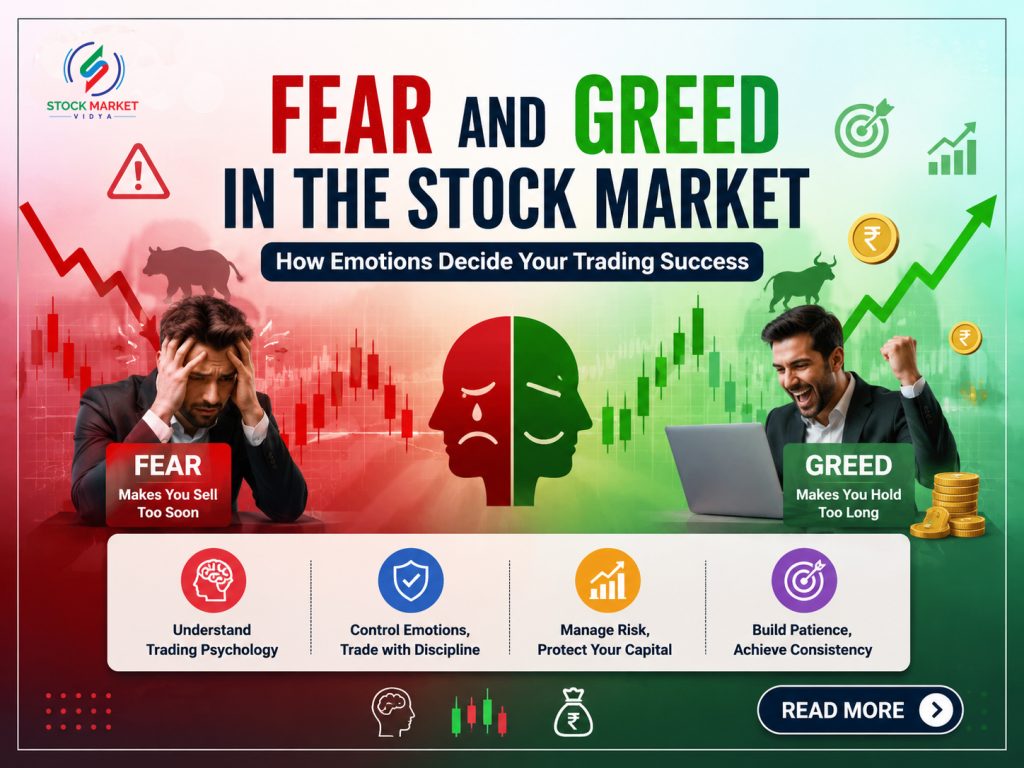

The stock market is often seen as a place where numbers, charts, and financial reports decide success. While these factors are important, one hidden force influences almost every trading decision—human emotions. Among all emotions, fear and greed have the biggest impact on how people buy and sell stocks.
Many beginners believe that earning profits in the share market is all about finding the right stock. In reality, even the best stock selection can fail if emotions take control. Fear can force a trader to sell a good stock too early, while greed can make someone hold a winning trade for too long. Learning to manage these emotions is one of the most valuable skills for anyone entering the stock market.
Whether you are searching for a stock market course for beginners, looking for the best share market classes in Nagpur, or wondering how to learn stock market trading in India, understanding trading psychology is just as important as learning technical analysis or fundamental analysis.
This article explains how fear and greed influence every trader, why emotional control is essential, and how proper stock market education can help you become a disciplined trader.
Why Psychology Matters More Than Tips
Every day, thousands of traders enter the market with excitement. They read news, watch YouTube videos, follow social media influencers, and join trading groups. Yet, a large number of traders struggle to earn consistent profits.
The reason is simple.
Most traders spend months learning indicators, chart patterns, and trading software but spend very little time understanding their own mindset.
Professional traders know that successful trading is a game of discipline, patience, and emotional control.
Your psychology decides:
- When you enter a trade
- When you exit
- Whether you follow your trading plan
- Whether you accept a small loss
- Whether you overtrade
- Whether you protect your capital
The market rewards discipline more than intelligence.

What is Fear in the Stock Market?
Fear is the emotional response that appears when traders think they may lose money.
Losses are a natural part of trading, but fear often makes traders react instead of thinking logically.
Fear usually appears in different situations.
Fear of Losing Money
A trader buys a stock expecting it to rise.
Instead, the price starts falling.
Instead of following the planned stop loss, panic takes over.
Some traders sell immediately.
Others keep watching the screen every minute, hoping the price recovers.
Neither decision is based on strategy.
It is based on fear.
Fear of Missing Out (FOMO)
This is one of the biggest reasons beginners lose money.
Imagine a stock rising continuously for three days.
Everyone on social media is talking about it.
Friends say,
“This stock will double soon.”
The trader feels left behind.
Without proper analysis, they buy at a very high price.
Soon after, the stock starts correcting.
Now fear replaces excitement.
This cycle repeats every day in the market.
Fear After a Big Loss
Many traders lose confidence after one bad trade.
Even when they find an excellent opportunity later, they hesitate.
Questions keep coming into their mind.
“What if I lose again?”
“What if this trade also fails?”
As a result, they miss profitable opportunities.
Fear During Market Corrections
Whenever the market falls sharply, headlines become negative.
Television channels discuss crashes.
Social media spreads panic.
Many investors sell quality stocks at the worst possible time.
Experienced investors, however, understand that market corrections are a normal part of investing.
What is Greed in the Stock Market?
Greed is the desire to earn more and more money without following proper discipline.
Greed can be even more dangerous than fear because it creates overconfidence.
Holding Profits for Too Long
Suppose a trader planned to book profit at ₹500.
The stock reaches ₹500.
Instead of selling, greed says,
“It can reach ₹600.”
Then,
“It can reach ₹700.”
Suddenly the stock falls to ₹450.
A profitable trade becomes a losing trade.
Taking Bigger Risks
After earning profits in two or three trades, many traders believe they cannot lose.
They increase position size.
Ignore stop losses.
Take random entries.
Trade multiple stocks together.
One bad trade wipes out weeks of profits.
Overtrading
Greed convinces traders that every market movement is an opportunity.
Instead of waiting patiently, they enter trade after trade.
More trades do not mean more profits.
Professional traders often wait several days for one quality setup.
Ignoring Risk Management
Greedy traders focus only on profit.
Disciplined traders focus on protecting capital first.
Without capital, there is no future trading.
The Fear and Greed Cycle
Every market follows an emotional cycle.
Understanding this cycle helps traders avoid emotional decisions.
Optimism
The market starts moving upward.
Confidence increases.
Investors become positive.
Excitement
Profits start coming.
More people enter the market.
Trading activity increases.
Greed
People believe prices will never fall.
Everyone wants quick profits.
Risk-taking increases.
Euphoria
This is the most dangerous stage.
People invest without research.
Many even borrow money to trade.
History shows that market bubbles often form during this phase.
Anxiety
The market starts correcting.
People believe it is only temporary.
They continue holding.
Fear
Prices continue falling.
Panic begins.
Investors become nervous.
Panic Selling
Now everyone wants to exit.
Stocks are sold at heavy losses.
Despair
Many people decide never to invest again.
Ironically, this stage often creates opportunities for disciplined investors.
Why Beginners Get Trapped
Most beginners enter the market expecting fast profits.
Social media often shows only successful trades.
Very few people discuss losses.
As a result, expectations become unrealistic.
Some common mistakes include:
- Buying without research
- Following random Telegram or WhatsApp tips
- Trading without a plan
- Ignoring stop loss
- Investing based on emotions
- Trying to recover losses immediately
- Taking advice from unverified sources
Proper education helps traders avoid these mistakes before they become expensive lessons.
Real-Life Example of Fear
Rahul starts trading with ₹1,00,000.
He buys shares worth ₹50,000.
The stock falls by 5%.
Instead of following his trading plan, he panics and sells.
The very next week, the stock rises 18%.
Rahul lost money not because the company was bad.
He lost because fear controlled his decision.
Real-Life Example of Greed
Priya buys a stock after careful analysis.
She plans to book profit at 15%.
The target arrives.
Instead of selling, she decides to wait.
The market suddenly turns negative.
Her 15% profit changes into a 10% loss.
The analysis was correct.
The mistake was emotional.
Why Successful Traders Think Differently
Professional traders understand one important truth.
No one can predict every market movement.
Instead of trying to win every trade, they focus on following a process.
They know that:
- Small losses are normal.
- Risk management is essential.
- Consistency is more important than one big profit.
- Discipline creates long-term success.
- Emotional decisions usually lead to losses.
This mindset separates experienced traders from beginners.
The Role of Stock Market Education
Many people believe trading is simply buying low and selling high.
In reality, successful trading involves much more.
A good learning program teaches:
- Market psychology
- Technical analysis
- Risk management
- Capital allocation
- Trading discipline
- Position sizing
- Practical chart reading
- Real market behaviour
Instead of depending on rumours, traders learn how markets actually function.
For anyone searching online for a share market course near me, stock market course for beginners, or where to learn stock market trading in Nagpur, choosing an institute that combines theory with practical market learning can make a significant difference in building long-term confidence.
Why Emotional Discipline Cannot Be Learned from YouTube Alone
Thousands of free videos explain trading strategies.
Yet many traders continue losing money.
Why?
Because knowledge alone is not enough.
Trading requires practice, observation, feedback, and continuous improvement.
Watching a video cannot correct emotional mistakes made during live trading.
That is why structured learning, practical market sessions, and guidance from experienced mentors help traders develop discipline over time.
How to Control Fear and Greed in the Stock Market
Controlling emotions does not mean becoming emotionless. Every trader experiences excitement, fear, disappointment, and confidence. The difference is that successful traders do not allow these emotions to control their decisions.
Emotional discipline is built through daily habits and a structured trading process.
1. Always Trade with a Written Trading Plan
One of the biggest mistakes beginners make is entering trades without a clear plan.
Before buying any stock, ask yourself:
- Why am I entering this trade?
- What is my target price?
- Where will I exit if the trade goes against me?
- How much money am I willing to risk?
- Does this trade match my strategy?
Writing these answers before placing an order removes emotional decision-making during market hours.
A trading plan acts like a roadmap. When markets become volatile, your plan keeps you focused.
2. Never Ignore Stop Loss
Many traders accept profits happily but hesitate to accept losses.
This is where fear creates bigger problems.
A small planned loss is much better than a large unexpected loss.
Imagine two traders.
The first trader exits with a planned loss of 2%.
The second trader refuses to exit because he hopes the stock will recover.
If the stock falls another 15%, the emotional pressure becomes even greater.
Professional traders understand that protecting capital is their first responsibility.
A stop loss is not a sign of failure.
It is a tool for survival.
3. Focus on Process Instead of Daily Profits
Many beginners check their profit and loss every few minutes.
This habit creates unnecessary stress.
Instead of asking,
“How much money did I make today?”
Ask,
“Did I follow my trading rules today?”
Consistently following a good process eventually produces better long-term results than chasing quick profits.
4. Accept That Losses Are Part of Trading
Even the world’s best traders experience losing trades.
No trading strategy can provide a 100% success rate.
Suppose your strategy wins 7 trades out of 10.
That still means three losing trades are completely normal.
When traders understand this reality, they stop reacting emotionally to every loss.
Instead of feeling disappointed, they analyse what happened and prepare for the next opportunity.
5. Avoid Overtrading
Many people believe that more trades mean more income.
In reality, unnecessary trading usually increases losses.
Professional traders are patient.
Sometimes they wait several hours or even several days for the right setup.
Quality matters far more than quantity.
One well-planned trade is often better than ten emotional trades.
6. Manage Your Position Size
Another common mistake is investing too much money in a single trade.
Suppose you have ₹2,00,000.
Investing the entire amount in one stock increases emotional pressure.
Every small market movement feels stressful.
Instead, experienced traders divide their capital wisely.
Proper position sizing helps traders think clearly because the financial risk remains under control.
7. Keep a Trading Journal
A trading journal is one of the simplest yet most powerful tools for improvement.
After every trade, write down:
- Why you entered the trade
- Entry price
- Exit price
- Profit or loss
- Your emotions during the trade
- What you learned
After a few months, patterns become visible.
You may discover that:
- Most losses happen when you ignore your trading plan.
- Emotional trades perform poorly.
- Patient trades produce better results.
Learning from your own experience is one of the fastest ways to improve.
8. Do Not Compare Yourself with Others
Social media often creates unrealistic expectations.
You may see screenshots showing huge profits.
What you usually do not see are the losses behind those screenshots.
Comparing yourself with others leads to frustration and greed.
Every trader has different:
- Capital
- Experience
- Risk tolerance
- Financial goals
- Trading strategy
Focus on your own learning journey rather than someone else’s success story.
9. Continue Learning
The stock market changes continuously.
New sectors emerge.
Economic conditions change.
Government policies affect industries.
Global events influence market sentiment.
A successful trader never stops learning.
Reading books, analysing charts, understanding company fundamentals, and learning from experienced mentors help improve decision-making over time.
Continuous learning builds confidence, and confidence reduces emotional reactions.
10. Develop Patience
Patience is one of the greatest strengths in trading.
Many beginners feel they must trade every day.
Professional traders know that waiting is also a trading decision.
Sometimes the best trade is the one you do not take.
Patience helps traders avoid low-quality opportunities and focus only on high-probability setups.
The Importance of Risk Management
Many people enter the market thinking only about profits.
Professional traders think differently.
Their first question is:
“How much can I lose if this trade goes wrong?”
This simple change in thinking protects capital.
Good risk management includes:
- Using stop loss
- Managing position size
- Avoiding excessive leverage
- Diversifying investments when appropriate
- Following a fixed risk percentage for each trade
Capital preservation allows traders to stay in the market for years.
Without proper risk management, even a few emotional decisions can erase months of hard work.
Emotional Mistakes Every Trader Should Avoid
Every trader makes mistakes, but learning to recognise them early can save both money and confidence.
Some of the most common emotional mistakes include:
Revenge Trading
After a loss, many traders immediately enter another trade to recover their money.
Instead of following analysis, they trade based on frustration.
This often leads to even bigger losses.
Blindly Following Tips
Buying shares based only on social media posts, WhatsApp messages, Telegram channels, or friends’ suggestions is risky.
Always analyse the stock yourself before making any investment decision.
Changing Strategies Frequently
Many beginners switch strategies after just two or three losing trades.
No strategy works perfectly in every market condition.
Give your strategy enough time and evaluate it over a larger number of trades before making changes.
Trading Without Preparation
Successful traders prepare before the market opens.
They study charts, identify important support and resistance levels, and create a watchlist.
Entering the market without preparation often results in emotional decisions.
Ignoring Market Conditions
The same strategy may not work in every situation.
Trending markets and sideways markets require different approaches.
Learning to recognise market conditions helps improve trading decisions.
Habits of Consistently Successful Traders
Successful traders usually share several common habits.
They:
- Follow a disciplined routine.
- Keep learning continuously.
- Accept losses calmly.
- Avoid emotional decisions.
- Focus on long-term consistency.
- Maintain detailed trading records.
- Respect risk management rules.
- Stay patient during uncertain markets.
These habits are developed over time through practice and experience.
Why Trading Psychology Is Equally Important as Technical Analysis
Many beginners spend months learning candlestick patterns, chart indicators, moving averages, and support-resistance levels.
All of these are valuable.
However, technical knowledge alone cannot make someone successful.
Imagine two traders using exactly the same trading strategy.
One follows every rule with discipline.
The other exits early because of fear or holds losing trades because of hope.
Although both learned the same strategy, their results will be completely different.
This is why trading psychology and technical analysis must work together.
Building Confidence Through Practical Learning
Confidence does not come from guessing market direction.
It comes from understanding:
- Why a trade is taken.
- How much risk is involved.
- When to exit.
- How to review mistakes.
The more structured your learning process becomes, the less emotional your decisions become.
Practical market observation, chart analysis, and regular practice help traders develop confidence gradually rather than relying on luck.
Discipline is the Real Competitive Advantage
Many people search for the “perfect indicator” or the “secret trading strategy.”
In reality, there is no magic formula.
The real advantage comes from discipline.
A disciplined trader:
- Waits for quality opportunities.
- Follows the trading plan.
- Accepts small losses.
- Protects capital.
- Learns from every trade.
- Avoids emotional reactions.
Over time, this disciplined approach often produces more consistent results than chasing shortcuts or quick profits.
The stock market is often seen as a place where numbers, charts, and financial reports decide success. While these factors are important, one hidden force influences almost every trading decision—human emotions. Among all emotions, fear and greed have the biggest impact on how people buy and sell stocks.
Many beginners believe that earning profits in the share market is all about finding the right stock. In reality, even the best stock selection can fail if emotions take control. Fear can force a trader to sell a good stock too early, while greed can make someone hold a winning trade for too long. Learning to manage these emotions is one of the most valuable skills for anyone entering the stock market.
Whether you are searching for a stock market course for beginners, looking for the best share market classes in Nagpur, or wondering how to learn stock market trading in India, understanding trading psychology is just as important as learning technical analysis or fundamental analysis.
This article explains how fear and greed influence every trader, why emotional control is essential, and how proper stock market education can help you become a disciplined trader.
Why Emotional Discipline Cannot Be Learned from YouTube Alone
Thousands of free videos explain trading strategies.
Yet many traders continue losing money.
Why?
Because knowledge alone is not enough.
Trading requires practice, observation, feedback, and continuous improvement.
Watching a video cannot correct emotional mistakes made during live trading.
That is why structured learning, practical market sessions, and guidance from experienced mentors help traders develop discipline over time.
Why Structured Learning Matters
Many beginners try to learn trading only through random YouTube videos or social media tips. The problem is that information is often scattered and incomplete. One video teaches candlestick patterns, another talks about options trading, and another promotes quick-profit strategies. As a result, beginners become confused and start trading without a proper foundation.
A structured learning approach helps traders understand the market step by step. Instead of depending on rumours or emotions, they learn how to analyse stocks, manage risk, and make informed decisions. This is especially important for anyone searching for the best share market course for beginners in Nagpur or wondering where to learn stock market trading in Nagpur.
About Stock Market Vidya Nagpur
Stock Market Vidya is a leading stock market learning institute Nagpur focused on practical share market education.
The institute is designed for students, working professionals, business owners, and anyone who wants to learn stock market trading in a structured manner.
What makes Stock Market Vidya Nagpur different is its focus on practical stock market training rather than only theoretical concepts. Students learn how the market actually works, how traders think, and how to develop a disciplined approach toward trading and investing.
For people searching online for share market classes in Nagpur, stock market course in Nagpur, trading classes in Nagpur, or share market training in Nagpur, Stock Market Vidya share market classes provide a complete learning environment.
Meet Mr. Prashant Sarode – NISM Certified Trainer
Mr. Prashant Sarode is the founder and trainer at Stock Market Vidya Nagpur.
He is a NISM and NSE Certified Trainer and has extensive experience in stock market education and trading. His teaching style focuses on making complex market concepts easy to understand for beginners.
Many students know him as Prashant Sarode stock market trainer, who explains trading psychology, technical analysis, risk management, and market behaviour in simple language.
His goal is not just to teach chart patterns but to help students develop the mindset and discipline required for long-term success in the stock market.
What Students Learn at Stock Market Vidya
The courses are designed to help beginners as well as intermediate traders.
Students learn:
- Stock market basics
- How stock exchanges work
- Technical analysis
- Candlestick patterns
- Support and resistance
- Trend analysis
- Risk management
- Trading psychology
- Intraday trading concepts
- Options trading basics
- Futures and options understanding
- Practical chart reading
- Trade planning and execution
This makes it a valuable choice for anyone looking for a share trading course in Nagpur, intraday trading course in Nagpur, option trading course in Nagpur, or futures and options training Nagpur.
Practical Learning Approach
One of the biggest challenges for beginners is converting theory into real market decisions.
At Stock Market Vidya, the focus is on:
- Chart analysis sessions.
- Practical examples from Indian stock markets.
- Trade setup identification.
- Risk management techniques.
- Developing trading discipline.
This practical approach helps students gain confidence before making independent trading decisions.
Why Emotional Control is Taught Along with Trading
Many traders know technical analysis but still struggle because of fear and greed. That is why Stock Market Vidya gives importance to trading psychology along with market analysis.
Students learn how to:
- Avoid panic selling.
- Control greed during profitable trades.
- Use stop losses properly.
- Follow a trading plan.
- Maintain discipline during volatile markets.
- Think long-term instead of chasing quick profits.
These skills are often the difference between emotional trading and professional trading.
Benefits of Joining Stock Market Vidya Share Market Classes
Here are some key benefits of joining Stock Market Vidya share market classes:
- Learn from a NISM and NSE Certified Trainer.
- Simple teaching style suitable for beginners.
- Practical market-focused training.
- Better understanding of trading psychology.
- Structured learning instead of random tips.
- Guidance on risk management.
- Useful for students, job professionals, and business owners.
- Local classroom learning in Nagpur.
- Build confidence in stock market decision-making.
Best Share Market Classes in Nagpur for Beginners
If you are completely new to the stock market, choosing the right learning institute is very important.
Many beginners ask:
- Which is the best trading institute in Nagpur?
- What is the best share market course for beginners in Nagpur?
- How can I learn trading safely?
- Where can I get stock market course with practical training?
Stock Market Vidya Nagpur is designed to answer these needs by combining market knowledge, practical learning, and trading discipline.
Convenient Location for Nagpur Students
The institute is helpful for learners across Nagpur, including those searching for trading classes near Wardha Road Nagpur, stock market classes near Sonegaon Nagpur, and nearby areas.
For anyone looking for a reliable share market institute in Nagpur with practical learning, Stock Market Vidya offers a structured path to stock market education.
The Real Secret to Stock Market Success
After learning technical analysis, indicators, and strategies, most traders eventually discover one important truth:
The biggest battle is not against the market. It is against your own emotions.
Fear makes traders exit too early.
Greed makes traders hold too long.
Discipline helps traders follow their plan.
Risk management protects capital.
Continuous learning improves decision-making.
Successful traders are not necessarily the smartest people in the market. They are often the most disciplined.
Final Thoughts
Fear and greed will always exist in the stock market. The goal is not to eliminate emotions completely but to prevent emotions from controlling your decisions.
A disciplined trader:
- Follows a trading plan.
- Uses proper risk management.
- Accepts small losses.
- Protects capital.
- Continues learning.
- Stays patient during uncertain markets.
If you want to build a strong foundation in stock market trading, learn practical market skills, and develop the mindset required for long-term success, Stock Market Vidya Nagpur can be a valuable place to begin your journey.
Website:
www.stockmarketvidya.com
Mobile: 9822718163, 8421893845
FAQs for “Fear and Greed in the Stock Market”
1. What are fear and greed in the stock market?
Fear and greed are the two strongest emotions that influence trading decisions. Fear makes traders sell too early or avoid good opportunities, while greed encourages them to take unnecessary risks or hold profitable stocks for too long. Learning to control these emotions is essential for long-term success. A good stock market course for beginners teaches both technical knowledge and trading psychology to help traders make disciplined decisions.
2. How do fear and greed affect stock market trading?
Fear often causes panic selling during market declines, while greed encourages traders to buy at high prices expecting bigger profits. Both emotions lead to poor decision-making and unnecessary losses. Successful traders rely on analysis, risk management, and discipline instead of emotions. Developing these skills through share market training in Nagpur can help beginners build confidence and improve their trading performance.
3. Why is trading psychology important in the stock market?
Trading psychology helps traders manage emotions, remain disciplined, and follow a well-defined trading plan. Even the best trading strategy can fail if fear or greed controls decisions. Understanding psychology improves consistency and reduces emotional mistakes. This is why many share market classes in Nagpur include trading psychology along with technical analysis and practical market learning.
4. How can beginners control fear while trading?
Beginners can control fear by using stop-loss orders, following a written trading plan, avoiding oversized positions, and accepting that losses are a normal part of trading. Regular practice and continuous learning also improve confidence. Joining a stock market course in Nagpur
with practical sessions helps beginners understand market behaviour and reduces emotional decision-making.
5. How can traders avoid greed in the stock market?
Greed can be controlled by setting realistic profit targets, following risk management rules, and avoiding overtrading. Traders should book profits according to their strategy instead of expecting unlimited gains. Maintaining a trading journal also helps identify emotional mistakes. Discipline is more important than chasing quick profits in the stock market.
6. What is the biggest emotional mistake made by new traders?
The biggest emotional mistake is making decisions without a trading plan. Beginners often buy because of excitement or sell because of panic. They may also follow social media tips without proper analysis. Learning structured trading methods through a stock market course for beginners helps reduce emotional errors and improves overall decision-making.
7. Why do traders panic during market corrections?
Market corrections create uncertainty, and negative news increases fear among investors. Many traders sell quality stocks without analysing the long-term trend. Experienced traders understand that market corrections are a normal part of investing and often create buying opportunities. Proper stock market education helps traders remain calm during volatile market conditions.
8. What is FOMO in stock market trading?
FOMO, or Fear of Missing Out, happens when traders buy a stock simply because its price is rising rapidly or others are making profits. This often results in buying at high prices and facing losses when the market corrects. A disciplined trading strategy helps traders avoid emotional buying and focus on well-researched opportunities.
9. Why is risk management important in controlling fear and greed?
Risk management limits potential losses and helps traders stay emotionally balanced. Using stop-loss orders, managing position size, and following a trading plan prevent panic during market fluctuations. Professional traders focus on protecting capital before thinking about profits. Good risk management is an important part of every technical analysis course in Nagpur and professional trading program.
10. Can technical analysis reduce emotional trading?
Yes. Technical analysis provides a structured approach for identifying entry, exit, and stop-loss levels based on charts rather than emotions. It helps traders make logical decisions instead of reacting to market rumours or sudden price movements. Combining technical analysis with trading psychology creates a disciplined trading approach.
11. Where can I learn share trading in Nagpur?
If you are searching for share market course near me or wondering where to learn share trading in Nagpur, look for an institute that provides practical market education, technical analysis, and trading psychology. Stock Market Vidya Nagpur offers structured learning under Prashant Sarode stock market trainer, a NISM and NSE Certified Trainer, helping beginners understand the stock market through practical examples and discussions.
12. Which is the best share market classes in Nagpur for beginners?
The Best share market classes in Nagpur are those that combine theory with practical learning. Beginners should choose an institute that covers stock market basics, technical analysis, risk management, trading psychology. Stock Market Vidya Nagpur focuses on practical learning, making it suitable for students, professionals, and first-time investors.
13. Why should I join a share market course in Nagpur instead of learning only from YouTube?
YouTube provides useful information, but the content is often unstructured and may not cover complete trading concepts. A share market course in Nagpur offers step-by-step learning, practical market sessions, guidance from experienced trainers, and opportunities to clarify doubts. Structured education helps beginners build strong trading foundations and avoid common mistakes.
14. Who is Prashant Sarode, and why do traders learn from him?
Prashant Sarode stock market trainer
is a NISM and NSE Certified Trainer and founder of Stock Market Vidya Nagpur. He focuses on teaching stock market concepts in simple language, making them easy for beginners to understand. His training includes technical analysis, risk management, trading psychology, and practical market learning to help students develop disciplined trading habits.
15. Does trading psychology help in intraday and options trading?
Yes. Emotional discipline is especially important in intraday and options trading because prices change rapidly. Traders who control fear and greed are more likely to follow their strategy and avoid impulsive decisions. Along with an intraday trading course in Nagpur or option trading course in Nagpur, learning trading psychology significantly improves decision-making.
16. Are there practical stock market training classes in Nagpur?
Yes. Several institutes offer practical training,learning, chart analysis, trading psychology, and risk management. Stock Market Vidya Nagpur focuses on practical stock market education, helping students understand how to analyse trades instead of depending on market tips or rumours.
17. How does futures and options training help control emotions?
Futures and options training Nagpur teaches traders how derivative markets work, how to manage risk, and how to develop disciplined trading strategies. Since F&O trading involves higher risk, emotional control becomes even more important. Proper training helps traders avoid impulsive decisions and understand when to enter or exit trades based on analysis.
18. What should I look for in a stock market training institute in Nagpur?
Choose an institute that offers structured learning, experienced trainers, practical sessions, technical analysis, trading psychology, and live market exposure. Reading student reviews and understanding the course syllabus can also help. Stock Market Vidya provides comprehensive learning designed for beginners and aspiring traders looking to build practical market knowledge.
19. Where can I get more information about Stock Market Vidya Nagpur?
You can learn more about Stock Market Vidya Nagpur, available courses, batch schedules, and training programs by visiting StockMarketVidya.com or contacting the institute directly. If you are looking for a stock market course in Nagpur, share market training in Nagpur, or professional guidance from Prashant Sarode stock market trainer
, the institute provides practical learning designed to help students understand the stock market with confidence.
-
How to Read an Annual Report as a Stock Investor: A Beginner’s Guide
Buying a stock only because someone recommended it on social media or television can be risky. A smart investor tries to understand the business before investing money. One of the best documents available for this purpose is the company’s annual report. But many beginners feel confused when they open a 200-page or 300-page annual report.…
-

10 Smart Questions to Ask Before Your First Stock Investment
Buying your first stock can feel exciting. You open a trading app, search for a company name, see the share price moving up, and think, “Should I buy this stock?” But successful investing should not begin with excitement or a random tip from social media. It should begin with questions. Before investing your hard-earned money,…
-
How to Research a Stock Before Buying It: A Beginner’s Guide for Indian Investors
Buying a stock should not be like buying something because a friend recommended it, a social media post called it a “multibagger”, or its price suddenly started moving upward. A better approach is simple: research first, decide later. For beginners, stock research means understanding the company, its business, financial performance, valuation, industry, management and future…