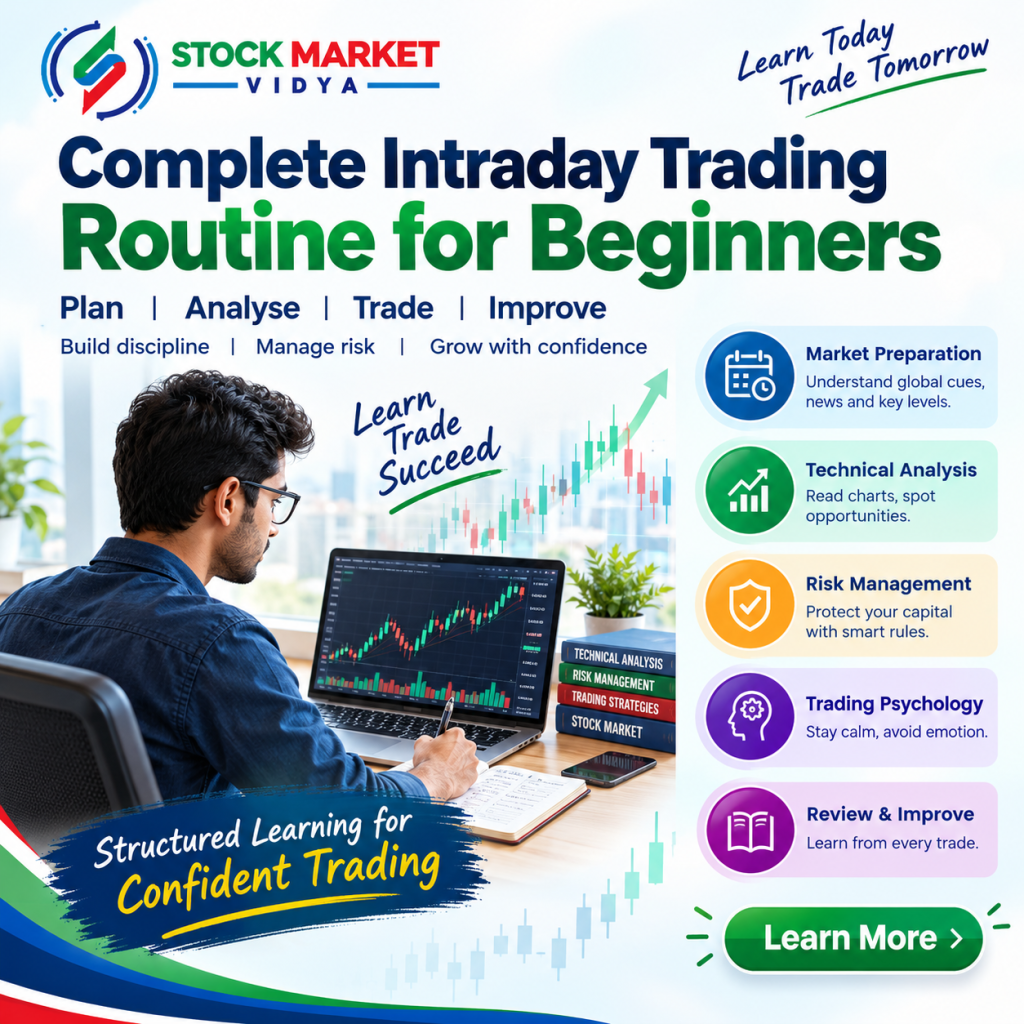

Intraday trading is not simply about buying a share in the morning and selling it before the market closes. It requires preparation, technical analysis, risk management, patience and a clear trading plan.
Many beginners enter the share market after watching trading videos or seeing price movements on their mobile screens. However, without a proper intraday trading routine, they may take random trades, follow tips or make emotional decisions.
A structured day trading routine helps beginners approach the market with discipline. In this guide, we will explain how to prepare before the market opens, identify trading opportunities, manage risk and review your performance.
What Is a Good Intraday Trading Routine?
A good intraday trading routine is a planned sequence of activities that a trader follows before, during and after the stock market session. It includes market preparation, stock selection, technical analysis, entry and exit rules, risk management and performance review.
For example, a beginner may spend 30 minutes studying market news, identify two or three stocks, wait for a suitable trading setup and record the outcome after the trade. The objective is to follow a process rather than react to every market movement.
1. Start Your Day with Market Preparation
Your intraday trading routine should begin before the market opens. In India, the regular NSE and BSE equity market session generally runs from 9:15 AM to 3:30 PM on trading days.
Before the opening bell, check:
- Global market cues: Understand the broad direction of major international markets.
- Gift Nifty: Observe its movement as one of the indicators of expected market sentiment.
- Important news: Check company announcements, economic updates and corporate results.
- Previous day’s levels: Mark the previous day’s high, low and closing price.
- Sector performance: Observe which sectors are showing strength or weakness.
For example, if banking stocks are showing strength, you can shortlist a few liquid banking shares for further analysis. This does not mean their prices will automatically rise.
The purpose of preparation is to develop a market view without making assumptions about the direction of prices.
2. Create a Simple Intraday Trading Plan
A trading plan should be written before placing any order. It must explain what you will trade, why you will enter and when you will exit.
Your plan should include:
- The stocks or indices you will monitor.
- The chart timeframe you will use.
- Your entry conditions.
- Your stop-loss level.
- Your profit-taking or exit rules.
- Your maximum acceptable daily loss.
- The maximum number of trades you will consider.
Suppose a stock is trading near ₹500. Your analysis suggests an entry at ₹502, with a stop-loss at ₹498. Your planned risk is ₹4 per share, excluding charges and slippage.
If your rules are not satisfied, skip the trade. A good trading plan should also tell you when not to trade.
3. Use Technical Analysis to Find Trading Opportunities
Technical analysis helps traders study price movements, chart patterns, support and resistance, volume and market trends.
Beginners can start by learning:
- Candlestick patterns.
- Support and resistance.
- Trendlines and price structure.
- Moving averages.
- Volume analysis.
- Breakout and pullback setups.
For example, if a stock breaks above a resistance level with strong volume, a trader may watch for a possible continuation. However, breakouts can fail, so the entry should follow a defined confirmation and risk-management rule.
Avoid filling your chart with too many indicators. Learn a few tools properly and understand their limitations.
A technical analysis course in Nagpur can help learners understand chart reading through structured examples and practical exercises.
4. Follow a Fixed Routine During Market Hours
Once the market opens, avoid placing trades just because prices are moving quickly.
9:00 AM to 9:15 AM: Final preparation
Review your watchlist and important price levels. Confirm that your trading platform is working properly.
9:15 AM to 9:30 AM: Observe the opening movement
The opening period can be volatile. Beginners may observe price action instead of rushing into a trade.
9:30 AM to 11:30 AM: Watch for planned setups
Look for opportunities that match your trading strategy. Wait for the required confirmation and calculate the risk before entering.
11:30 AM to 2:30 PM: Stay selective
Market activity may change during the session. Avoid unnecessary trades when price movements are unclear or your setup is missing.
2:30 PM to 3:30 PM: Manage open positions and close intraday trades
Review open positions and follow your exit rules. Do not assume that a losing intraday position will recover if held longer.
These time blocks are a sample routine, not a rule that every profitable trade must occur during a particular period.
5. Make Risk Management Your First Priority
Risk management is one of the most important parts of a beginner’s day trading routine.
Before every trade, ask yourself: How much can I lose if the trade goes wrong?
Consider these practices:
- Decide your risk limit before entering.
- Place a stop-loss according to your strategy.
- Calculate position size based on the planned risk.
- Avoid borrowing money to trade.
- Do not increase your position simply to recover a loss.
- Include brokerage, taxes, exchange charges and possible slippage in your calculations.
For example, if your planned risk is ₹300 and the stop-loss distance is ₹5 per share, the theoretical position size is 60 shares before allowing for charges and slippage.
A stop-loss cannot eliminate all risk because execution prices may differ during fast markets or gaps. Beginners should practise with a trading simulator or paper trading before risking real money.
6. Control Trading Psychology and Emotions
Even a well-designed strategy can fail when a trader does not follow the rules.
Fear may cause you to exit too early. Greed may encourage you to hold a position beyond your plan. Frustration after a loss can lead to revenge trading, where you enter another trade mainly to recover the money.
Build these habits into your intraday trading routine:
- Accept that not every trade will be successful.
- Never chase a rapidly moving stock.
- Do not follow unverified tips or rumours.
- Take a break after an emotionally difficult trade.
- Stop trading when your predefined daily loss limit is reached.
Discipline means following your process even when the market does not behave as expected.
7. Maintain a Trading Journal After Market Hours
Your routine should not end when the market closes. Spend 15–20 minutes reviewing your trades.
Record the stock name, entry price, exit price, reason for entry, stop-loss, result and any mistake you made.
For example, you may discover that your losses often occur when you enter before a breakout is confirmed. This information can help you improve your trading rules.
Review your performance over a meaningful number of trades rather than changing your strategy after every single loss.
A trading journal also helps you understand whether your approach works after accounting for transaction costs.
8. Learn Before Moving to Advanced Trading Strategies
Beginners should first understand market basics, order types, price charts and risk management. Once these concepts are clear, they can study more advanced topics at a suitable pace.
A structured stock market course for beginners may cover fundamental analysis, technical analysis, market structure, trading psychology and practical exercises. Learners interested in derivatives can study options, option chain analysis, futures and options strategies, including the risks involved.
Choose learning resources that explain both the advantages and limitations of each strategy. Avoid courses or claims that promise easy income from daily trading.
Learn Practical Trading at Stock Market Vidya Nagpur
If you are searching for a share market course in Nagpur or wondering where to learn stock market trading in Nagpur, structured education can help you build a stronger foundation.
Stock Market Vidya Nagpur is a share market training institute run by Mr. Prashant Sarode, a NISM Certified Trainer. His stock market training experience dates back to 2002, and the institute was established on 3 December 2004. The institute has trained more than 6,000 individuals, according to its supplied institutional profile.
The learning programme covers areas such as:
- Fundamental and technical analysis.
- Candlestick charts and price behaviour.
- Option chain analysis.
- Futures and options strategies with hedging concepts.
- Intraday, short-term and long-term trading approaches.
- Stock, commodity and currency market basics.
The benefit of joining Stock Market Vidya is the opportunity to learn market concepts in a structured way, understand trading tools and practise decision-making instead of depending only on social media tips.
Depending on your learning needs, you can explore an intraday trading course in Nagpur, a technical analysis course in Nagpur, an option trading course in Nagpur or broader practical stock market training.
People searching for the best share market classes in Nagpur, trading classes near Wardha Road Nagpur or stock market classes near Sonegaon Nagpur can explore the institute to understand its course syllabus and practical learning approach. Compare the course content, trainer credentials and suitability for your experience level before enrolling.
Contact Stock Market Vidya
- Institute: Stock Market Vidya Nagpur
- Trainer: Mr. Prashant Sarode, NISM Certified Trainer
- Website: StockMarketVidya.com
- Mobile: 9822718163, 8421893845
- Location: Swamikrupa, 86, Kannamwar Nagar, opposite Sonegaon Police Station, near Hotel Pride, Wardha Road, Nagpur – 440025.
- Google Maps directions: Visit Stock Market Vidya Nagpur
Conclusion: Build Consistency Before Increasing Trading Activity
A complete intraday trading routine combines market preparation, a written trading plan, technical analysis, controlled risk, emotional discipline and a daily performance review.
Beginners do not need to trade every day or follow every market movement. The better approach is to learn patiently, practise with clear rules and understand the risks before committing real capital.
With systematic stock market education and consistent practice, you can develop a more informed approach to intraday trading. Stock Market Vidya Nagpur offers a learning option for people who want to understand trading concepts through structured share market training in Nagpur.
Disclaimer: This article is for educational purposes only. It is not investment advice or a recommendation to buy or sell any security. Intraday trading and derivatives can result in significant losses.
FAQs: Complete Intraday Trading Routine for Beginners
1. What is a good intraday trading routine for beginners?
A good intraday trading routine includes market preparation, stock selection, technical analysis, risk management and performance review. Beginners should check important market news before 9:15 AM, prepare a watchlist, identify support and resistance levels, and define entry and exit rules. During market hours, they should wait for suitable trading setups instead of placing random orders. After the market closes, they should maintain a trading journal. This disciplined approach helps beginners make informed decisions and avoid emotional trading.
2. How should beginners prepare for intraday trading every morning?
Beginners should start their day by reviewing global market cues, Gift Nifty movements, important economic news and company announcements. They should also study the previous trading session’s high, low and closing price. Next, they can shortlist a few liquid stocks and mark important support and resistance levels. Before entering any trade, they must decide the entry price, stop-loss, target and position size. This preparation helps traders follow a written trading plan rather than reacting to sudden market movements.
3. What is the best time for intraday trading in India?
The regular NSE and BSE equity market session generally runs from 9:15 AM to 3:30 PM on trading days. The opening period may experience sharp price movements, while market conditions can change throughout the day. Beginners should observe price action and wait for a setup that matches their strategy. There is no single best time for every trader. The suitable trading period depends on liquidity, volatility, strategy and risk tolerance. Avoid entering trades simply because the market is moving quickly.
4. How do I create a daily intraday trading plan?
To create a daily intraday trading plan, first decide which stocks or indices you will monitor. Define your trading setup, entry conditions, stop-loss, exit rules and maximum acceptable daily loss. Calculate the position size according to the amount you are prepared to risk. For example, if your planned risk is ₹200 and your stop-loss distance is ₹4 per share, your theoretical position size is 50 shares before charges and slippage. Record your decisions and review whether you followed your rules after the market closes.
5. How much money should a beginner use for intraday trading?
There is no fixed amount suitable for every beginner. The amount depends on personal finances, trading knowledge, market conditions and risk tolerance. Beginners should never use emergency savings, borrowed money or money needed for household expenses. Start with paper trading to understand order execution and risk management before using real capital. When trading with real money, calculate position size from the planned stop-loss and acceptable loss. Remember that brokerage, taxes, slippage and sudden price movements can increase the actual loss.
6. Which technical analysis tools should beginners learn for intraday trading?
Beginners should first understand candlestick charts, support and resistance, price trends, volume and moving averages. These tools help traders study market behaviour and identify possible trading opportunities. For example, a breakout above resistance with strong volume may indicate buying interest, but it can also fail. Learn how to confirm a setup and define risk before entering a trade. A technical analysis course in Nagpur can provide structured learning through chart examples and practical exercises. Avoid using too many indicators without understanding their purpose.
7. How can I control emotions during intraday trading?
Controlling emotions requires written rules and consistent practice. Fear may cause premature exits, while greed can encourage traders to hold positions for too long. After a loss, some beginners take unnecessary trades to recover their money, a behaviour known as revenge trading. To avoid these mistakes, decide your risk limit before entering, follow your stop-loss rules and take a break when frustrated. Maintain a trading journal to identify emotional decisions. Remember that missing a trade is better than entering a position that does not match your strategy.
8. Why is a trading journal important for intraday traders?
A trading journal helps beginners understand what works and what needs improvement. Record the stock name, entry and exit prices, stop-loss, reason for entering, result and any mistakes. For example, if your journal shows repeated losses from entering breakouts without confirmation, you can review that rule before taking another trade. Include transaction costs when calculating performance. Reviewing a meaningful number of trades gives a more useful picture than judging a strategy after one or two results. A journal encourages accountability and helps build trading discipline.
9. Where can I learn share trading in Nagpur?
People looking for share market training in Nagpur can explore Stock Market Vidya Nagpur, a share market training institute run by Mr. Prashant Sarode, a NISM Certified Trainer. The institute’s learning areas include fundamental analysis, technical analysis, option chain analysis, intraday trading and futures and options strategies. Visit StockMarketVidya.com to explore the available courses and training details. Before enrolling, review the syllabus, practical exercises, trainer credentials and suitability of the programme for your current knowledge level.
10. Which is the best trading institute in Nagpur for beginners?
The best trading institute in Nagpur depends on your learning objectives, experience and preferred teaching method. Beginners should compare the syllabus, trainer qualifications, practical chart-reading exercises, risk-management education and coverage of trading psychology. Stock Market Vidya Nagpur, led by Mr. Prashant Sarode, a NISM Certified Trainer, is one option to explore. The institute has provided stock market education since 2004, according to its institutional profile. Check the current course details and confirm that the programme matches your requirements before making an enrolment decision.
11. What should I look for in an intraday trading course in Nagpur?
An intraday trading course in Nagpur should explain market basics, candlestick patterns, support and resistance, trading setups, stop-loss placement, position sizing and trading psychology. Practical exercises are important because beginners need to learn how to apply concepts to charts instead of memorising definitions. Look for training that explains losing trades, transaction costs and the limitations of trading strategies.
12. What is the difference between intraday trading and options trading?
Intraday trading means opening and closing a position within the same trading day. Options trading involves contracts that give the buyer a right, but not an obligation, to buy or sell an underlying asset under specified conditions. Options positions may be opened and closed intraday or held longer, subject to the contract and applicable rules. Options have additional risks, including time decay, changes in implied volatility and leverage. Beginners should learn equity market basics and risk management before considering an option trading course or futures and options training in Nagpur.
13. Are practical stock market training classes useful for beginners?
Practical stock market training classes can help beginners connect theoretical concepts with actual chart movements and trading decisions. Learners can practise identifying support and resistance, reading candlesticks, planning entries and exits, and calculating position sizes. Paper trading is useful for testing these skills without risking real capital, although simulated results may differ from live execution. When evaluating a stock market course for beginners, check whether it includes structured exercises, feedback on mistakes and clear explanations of trading risks rather than focusing only on potential profits.
14. How can I find the best share market course for beginners near me in Nagpur?
To find a suitable share market course near me, search for share market classes in Nagpur and compare institutes by location, course content, trainer experience and practical learning opportunities. If you live near Wardha Road or Sonegaon, travel convenience may also matter. Stock Market Vidya is located at Swamikrupa, 86, Kannamwar Nagar, opposite Sonegaon Police Station, near Hotel Pride, Wardha Road, Nagpur. You can check directions through Google Maps and visit StockMarketVidya.com for course information.
15. How can Stock Market Vidya Nagpur help me learn a disciplined trading routine?
Stock Market Vidya Nagpur provides stock market education under Mr. Prashant Sarode, a NISM Certified Trainer. Its training areas include fundamental analysis, technical analysis, intraday trading, option chain analysis and futures and options strategies. These subjects can help learners understand market behaviour, plan trades and develop risk-management habits. People considering Stock Market Vidya share market classes should review the available syllabus and practical learning format to determine whether it meets their needs. The objective should be to build knowledge, independent decision-making and disciplined trading habits, not to expect assured profits.



Pingback: What Is Stock Market Liquidity? Meaning and Importance