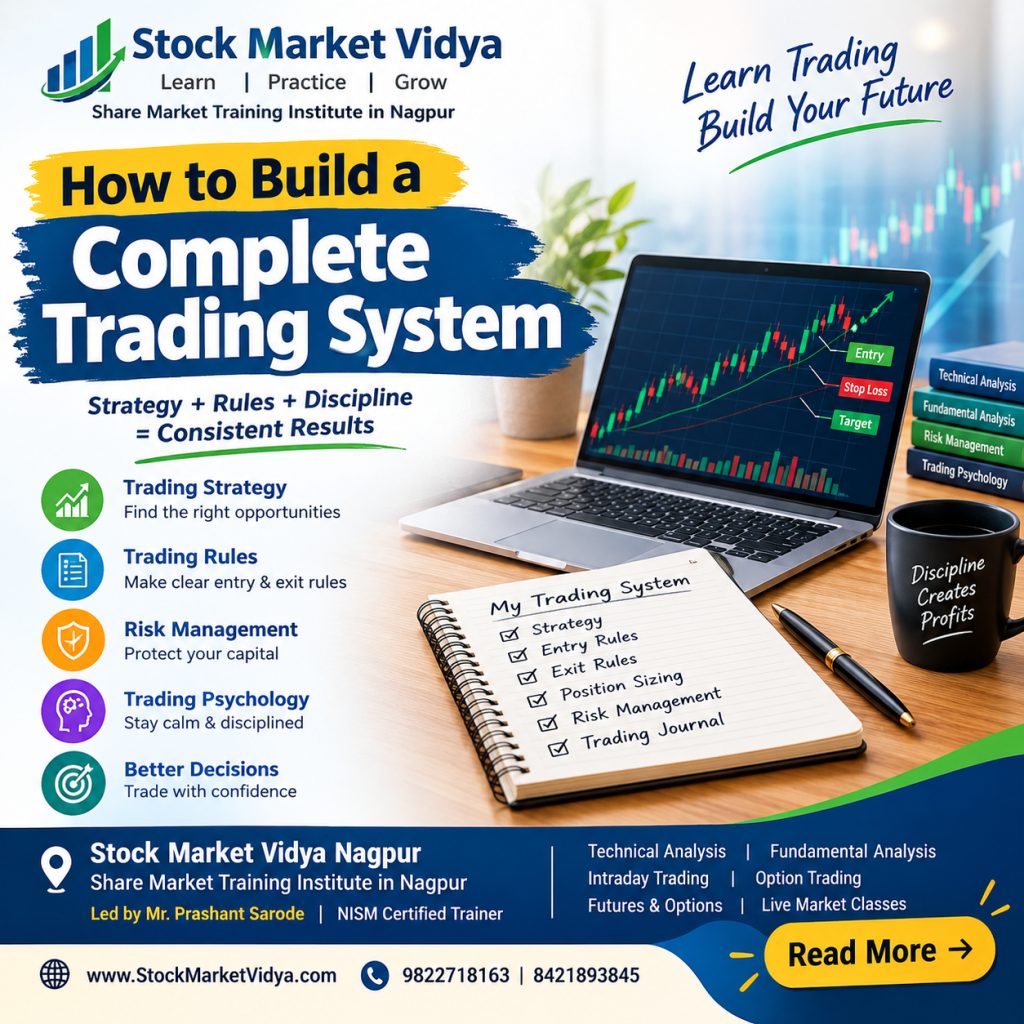

Many new traders spend a lot of time searching for the best trading strategy, indicators and buy or sell signals. But there is an important question that often gets missed:
How do you build a complete trading system?
A trading system is much more than an entry signal. It is a complete framework that tells you what to trade, when to trade, when to exit, how much money to risk, and when not to trade.
For an Indian trader using NSE or BSE markets, having clearly defined trading rules can make the trading process more structured and less dependent on emotions.
This guide explains how beginners can build a practical trading system step by step.
What Is a Complete Trading System?
A trading system is a written set of rules used to make trading decisions consistently.
A complete system generally covers:
- Market and stocks to trade
- Trading timeframe
- Entry conditions
- Stop-loss rules
- Profit-taking or exit rules
- Position sizing
- Risk management
- Trading psychology
- Trade management
- Performance review
A strategy may tell you when to enter. A complete trading system goes further and defines what happens before, during and after the trade.
This distinction is important because an attractive entry signal alone does not create a complete trading process. Current trading education resources similarly describe a system as covering entries, exits, position sizing, risk controls and testing.
Step 1: Decide What Type of Trader You Want to Be
Do not begin by adding ten indicators to your chart.
First decide your trading style.
For example:
Intraday trading: Positions are generally opened and closed during the trading session.
Short-term trading: Trades may remain open for several days or weeks.
Positional trading: The trader attempts to capture a larger market move over a longer period.
Your available time, knowledge, capital and personality should influence this decision.
Someone working full-time may not be comfortable monitoring charts throughout the trading session. A student may have different time availability.
Your trading system should fit your lifestyle rather than forcing you to copy another trader.
Step 2: Select Your Market and Timeframe
Your system should clearly state what you will trade.
For example:
- Selected NSE stocks
- Nifty or Bank Nifty
- Equity delivery
- Futures
- Options
- Commodities
If you are interested in derivatives, remember that leverage can increase both profits and losses. SEBI’s investor education material highlights the risks associated with derivatives and encourages informed decision-making.
Also select your timeframe.
For example, an intraday system may use 5-minute or 15-minute charts, while a positional system may use daily charts.
Avoid changing your timeframe simply because the current chart does not give the signal you wanted.
Step 3: Define Your Trading Strategy
Now you need a clear trading idea.
Your strategy should answer:
Why should this trade be taken?
For example, a beginner’s technical-analysis strategy might be based on:
- Trend direction
- Support and resistance
- Moving averages
- Breakouts
- Volume
- Candlestick confirmation
Do not use an indicator simply because it is popular.
A good strategy should have a logical reason behind it and should be simple enough to explain in a few sentences.
For example:
“I will consider a long trade only when the stock is in an established uptrend, breaks a defined resistance level and satisfies my volume confirmation rule.”
The exact conditions should then be written down.
Step 4: Create Exact Entry Rules
This is where your trading idea becomes a system.
Avoid vague rules such as:
“Buy when the stock looks strong.”
Instead, define measurable conditions.
For example:
- Stock must be above a selected moving average.
- Price must approach a previously identified resistance level.
- The resistance must break according to your predefined condition.
- Volume must satisfy your selected confirmation rule.
- Entry must occur only during your chosen trading period.
The objective is consistency.
If another person follows your written rules, they should be able to understand why a trade qualifies.
Step 5: Define Stop-Loss and Exit Rules Before Entry
One of the biggest mistakes beginners make is thinking only about the entry.
Before entering a trade, know:
Where am I wrong?
That level becomes part of your stop-loss plan.
Your system can also define different exit methods, such as:
- Fixed target
- Risk-reward based exit
- Trailing stop
- Technical exit
- Time-based exit
- Opposite signal
For example, if your predefined risk is ₹500, your position size should be calculated around that risk rather than choosing the quantity randomly.
Never increase your position simply because you want to recover a previous loss.
Step 6: Build a Risk Management System
A trading system without risk management is incomplete.
Your rules should define:
- Maximum risk per trade
- Maximum daily loss
- Maximum number of trades
- Maximum open positions
- Position size
- Conditions for stopping trading
The exact risk level should depend on your capital, experience, strategy and personal financial situation. There is no universal percentage suitable for every trader.
The important principle is to decide your risk before entering the trade.
This protects you from making emotional decisions when the market moves quickly.
Step 7: Add Trading Psychology Rules
Trading psychology is not separate from your system. It is part of the system.
A trader may have an excellent strategy but still break the rules because of:
- Fear
- Greed
- FOMO
- Revenge trading
- Overtrading
- Impatience
- Fear of accepting a loss
Create rules for these situations.
For example:
“After reaching my maximum daily loss, I will stop trading for the day.”
Another useful rule is:
“I will not enter a trade merely because another person has shared a market tip.”
A written process can help reduce impulsive decisions and improve trading discipline. Maintaining a trading journal can also help identify repeated emotional mistakes.
Step 8: Backtest Your Trading System
Before using real money, test your rules on historical market data.
Backtesting can help answer questions such as:
- How often did the setup occur?
- What was the win rate?
- What was the average winning trade?
- What was the average losing trade?
- What was the maximum drawdown?
- Did the strategy perform differently in different market conditions?
Do not change your rules repeatedly until historical results look perfect.
That can lead to over-optimisation.
The purpose of testing is to understand how your system behaves, not to create a perfect historical result.
Step 9: Forward Test Before Increasing Capital
After historical testing, observe the strategy in the live market without immediately taking large positions.
You can use paper trading or very small exposure where appropriate.
Record every qualifying trade.
Your journal should include:
- Date
- Stock or index
- Setup
- Entry
- Stop-loss
- Exit
- Profit or loss
- Reason for taking the trade
- Whether you followed your rules
- Emotional state
This creates useful evidence about both your trading strategy and your trading behaviour.
Step 10: Create a Simple Trading Checklist
A checklist makes your system easier to follow.
Before entering a trade, ask:
Market: Is this the market I am allowed to trade?
Trend: Does the market condition match my strategy?
Setup: Is my predefined setup present?
Entry: Are all entry conditions satisfied?
Risk: Do I know my maximum possible loss?
Position size: Is the quantity calculated according to my rules?
Exit: Do I already know my exit conditions?
Psychology: Am I trading according to my plan or reacting emotionally?
If one important condition is missing, the best decision may be not to trade.
Why Learning Trading System Design Matters
Many beginners search for a stock market course for beginners hoping to find one perfect strategy. But real stock market learning should cover the complete decision-making process.
A practical learning programme can help students understand:
- Fundamental analysis
- Technical analysis
- Chart reading
- Trading strategies
- Risk management
- Option chain analysis
- Futures and options
- Intraday trading
- Short-term trading
- Long-term investing
- Trading psychology
- Practical market observation
This is why structured practical stock market training can be useful for people who want to understand not just market concepts but also how those concepts are applied.
Learn Stock Market Trading in Nagpur with Stock Market Vidya
If you are searching for where to learn stock market trading in Nagpur, Stock Market Vidya Nagpur provides structured share market education for students, investors and traders.
Stock Market Vidya is a Share Market Training Institute in Nagpur run by Mr. Prashant Sarode, NISM and NSE Certified Trainer.
Mr. Prashant Sarode has been associated with stock market trading and training for many years. His practical approach focuses on helping learners understand market concepts and apply them through structured learning.
The institute provides training covering areas such as fundamental analysis, technical analysis, option chain analysis, futures and options strategies, intraday trading, short-term trading and long-term market understanding.
For learners looking for a share market course in Nagpur, stock market course in Nagpur, share market training in Nagpur or trading classes in Nagpur, practical classroom learning can provide a structured starting point.
Stock Market Vidya is also relevant for people searching for:
- Share market institute in Nagpur
- Stock market training institute in Nagpur
- Share market classes in Nagpur
- Stock market training Nagpur
- Share trading course in Nagpur
- Stock market learning institute Nagpur
- Trading classes near Wardha Road Nagpur
- Stock market classes near Sonegaon/Somalwada Nagpur
- Share market course near me
Learners can explore specialised areas such as a technical analysis course in Nagpur, intraday trading course in Nagpur, option trading course in Nagpur and futures and options training Nagpur, depending on their learning requirements.
Benefits of Joining Stock Market Vidya
A structured course can help learners move from scattered information to an organised learning process.
Key benefits include:
Structured learning: Concepts are covered systematically instead of learning random tips from different sources.
Practical understanding: Learners can connect theory with real market situations.
Experienced trainer: Mr. Prashant Sarode is an NISM and NSE Certified Trainer, bringing professional market-training experience to the classroom.
Complete market perspective: Students can learn about analysis, trading strategies, risk management and different market segments.
Beginner-friendly approach: The learning process can be useful for people starting their stock market journey as well as learners looking to improve their existing knowledge.
For someone comparing the best share market course for beginners in Nagpur or searching for the best institute to learn trading in Nagpur, the quality of practical education, trainer experience and structured curriculum should be considered rather than choosing a course only on advertisements.
Where to Learn Stock Market Trading in Nagpur?
Stock Market Vidya Nagpur is located at:
Swamikrupa, 86, Kannamwar Nagar, Opposite Sonegaon Police Station, Near Hotel Pride, Wardha Road, Nagpur – 440025.
The location is convenient for learners searching for trading classes near Wardha Road Nagpur and stock market classes near Sonegaon/Somalwada Nagpur.
For directions, you can use the Google Maps location provided by Stock Market Vidya.
Website: StockMarketVidya.com
Mobile: 9822718163 / 8421893845
Final Thoughts
A complete trading system is not a magic formula. It is a disciplined framework that brings together strategy, trading rules, risk management, psychology, execution and review.
If you want to learn how to build a trading system, start small. Select one market, define one clear strategy, write objective rules, test them, record your results and improve your process based on evidence.
The goal is not to predict every market move.
The goal is to create a process that tells you when to trade, when to stay out, how much to risk and what to do after the trade.
For learners in Nagpur, structured stock market education Nagpur programmes such as Stock Market Vidya can provide a practical environment to build these foundational skills under the guidance of Prashant Sarode, NISM and NSE Certified Trainer.
FAQs: How to Build a Complete Trading System
1. What is a complete trading system?
A complete trading system is a structured set of rules that guides a trader from market selection to trade exit. It normally includes the trading strategy, entry conditions, stop-loss, profit target, position sizing, risk management, trading timeframe and rules for managing emotions. A complete system also explains when not to trade. Instead of depending on tips or emotions, the trader follows predefined conditions. This makes the trading process more systematic and helps maintain consistency during different market conditions.
2. How do you build a complete trading system?
To build a complete trading system, first select the market, trading style and timeframe. Then define your trading strategy, exact entry conditions, stop-loss and exit rules. Add position sizing and maximum risk limits before testing the system on historical data. After backtesting, forward-test the rules and maintain a trading journal. Finally, create a simple checklist for every trade. A good system should be specific enough that you can follow the same rules repeatedly without changing them because of fear, greed or market excitement.
3. What are the most important rules in a trading system?
The most important trading rules cover entry, exit, risk and behaviour. Your system should clearly state why you will enter a trade, where you will place the stop-loss, how you will calculate position size and when you will exit. It should also include a maximum daily loss and rules against revenge trading or overtrading. These rules help prevent emotional decisions. A trading system becomes stronger when every important decision is planned before the trade rather than made after the market starts moving.
4. Why is risk management important when building a trading system?
Risk management is important because even a good trading strategy can experience losing trades. A complete system should define the maximum amount you are prepared to lose on an individual trade and the maximum loss you will accept in a trading session or period. Position size should be calculated according to the planned risk and stop-loss. This prevents one unsuccessful trade from causing disproportionate damage to your capital. Good risk management focuses on protecting trading capital so that you can continue learning and participating in the market.
5. How do entry and exit rules improve trading discipline?
Entry and exit rules give traders a predefined decision-making framework. Instead of buying because a stock suddenly rises or selling because of fear, the trader checks whether the predefined conditions are satisfied. For example, an entry may require a specific trend, price setup and confirmation, while the exit may depend on a stop-loss, target or technical condition. Following such rules can reduce impulsive decisions and improve trading discipline. The purpose is not to predict every market movement but to execute a consistent process.
6. How can beginners test a trading strategy before using real money?
Beginners can first test a trading strategy using historical market data through backtesting. They should record every trade that satisfies the predefined rules and calculate important results such as winning trades, losing trades, average profit, average loss and maximum drawdown. After historical testing, the strategy can be forward-tested in current market conditions using paper trading or appropriately small exposure. This process helps identify weaknesses before significant capital is committed. Beginners should avoid changing the rules after every losing trade because losses are a normal part of trading.
7. What is the difference between a trading strategy and a complete trading system?
A trading strategy mainly explains the logic behind identifying trading opportunities, such as breakouts, trends, support and resistance or other technical conditions. A complete trading system is broader. It combines the strategy with entry rules, stop-loss, exit conditions, position sizing, risk management, trading psychology and performance evaluation. For example, a strategy may identify a breakout, while the complete system specifies when to enter, how much to buy, where to place the stop-loss, when to exit and when to stop trading.
8. How does trading psychology affect a trading system?
Trading psychology can strongly affect whether a trader actually follows a system. Fear may cause early exits, greed can encourage excessive positions, and FOMO can result in trades that do not meet the strategy’s conditions. Revenge trading may also occur after a loss. Therefore, psychology should be included in the trading plan. Rules such as stopping after a predefined daily loss, avoiding unplanned trades and maintaining a trading journal can help. A profitable-looking strategy is of limited value if the trader repeatedly breaks its rules because of emotions.
9. Can beginners build a trading system using technical analysis?
Yes, beginners can build a trading system using technical analysis, provided they first understand the concepts and define objective rules. A technical system may use trend, support and resistance, price action, volume, moving averages or other indicators. The important point is not to add many indicators simply to make a chart complicated. Beginners should understand why each condition is included, define clear entry and exit rules, and test the complete setup. A technical analysis course in Nagpur can provide structured learning for those who want to develop these skills.
10. Where can I learn share trading in Nagpur?
People looking for share trading education in Nagpur can consider Stock Market Vidya Nagpur, a share market training institute that focuses on structured market education. The institute is run by Mr. Prashant Sarode, NISM and NSE Certified Trainer. Learners can study areas such as fundamental analysis, technical analysis, option chain analysis, futures and options, intraday trading and other market concepts. Those searching online for a share market course near me, share market classes in Nagpur or practical stock market education can explore the course structure and training approach at StockMarketVidya.com.
11. Which is the best trading institute in Nagpur for beginners?
The best trading institute for a beginner should be evaluated on factors such as trainer experience, curriculum, practical learning, risk-management education and whether the course covers market concepts systematically. Stock Market Vidya Nagpur provides share market education under Prashant Sarode, an NISM and NSE Certified Trainer, with training covering areas such as technical analysis, fundamental analysis, options and trading strategies. Beginners comparing the best share market classes in Nagpur should focus on learning quality and practical understanding rather than selecting a course only because of promotional claims.
12. Are there practical stock market training classes in Nagpur?
Yes, learners can find practical-oriented stock market education in Nagpur. Stock Market Vidya focuses on structured learning of market concepts including technical analysis, fundamental analysis, option chain analysis, futures and options strategies and different trading approaches. Learners interested in practical education can look for programmes that explain how concepts are applied to real market situations rather than only teaching definitions. People searching for share market training in Nagpur, stock market course in Nagpur, should check the curriculum and practical components before joining.
13. What should I look for in a stock market course for beginners?
A good stock market course for beginners should start with market fundamentals and gradually introduce technical analysis, fundamental analysis, risk management and trading psychology. It should explain how orders work, how to analyse stocks, how trading strategies are developed and how losses are controlled. If you are interested in derivatives, the course should also explain futures and options risks clearly. Beginners can compare a share market course in Nagpur based on curriculum, trainer experience and practical learning rather than selecting a programme only on the number of topics advertised.
14. Can I learn intraday and options trading after building a basic trading system?
Yes, but beginners should first understand basic market concepts, risk management and position sizing before moving into more complex trading approaches. An intraday trading course in Nagpur can help learners understand short-term market movements, while an option trading course in Nagpur can introduce concepts such as option chains, premiums, Greeks and strategies. Futures and options training Nagpur programmes should also explain leverage and risk clearly. The objective should be to understand how these instruments work and create rules appropriate to the trader’s knowledge and risk capacity.
15. Why choose Stock Market Vidya for practical stock market learning in Nagpur?
Stock Market Vidya Nagpur offers structured share market education under Mr. Prashant Sarode, NISM and NSE Certified Trainer. The learning approach covers important areas such as fundamental analysis, technical analysis, option chain analysis, futures and options, intraday trading, short-term trading and long-term market understanding. This can be useful for students, investors and aspiring traders who want organised market education. People searching for best share market classes in Nagpur, share market training in Nagpur, stock market course for beginners, or practical trading education can visit StockMarketVidya.com to understand the available learning options.