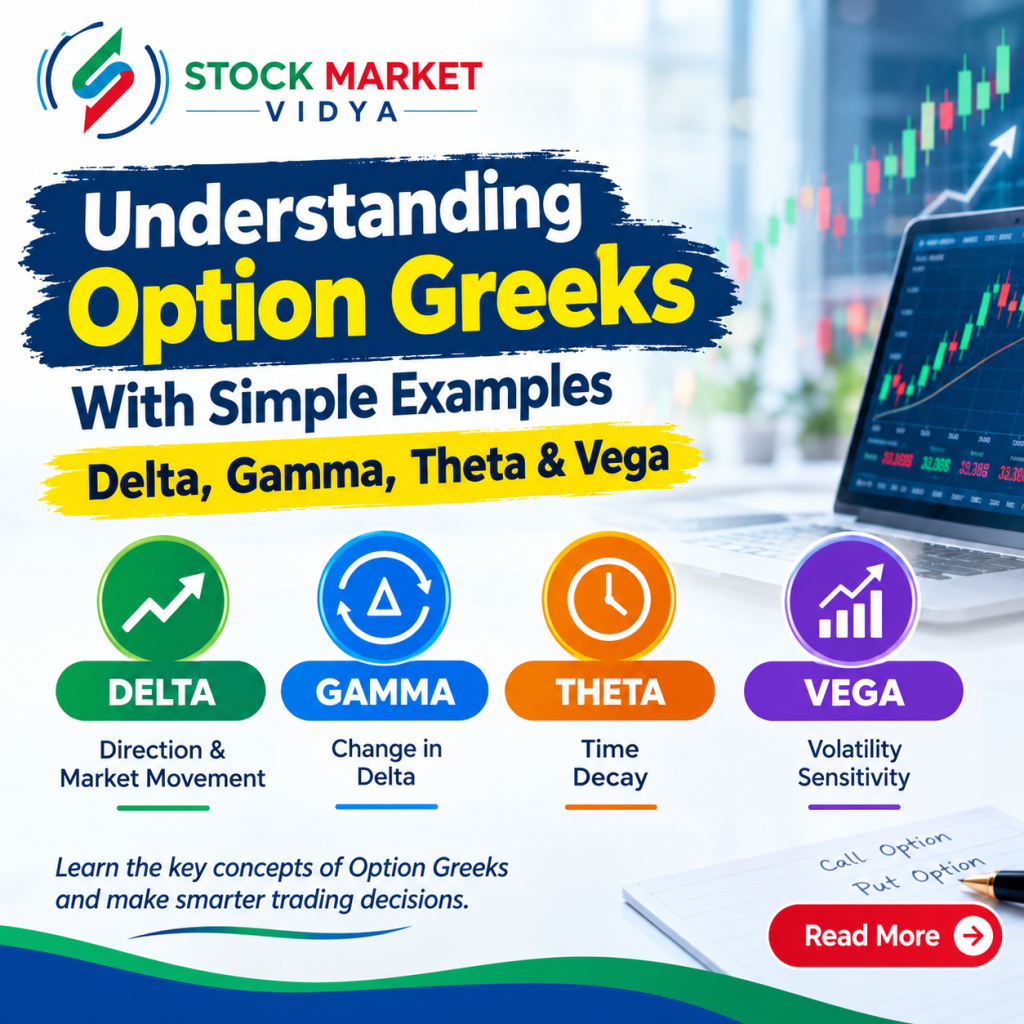

Options trading can look confusing when you first see terms such as Delta, Gamma, Theta and Vega. But these terms become much easier when you understand what each one is trying to tell you.
In simple words, option Greeks are measurements that help traders understand how an option premium may react when the underlying price, time or volatility changes. Delta measures directional sensitivity, Gamma measures the change in Delta, Theta relates to time decay, and Vega measures sensitivity to implied volatility.
This article explains option Greeks with simple examples so that beginners can understand their practical importance before studying advanced option trading strategies.
What Are the Four Main Option Greeks?
The four commonly studied option Greeks are:
- Delta – sensitivity to movement in the underlying asset
- Gamma – change in Delta
- Theta – effect of passage of time
- Vega – sensitivity to implied volatility
These Greeks do not work independently in the real market. An option premium can be affected by several factors at the same time. Therefore, traders generally study multiple Greeks together rather than depending on just one measure.
1. Delta: How Much Can the Option React to Price Movement?
Think of Delta as the directional sensitivity of an option.
Suppose a Nifty call option has a Delta of 0.50.
If Nifty moves up by 100 points, the option premium may increase by approximately 50 points, assuming other factors remain unchanged.
Similarly, if Nifty moves down by 100 points, the premium may fall by approximately 50 points.
This is only an estimate because option premiums are also influenced by time, volatility and other factors.
For call options, Delta generally ranges between 0 and 1. Put option Delta is generally between -1 and 0.
Simple way to remember Delta
Delta = Directional sensitivity
For example:
Nifty moves → Delta tells you roughly how strongly the option premium may respond.
This makes Delta particularly useful when comparing different option contracts.
2. Gamma: How Quickly Can Delta Change?
If Delta tells you how sensitive an option is today, Gamma tells you how quickly that sensitivity can change.
Imagine a call option has:
Delta = 0.50
and
Gamma = 0.05
If the underlying moves significantly, Delta may change because of Gamma.
For example, Delta could move from 0.50 towards 0.55 after a favourable price movement, depending on the contract and market conditions.
This is why Gamma becomes especially interesting when the underlying price moves rapidly.
Simple way to remember Gamma
Gamma = Change in Delta
You can think of it like the acceleration of Delta.
A trader who only looks at Delta may miss the fact that the option’s sensitivity itself is changing.
3. Theta: The Effect of Time
Time is an important part of an option’s value.
Theta measures the estimated effect of the passage of time on an option premium, assuming other variables remain unchanged.
Suppose an option premium is ₹100 today.
As expiry approaches, the option may lose some time value if other conditions remain unchanged.
For an option buyer, this time decay can work against the position.
For example:
- Monday: Premium ₹100
- Tuesday: Premium ₹97
- Wednesday: Premium ₹94
This does not mean an option will automatically lose ₹3 every day. Actual premium movement depends on the underlying price, implied volatility and other factors.
Why should beginners understand Theta?
Many new traders focus only on whether the market will go up or down.
But an option buyer also has a time problem.
Even if the market view is eventually correct, the option premium can behave differently because time is passing.
Simple way to remember Theta
Theta = Time decay
This is one reason understanding options is different from simply understanding the direction of a stock or index.
4. Vega: What Happens When Volatility Changes?
Now imagine the underlying asset is not moving much, but the market suddenly expects a large movement.
This is where implied volatility (IV) becomes important.
Vega measures the estimated change in an option’s premium for a change in implied volatility.
Suppose an option has:
Vega = 5
If implied volatility rises by 1 percentage point, the option premium may increase by approximately ₹5, assuming other factors remain unchanged.
If volatility falls by 1 percentage point, the premium may decrease by approximately ₹5.
This is a simplified example. Actual option pricing can be more complex.
Simple way to remember Vega
Vega = Volatility sensitivity
Higher uncertainty can affect option premiums even when the underlying price has not moved much.
A Simple Real-Life Way to Remember the Four Greeks
Imagine you are checking the price of an option before placing a trade.
Ask four questions:
1. Delta:
“If the index or stock moves, how strongly could my option react?”
2. Gamma:
“If the underlying moves, how quickly can my Delta change?”
3. Theta:
“What happens to my option as expiry gets closer?”
4. Vega:
“What happens if market expectations about volatility change?”
This four-question approach makes option Greeks explained much easier for beginners.
Why Option Greeks Matter in Options Trading
Options are affected by several variables simultaneously. NSE educational material also highlights Delta, Gamma, Theta and Vega as important concepts for option pricing and risk management.
Understanding Greeks can help learners:
- Compare different option contracts
- Understand option premium behaviour
- Study directional exposure
- Understand time decay
- Examine volatility sensitivity
- Build a better understanding of hedging
- Analyse option strategies more systematically
However, Greeks are estimates derived from pricing models. They should be treated as tools for understanding sensitivity and risk rather than exact predictions of future premium movement.
Option Greeks and the Option Chain
If you are learning option trading, Greeks should not be studied separately from the option chain.
An option chain gives information about different strikes, premiums, open interest and other market data. Greeks add another layer by helping you understand how an option may respond to changing market conditions.
For someone learning futures and options training in Nagpur, this combination is particularly useful because it connects theory with actual market observations.
Instead of simply memorising Delta or Theta, learners can observe how these values change as the market moves closer to expiry.
A Practical Example
Suppose you are studying a Nifty call option.
You observe:
- Delta = 0.60
- Gamma = 0.04
- Theta = -5
- Vega = 4
A beginner can interpret this broadly as follows:
Delta 0.60: The option has meaningful positive directional sensitivity.
Gamma 0.04: Delta can change as Nifty moves.
Theta -5: Time passing can reduce the option’s value, all else being equal.
Vega 4: A change in implied volatility can affect the premium.
Notice that no single Greek tells the complete story.
That is the real purpose of option Greeks education: understanding different sources of sensitivity rather than trying to predict an option premium using one number.
Common Mistake Beginners Make
One common mistake is buying an option only because they expect the market to move.
For example, a trader may correctly predict that Nifty will rise but still experience an unexpected option-premium result because of:
- Time decay
- Change in implied volatility
- Changing Delta
- Changing Gamma
- Distance from the strike price
- Other pricing factors
This is why learning options should include both market direction and risk understanding.
Learn Options Trading with Practical Understanding
If you are searching for a stock market course for beginners, it is useful to learn concepts in a structured way rather than jumping directly into complicated strategies.
Stock Market Vidya Nagpur is a share market training institute in Nagpur run by Mr. Prashant Sarode, NISM/NSE Certified Trainer.
The objective of practical stock market training is to help learners understand market concepts step by step and connect classroom learning with real market situations.
Stock Market Vidya covers areas such as fundamental analysis, technical analysis, option chain analysis, futures and options concepts, trading strategies and practical market learning.
For learners specifically interested in derivatives, an option trading course in Nagpur can help build understanding of option terminology, premiums, option chains, Greeks, strategies and risk management.
Why Consider Stock Market Vidya Nagpur?
People searching for where to learn stock market trading in Nagpur may prefer structured classroom education where concepts can be discussed and questions can be addressed.
At Stock Market Vidya share market classes, learners can work towards understanding:
- Stock market fundamentals
- Technical analysis
- Option chain analysis
- Futures and options
- Trading psychology
- Trading discipline
- Risk management
- Practical market analysis
- Different trading approaches
The learning approach is useful for beginners, investors and people who want to develop a stronger understanding of the Indian financial markets.
If you are comparing a share market course near me, stock market training institute in Nagpur, or trading classes near Wardha Road Nagpur, Stock Market Vidya is located at Swamikrupa, 86, Kannamwar Nagar, opposite Sonegaon Police Station, near Hotel Pride, Wardha Road, Nagpur.
The institute can also be relevant for people searching for stock market classes near Sonegaon/Somalwada Nagpur or a share market institute in Nagpur.
About Mr. Prashant Sarode
Mr. Prashant Sarode is the trainer associated with Stock Market Vidya Nagpur and is an NISM/NSE Certified Trainer.
His market education approach focuses on helping learners understand the concepts behind trading and investing instead of simply memorising terminology.
For a learner considering a professional stock trading course, guidance from an experienced trainer can make difficult concepts such as option Greeks, option chains, technical analysis and risk management easier to understand.
The goal of stock market education should be to develop knowledge, discipline and the ability to analyse market situations independently.
Final Takeaway
Understanding Delta, Gamma, Theta and Vega is an important step in options education.
Remember the simple formula:
Delta → Direction
Gamma → Change in Delta
Theta → Time
Vega → Volatility
Once these four concepts become familiar, option chains and options strategies can become much easier to study.
Stock Market Vidya provides stock market education for learners who want to understand the Indian market through a structured and practical approach.
Website: https://stockmarketvidya.com/
Mobile: 9822718163, 8421893845
Location: Swamikrupa, 86, Kannamwar Nagar, Opposite Sonegaon Police Station, Near Hotel Pride, Wardha Road, Nagpur-440025.
Google Maps Directions: https://maps.app.goo.gl/Kof5Z6LQsxq4BqLt6
Frequently Asked Questions: Understanding Option Greeks With Simple Examples
1. What are the four main option Greeks?
The four main option Greeks are Delta, Gamma, Theta and Vega. Delta measures how sensitive an option premium is to movement in the underlying asset. Gamma measures how quickly Delta can change. Theta explains the effect of time passing on an option premium, while Vega measures sensitivity to changes in implied volatility. Beginners can remember them as Delta = direction, Gamma = change in Delta, Theta = time, and Vega = volatility. Understanding these four Greeks is an important part of options education and options trading.
2. What is Delta in options trading?
Delta measures how much an option premium may change when the underlying stock or index changes in price, assuming other factors remain constant. For example, if a call option has a Delta of 0.50 and the underlying rises by ₹100, the option premium may increase by approximately ₹50. This is only a simplified estimate because actual option prices are also affected by volatility, time and other factors. Delta is particularly useful for understanding the directional sensitivity of an option.
3. What is Gamma in options trading?
Gamma measures how much an option’s Delta can change when the underlying asset moves. For example, suppose a call option has a Delta of 0.50 and Gamma of 0.05. After a suitable movement in the underlying, its Delta may change from 0.50 towards 0.55. Therefore, Gamma helps traders understand that Delta is not fixed. It is especially important when studying options close to the strike price and when the underlying is making significant movements.
4. What is Theta in options trading?
Theta represents the effect of the passage of time on an option’s premium, assuming other factors remain unchanged. As an option approaches its expiry date, its time value generally reduces. For example, an option premium may decline from ₹100 to ₹95 as time passes if other market conditions remain similar. This does not mean that every option loses the same amount each day. For option buyers, understanding Theta is important because time decay can reduce the value of an option even when the underlying does not move significantly.
5. What is Vega in options trading?
Vega measures how sensitive an option premium is to changes in implied volatility. Suppose an option has a Vega of 4. If implied volatility increases by one percentage point, the option premium may rise by approximately ₹4, assuming other factors remain unchanged. Similarly, falling volatility may put pressure on the premium. Vega is particularly useful when traders study how changing market expectations can affect option prices. It is an important concept for anyone taking an option trading course or studying advanced options strategies.
6. How do Delta, Gamma, Theta and Vega work together?
The four Greeks explain different aspects of an option’s price sensitivity. Delta relates to movement in the underlying, Gamma explains changes in Delta, Theta relates to the passage of time, and Vega relates to implied volatility. For example, an option buyer may correctly predict that Nifty will rise but still see a smaller-than-expected premium movement because of time decay or changing volatility. Studying the Greeks together provides a more complete understanding than looking at only one Greek.
7. Why should beginners learn option Greeks?
Beginners should learn option Greeks because an option premium does not depend only on whether the market goes up or down. Time remaining until expiry, implied volatility and the option’s sensitivity to the underlying can also affect its price. Learning Delta, Gamma, Theta and Vega helps beginners understand these different influences. This knowledge can be useful when studying option chains, comparing contracts and learning options strategies. Greeks should be treated as analytical tools rather than exact predictions of future option prices.
8. How are option Greeks useful when reading an option chain?
Option Greeks can add useful information when studying an option chain. The option chain shows different strike prices and option contracts, while Greeks help explain how those contracts may respond to changes in price, time and volatility. For example, Delta can help you understand directional sensitivity, while Theta can highlight the importance of approaching expiry. A learner combining option-chain analysis with Greeks can develop a more structured approach to studying options rather than selecting an option only because its premium looks inexpensive.
9. Can option Greeks predict the exact price of an option?
No. Option Greeks do not predict the exact future price of an option. They are measures of sensitivity based on option-pricing models and current market conditions. For example, Delta can estimate how an option may respond to a movement in the underlying, but actual prices can also change because of volatility, time and other factors. Greeks are therefore better understood as analytical indicators that help traders study potential changes in option premiums and risks rather than as guaranteed forecasting tools.
10. Which option Greek is most important for an option buyer?
There is no single Greek that is always the most important for every option buyer. Its importance depends on the strategy, strike price, expiry and market conditions. Delta can be useful for understanding directional exposure, Theta highlights time decay, Vega shows volatility sensitivity, and Gamma explains how Delta can change. A beginner should therefore learn all four instead of focusing on one number. Understanding how the Greeks interact can provide a more practical foundation for options education.
11. Where can I learn share trading and option trading in Nagpur?
People searching for a share market course in Nagpur, option trading course in Nagpur, or futures and options training Nagpur can consider structured classroom-based market education. Stock Market Vidya Nagpur provides training covering areas such as fundamental analysis, technical analysis, option-chain analysis, futures and options and practical market concepts. The institute is associated with Prashant Sarode stock market trainer, an NISM/NSE Certified Trainer. Learners can visit StockMarketVidya.com or contact the institute for current course information.
12. Which is the best trading institute in Nagpur for learning options?
Instead of choosing an institute only by the word “best”, learners should compare factors such as trainer credentials, syllabus, market concepts covered, class format and learning requirements. Stock Market Vidya Nagpur is a share market training institute that provides structured education in areas including technical analysis, option-chain analysis, futures and options and trading concepts. It can be relevant for learners searching for share market classes in Nagpur, an option trading course in Nagpur, or practical stock market education.
13. Are there practical stock market training classes in Nagpur?
Yes, learners can find classroom-based options for practical stock market training in Nagpur. Stock Market Vidya focuses on connecting market concepts with practical understanding, including technical analysis, option-chain analysis, futures and options and trading-related concepts. Learners searching for live market trading classes, share market training in Nagpur, or a stock market course in Nagpur should check the current course structure and practical components before enrolling. Practical learning can help beginners understand how theoretical concepts appear in actual market situations.
14. Where can I learn share trading in Nagpur near me?
If you are searching for a share market course near me in Nagpur, location can be one factor when comparing training institutes. Stock Market Vidya Nagpur is located at Swamikrupa, 86, Kannamwar Nagar, opposite Sonegaon Police Station, near Hotel Pride, Wardha Road, Nagpur. It may be relevant for learners searching for stock market classes near Sonegaon/Somalwada/Manish Nagar, Nagpur or trading classes around Wardha Road. Learners can check the institute’s current schedule and course details before joining.
15. Is Stock Market Vidya suitable for beginners learning option Greeks?
Stock Market Vidya can be considered by beginners looking for structured stock market education in Nagpur. The learning areas include fundamental analysis, technical analysis, option-chain analysis, futures and options and practical market concepts. Understanding option Greeks can be introduced as part of broader options education rather than studied in isolation. Mr. Prashant Sarode, NISM/NSE Certified Trainer, is associated with Stock Market Vidya Nagpur. Beginners can use the training to build foundational knowledge before moving towards more advanced options strategies and market analysis.