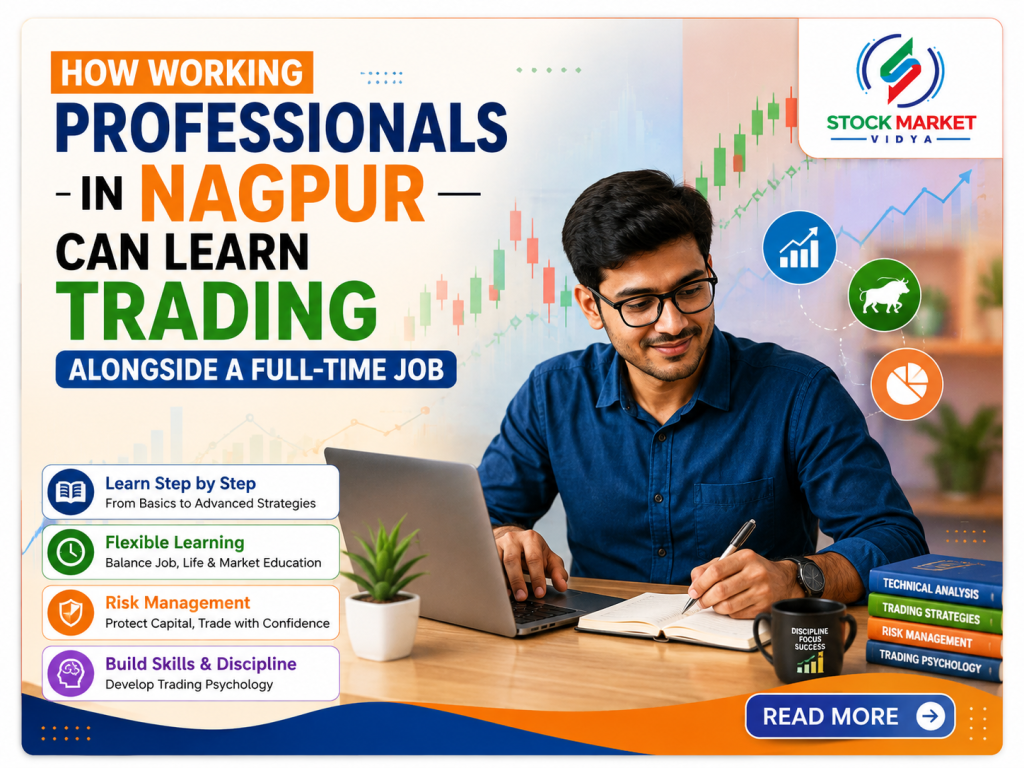

For a working professional, learning stock market trading can look difficult at first.
You already have office meetings, deadlines, travel, family responsibilities and a busy daily routine. After spending eight or nine hours at work, finding time to understand charts, financial markets, options and trading strategies may seem challenging.
But here is the practical truth: you do not need to leave your job to learn trading. You need a structured learning routine.
A working professional in Nagpur can learn the stock market step by step, understand market behaviour, develop trading discipline and gradually build practical knowledge without disturbing regular professional responsibilities.
Why Are Working Professionals Interested in Trading?
Many salaried professionals want to improve their financial knowledge.
Some want to understand their investments better. Others are interested in swing trading or long-term investing. Some want to explore intraday trading as a skill.
However, trading should not be viewed as quick money.

Recent SEBI research highlights why education and risk management are important. SEBI’s studies have found significant losses among individual traders in equity derivatives, while its study of individual intraday traders in the equity cash segment found that seven out of ten incurred losses.
Therefore, the first objective of stock market learning should be knowledge, not chasing daily profits.
The Biggest Advantage of a Working Professional
A salaried person already has one important advantage: a regular source of income.
This means you do not need to depend on trading income from day one.
Instead, you can use your employment period to develop market knowledge.
For example, suppose an IT professional in Nagpur works from 9:30 AM to 6:30 PM. Instead of continuously watching the market during office hours, the person can spend dedicated time before or after work learning:
- Stock market basics
- Fundamental analysis
- Technical analysis
- Chart reading
- Price action
- Trading psychology
- Risk management
- Option chain analysis
- Futures and options
- Intraday and swing trading concepts
This creates a much healthier learning process.
How Can a Working Professional Learn Trading?
The easiest method is to divide learning into small stages.
1. Start With Stock Market Basics
Do not begin with complicated option strategies.
First understand how the Indian stock market works.
Learn about NSE, BSE, shares, indices, brokers, demat accounts, trading accounts, market orders, limit orders, stop-loss orders and basic investment concepts.
A good stock market course for beginners should explain these concepts in simple language.
Once the foundation is clear, technical and derivative concepts become easier to understand.
2. Learn Technical Analysis
Technical analysis is an important part of trading education.
A professional should learn how to read charts rather than simply follow messages received on WhatsApp or social media.
A structured technical analysis course in Nagpur can introduce concepts such as trends, support and resistance, candlestick patterns, moving averages, volume, momentum indicators and price action.
The objective is not to predict every market movement.
The objective is to develop a logical framework for analysing a possible trade.
3. Understand Trading Psychology
This is one area that many beginners ignore.
You may know a good strategy, but fear, greed, overconfidence and revenge trading can still affect your decisions.
For example, a trader may decide to exit at a predetermined loss. When the price moves against the position, emotions may encourage the trader to keep waiting.
This is where trading psychology and discipline become important.
Good share market training in Nagpur should therefore teach not only charts and strategies but also the behaviour required to follow a trading plan.
4. Learn Risk Management Before Increasing Trade Size
Risk management should be part of stock market education from the beginning.
A working professional should never treat the trading account as money required for rent, school fees, EMIs or emergency expenses.
Understand concepts such as:
- Position sizing
- Stop-loss
- Risk-reward ratio
- Capital allocation
- Maximum acceptable loss
- Diversification
- Trading plan
SEBI’s investor education material also emphasises understanding market risks and risk-management concepts such as diversification and hedging.
What About Intraday Trading for Office-Goers?
This is an important question.
Intraday trading requires attention, decision-making and discipline. A person who cannot monitor the market because of meetings or work responsibilities should not assume that intraday trading will automatically fit their lifestyle.
Instead, working professionals can first learn the differences between intraday, swing and long-term approaches.
A structured intraday trading course in Nagpur can help learners understand the process, but learning does not mean that every strategy is suitable for every individual.
The right trading style depends on time availability, knowledge, risk tolerance and personal financial circumstances.
Can Working Professionals Learn Options Trading?
Yes, they can learn it—but options should not be treated as a shortcut to making money.
Before joining an option trading course in Nagpur, beginners should understand the basics of derivatives.
Topics such as option chain analysis, calls, puts, strike prices, expiry, premium, intrinsic value, time value, implied volatility and option strategies require proper understanding.
Similarly, futures and options training in Nagpur should include risk management and practical examples.
Derivatives can involve substantial risk, so education should come before experimentation.
Why Practical Learning Matters
Watching hundreds of videos does not automatically make someone a trader.
There is a difference between knowing the definition of a moving average and actually reading a chart.
This is why practical stock market training can be valuable.
A learner can study a concept and then observe how it appears on actual market charts. This connects theory with real market behaviour.
Live market trading classes, when conducted as an educational exercise, can also help students understand how market conditions change during trading hours.
The goal is to develop independent thinking rather than blindly copy another person’s trade.
Stock Market Vidya Nagpur: Learning With a Structured Approach
For people looking for a share market institute in Nagpur, Stock Market Vidya Nagpur offers structured share market education with a practical orientation.
According to its official website, Stock Market Vidya has been conducting share market classes in Nagpur since 2004. Its course covers fundamental analysis, technical analysis, option chain analysis, futures and options strategies with hedging, intraday trading, short-term trading, long-term trading and option trading, along with practical learning.
The training is organised progressively, beginning with basic and fundamental concepts before moving towards derivatives, technical analysis and practical market learning.
This type of progression can be particularly useful for a working professional who does not want to jump from basic stock market terminology directly into advanced strategies.
Meet Mr. Prashant Sarode – Stock Market Trainer
Stock Market Vidya was established by Mr. Prashant Sarode, who conducts the training.
The institute’s official information states that Mr. Prashant Sarode has extensive experience as a trader and stock market trainer.
He is also presented by Stock Market Vidya as a NISM and NSE Certified Trainer.
NISM, or the National Institute of Securities Markets, is a public trust established by SEBI and conducts certification examinations related to India’s securities markets. Its certification framework covers areas including derivatives, research analysis, investment advice and securities-market foundations.
For learners, a trainer’s professional market knowledge and structured teaching approach can make complicated topics easier to understand.
What Can You Gain From Joining Stock Market Vidya Share Market Classes?
A good learning programme should provide more than definitions.
For a working professional, the major benefits can include:
Better Understanding of the Market
You can understand how stocks, indices, derivatives and market participants work instead of depending entirely on tips.
Step-by-Step Learning
Starting with fundamentals and gradually progressing towards technical analysis and derivatives can make learning more manageable.
Practical Market Exposure
Studying actual charts and market situations helps connect classroom concepts with real-world application.
Improved Trading Discipline
A structured learning environment can help you understand why having entry, exit and risk-management rules matters.
Better Decision-Making
Instead of asking, “Which stock should I buy today?”, you can learn to ask better questions such as, “What is the trend?”, “What is my risk?” and “What is my trading plan?”
That change in thinking is an important part of professional stock trading education.
A Simple Routine for Working Professionals
You do not have to study for several hours every day.
Start with a realistic schedule.
Spend some time learning concepts on selected days. Use weekends for revision and chart practice. Maintain a trading journal and record what you understood, what you missed and what emotions affected your decisions.
Do not rush to increase capital simply because you have completed a course.
Learning, practice and experience should develop gradually.
Why Choose Local Stock Market Education in Nagpur?
Someone searching for a share market course near me may prefer a local classroom where concepts can be discussed directly with a trainer.
For professionals living around Wardha Road and Sonegaon, location can also be convenient. Stock Market Vidya is located at Swamikrupa, 86 Kannamwar Nagar, opposite Sonegaon Police Station, near Hotel Pride, Wardha Road, Nagpur.
This makes it relevant for people searching for trading classes near Wardha Road Nagpur or stock market classes near Sonegaon and Somalwada Nagpur.
How to Choose the Right Trading Course
Before joining any stock market training institute in Nagpur, ask a few simple questions.
Does the course start from basics?
Does it teach risk management?
Does it explain trading psychology?
Does it include technical and fundamental analysis?
Are derivatives explained properly?
Is practical chart learning included?
Who is the trainer?
These questions are more useful than choosing a course only because of advertisements or promises of easy returns.
Start With Learning, Not Pressure
A working professional does not need to become a full-time trader immediately.
The better path is simple:
Learn → Practise → Analyse → Develop discipline → Understand risk → Gain experience.
Stock Market Vidya Nagpur provides share market education for learners who want to understand trading and investing in a structured manner under the guidance of Mr. Prashant Sarode, NISM and NSE Certified Trainer.
Learn Stock Market Trading in Nagpur
If you are a working professional and want to learn trading without immediately leaving your career, start with proper education.
Stock Market Vidya
Website:StockMarketVidya.com
Mobile: 9822718163, 8421893845
Location:Swamikrupa, 86 Kannamwar Nagar, Opposite Sonegaon Police Station, Near Hotel Pride, Wardha Road, Nagpur – 440025
Google Maps:Get Directions to Stock Market Vidya
Whether you are a salaried employee, IT professional, business professional or someone simply interested in financial markets, the first step is not finding a shortcut.
The first step is learning how the market works.
Frequently Asked Questions
1. Can working professionals learn stock market trading in Nagpur?
Yes. Working professionals can learn stock market trading without leaving their jobs. The key is to follow a structured learning schedule and understand the basics before taking trades. A professional can gradually learn fundamental analysis, technical analysis, trading psychology, risk management, intraday trading and options trading according to their available time.
2. What is the best way to learn stock market trading for a working professional?
The best approach is to learn step by step. Start with stock market basics, then move to fundamental analysis, technical analysis, chart reading, risk management and trading psychology. After understanding these areas, you can study intraday trading, swing trading and derivatives. Practical learning can help connect concepts with actual market situations.
3. Where can I learn stock market trading in Nagpur?
If you are searching for where to learn stock market trading in Nagpur, you can consider a structured training institute such as Stock Market Vidya Nagpur. The institute provides share market education covering fundamental analysis, technical analysis, option chain analysis, futures and options strategies, intraday, short-term and long-term trading.
4. Is Stock Market Vidya suitable for working professionals?
Stock Market Vidya can be considered by working professionals who want structured stock market education. The course covers different areas of market learning, allowing students to develop their knowledge progressively rather than starting directly with complex trading strategies.
5. Who is Mr. Prashant Sarode?
Mr. Prashant Sarode is the trainer associated with Stock Market Vidya Nagpur. He provides education related to the stock market, trading and investment concepts. Stock Market Vidya presents him as a NISM and NSE Certified Trainer, making his professional training background an important part of the institute’s educational offering.
6. What does a share market course in Nagpur teach?
A comprehensive share market course in Nagpur can cover stock market fundamentals, fundamental analysis, technical analysis, chart patterns, indicators, trading psychology, risk management, trading strategies and derivatives. Depending on the course, students may also learn option chain analysis, intraday trading, short-term trading and long-term investment concepts.
7. Can I learn trading while working a 9-to-5 job?
Yes. You can learn trading while working a regular job. Instead of trying to monitor the market throughout the day, use dedicated time for education and practice. Weekends can be used for revision, chart analysis and maintaining a trading journal. Your employment should remain separate from trading decisions until you have sufficient knowledge and experience.
8. Is intraday trading suitable for working professionals?
Intraday trading may not suit every working professional because it can require regular attention during market hours. People with meetings or other job responsibilities should understand the time commitment before choosing this style. Learning an intraday trading course in Nagpur can help you understand its process, risks and strategies before deciding whether it fits your routine.
9. Can a beginner learn options trading?
Yes, beginners can learn options trading, but they should first understand the fundamentals of the stock market and derivatives. Topics such as calls, puts, strike prices, expiry, option premiums, time value and option chain analysis require proper understanding. Options should not be approached as an easy or quick way to make money.
10. What is taught in an option trading course in Nagpur?
An option trading course can cover calls and puts, option chain analysis, strike selection, expiry, option premiums, basic and advanced strategies, risk management and hedging concepts. A good course should also explain the risks involved in derivatives rather than focusing only on potential profits.
11. Why is technical analysis important for traders?
Technical analysis helps traders study price movements, trends, support and resistance, volume and other market information. It can provide a systematic way to analyse possible trading opportunities. However, technical analysis cannot predict every market movement, so it should be combined with proper risk management and trading discipline.
12. What is trading psychology and why does it matter?
Trading psychology refers to the emotions and mental behaviour that influence trading decisions. Fear, greed, overconfidence and revenge trading can cause traders to ignore their own plans. Learning trading psychology helps traders understand these emotional challenges and develop greater discipline while making market decisions.
13. How important is risk management in stock market trading?
Risk management is one of the most important parts of stock market education. Traders should understand position sizing, stop-losses, risk-reward ratios and capital management before taking trades. Proper risk management does not eliminate losses, but it can help prevent one unsuccessful trade from causing excessive damage to trading capital.
14. What are the benefits of joining share market classes in Nagpur?
Structured share market classes can provide a learning environment where beginners can understand complicated concepts in a systematic manner. Benefits may include trainer guidance, practical examples, chart learning, discussion of trading psychology, risk-management education and a structured curriculum covering different areas of the market.
15. Is practical stock market training better than only watching online videos?
Online videos can be useful for basic information, but practical stock market training can provide a more structured learning experience. A classroom environment allows learners to study concepts in sequence, ask questions and connect theoretical knowledge with actual market charts and situations.
16. How can I choose the best stock market training institute in Nagpur?
Before choosing a stock market training institute in Nagpur, check the trainer’s background, course syllabus, practical learning approach and topics covered. Make sure the programme discusses risk management and trading psychology along with technical and fundamental analysis. Avoid selecting an institute only because of claims about easy profits.
17. What is the difference between a stock market course and a trading course?
A stock market course may provide broader financial-market education, including investing, fundamental analysis and market basics. A trading course generally focuses more on analysing price movements and developing trading strategies. A comprehensive programme can cover both areas and help learners understand the difference between investing and trading.
18. Can working professionals learn trading without quitting their jobs?
Yes. There is no need to quit a job simply to start learning about the stock market. A professional can first focus on education and practice while continuing regular employment. Having a stable source of income can also reduce the pressure to depend on trading income before gaining sufficient knowledge and experience.
19. Which stock market course is suitable for beginners in Nagpur?
The best share market course for beginners in Nagpur should begin with basic concepts before moving into advanced subjects. Beginners should look for training that covers market fundamentals, technical analysis, risk management, trading psychology and practical examples. Stock Market Vidya offers structured stock market education for learners at different levels.
20. How can I join Stock Market Vidya Nagpur?
You can contact Stock Market Vidya Nagpur to enquire about its stock market training programmes. The institute is located at Swamikrupa, 86 Kannamwar Nagar, opposite Sonegaon Police Station, near Hotel Pride, Wardha Road, Nagpur.
Website: StockMarketVidya.com
Mobile: 9822718163 / 8421893845
Trainer: Mr. Prashant Sarode, NISM and NSE Certified Trainer
If you are looking for a share market course near me, trading classes in Nagpur, or practical stock market training Nagpur, you can contact the institute to understand the available course structure and learning options.
-

How to Read an Annual Report as a Stock Investor: A Beginner’s Guide
Buying a stock only because someone recommended it on social media or television can be risky. A smart investor tries to understand the business before investing money. One of the best documents available for this purpose is the company’s annual report. But many beginners feel confused when they open a 200-page or 300-page annual report.…
-

10 Smart Questions to Ask Before Your First Stock Investment
Buying your first stock can feel exciting. You open a trading app, search for a company name, see the share price moving up, and think, “Should I buy this stock?” But successful investing should not begin with excitement or a random tip from social media. It should begin with questions. Before investing your hard-earned money,…
-

How to Research a Stock Before Buying It: A Beginner’s Guide for Indian Investors
Buying a stock should not be like buying something because a friend recommended it, a social media post called it a “multibagger”, or its price suddenly started moving upward. A better approach is simple: research first, decide later. For beginners, stock research means understanding the company, its business, financial performance, valuation, industry, management and future…