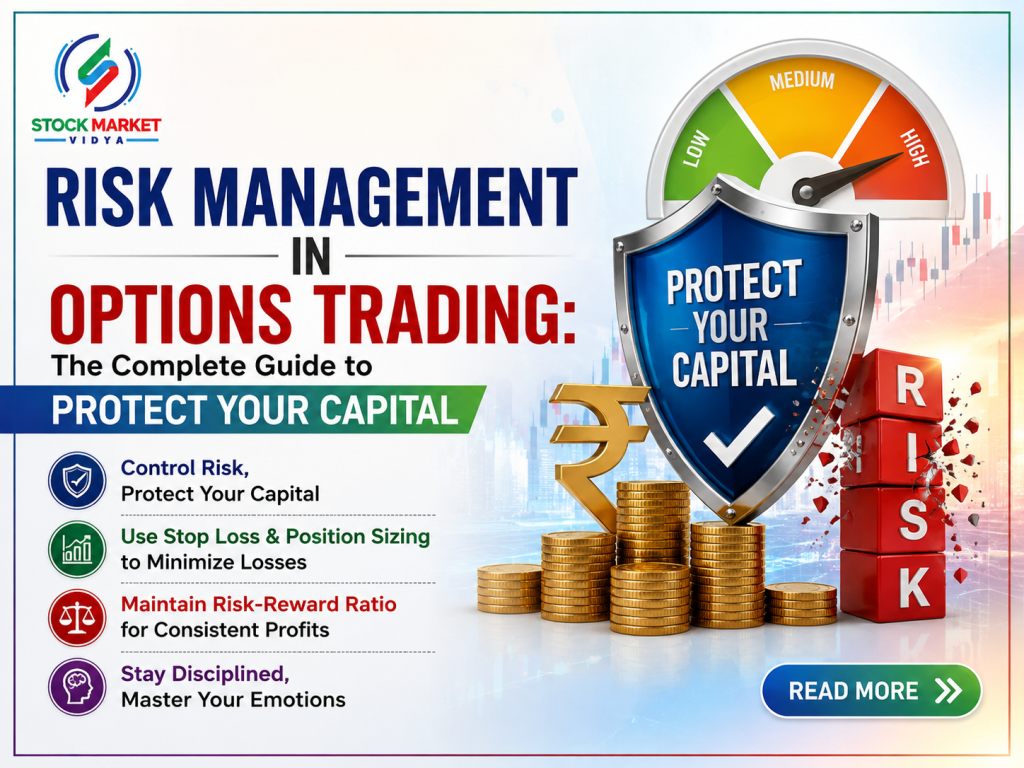

Options trading has become one of the most popular ways to participate in the Indian stock market. Every day, thousands of traders buy and sell options with the hope of earning profits. While many people focus only on finding the perfect trade, experienced traders know that risk management is the real foundation of long-term success.
The biggest difference between successful traders and unsuccessful traders is not the number of winning trades. It is how they manage their losses.
Many beginners believe that they need a secret strategy to become profitable. In reality, even the best trading strategy can fail if proper risk management is ignored. Learning how to control risk helps traders survive market uncertainty and build confidence over time.

If you are planning to build a career in stock market tradingas or want to improve your trading skills, understanding risk management should be your first priority.
What is Risk Management in Options Trading?
Risk management means protecting your trading capital while participating in the market. Instead of trying to avoid losses completely, traders learn how to keep losses small and manageable.
Think of it like wearing a helmet while riding a bike. The helmet does not stop accidents from happening, but it reduces the damage if an accident occurs. Similarly, risk management protects your trading account when the market moves against your position.
Every professional trader follows a risk management plan before entering any trade.
Why Risk Management is More Important Than Making Profits
Many new traders spend hours searching for the best indicators or the next profitable strategy. However, very few spend time learning how to manage risk.
Imagine two traders.
The first trader earns ₹20,000 in one week but loses ₹50,000 in the next week because he trades without any limits.
The second trader earns only ₹8,000 in the first week but follows strict discipline and limits losses to ₹2,000 whenever the market moves against him.
After a few months, the second trader usually performs much better because protecting capital allows continuous participation in the market.
Capital preservation is the first goal of every successful options trader.
Common Risks in Options Trading
Options trading offers opportunities, but it also carries several risks that traders must understand.
Time Decay
Option premiums reduce as expiry approaches. Even if the market remains stable, the value of an option can decline because of time decay.
Market Volatility
Unexpected news, global events, economic announcements, or company results can create sharp price movements.
Emotional Trading
Fear and greed often lead traders to take impulsive decisions. Emotional trading usually increases losses.
Overleveraging
Using too much capital in a single trade can create large losses within minutes.
Lack of Knowledge
Trading without understanding option pricing, technical analysis, or market behaviour increases risk significantly.
Golden Rules of Risk Management in Options Trading
Decide Your Maximum Risk Before Every Trade
Professional traders decide how much they are willing to lose before entering a position.
For example, if your total trading capital is ₹2,00,000, you may decide not to risk more than 1% or 2% on a single trade.
This simple habit prevents major losses.
Always Use a Stop Loss
A stop loss automatically limits your loss if the market moves in the opposite direction.
Many beginners avoid placing stop losses because they hope the market will reverse.
Hope is not a trading strategy.
A disciplined stop loss protects your capital and allows you to trade another day.
Never Trade with Your Entire Capital
One of the biggest mistakes beginners make is investing all their money in one trade.
Instead, divide your trading capital wisely.
This provides flexibility and reduces emotional pressure during market fluctuations.
Follow Position Sizing
Position sizing means deciding the quantity of contracts based on your available capital.
Professional traders never increase quantity simply because they feel confident.
Every trade should follow predefined money management rules.
Maintain Proper Risk-Reward Ratio
Before taking any trade, compare the possible profit with the possible loss.
Many experienced traders prefer a minimum risk-reward ratio of 1:2.
If the possible loss is ₹1,000, the expected profit should ideally be ₹2,000 or more.
This helps traders remain profitable even if several trades fail.
Importance of Trading Psychology
Risk management is closely connected with trading psychology.
Many traders know the rules but fail to follow them because of emotions.
Common emotional mistakes include:
- Revenge trading after a loss
- Overtrading
- Fear of missing out (FOMO)
- Holding losing trades for too long
- Booking profits too early
Developing emotional discipline is just as important as learning technical analysis.
Build a Written Trading Plan
Professional traders do not depend on emotions.
They prepare a written trading plan that includes:
- Entry rules
- Exit rules
- Stop loss
- Target
- Maximum daily loss
- Maximum weekly loss
- Risk percentage
Following a written plan improves consistency.
Learn Technical Analysis Before Trading Options
Risk management becomes much easier when traders understand technical analysis.
Support and resistance levels, trend analysis, price action, moving averages, option chain analysis and volume analysis help traders make informed decisions instead of emotional guesses.
Learning these concepts from experienced mentors reduces beginner mistakes.
Importance of Practical Learning
Watching YouTube videos or reading articles provides basic knowledge, but practical learning develops confidence.
Live market practice helps traders understand:
- Real market behaviour
- Option premium movement
- Volatility
- Trade execution
- Risk control during fast-moving markets
Practical exposure builds discipline that theoretical learning alone cannot provide.
Mistakes Beginners Should Avoid
Many new options traders repeat the same mistakes.
Avoid these habits:
- Trading without a stop loss
- Following social media tips blindly
- Trading based on rumours
- Increasing position size after losses
- Ignoring market trends
- Taking too many trades in one day
- Expecting quick profits
- Not maintaining a trading journal
Small improvements in discipline often create significant improvements in long-term performance.
How Professional Traders Manage Risk
Experienced traders understand that losses are part of trading.
Instead of trying to avoid losses completely, they focus on consistency.
Professional traders usually:
- Protect trading capital first
- Trade only high-probability setups
- Follow strict discipline
- Avoid emotional decisions
- Review every trade regularly
- Continue learning market behaviour
Their objective is not winning every trade but staying profitable over hundreds of trades.
Learn Risk Management with Stock Market Vidya Nagpur
If you are searching for the best share market classes in Nagpur, learning from experienced professionals can make a significant difference in your trading journey.
Stock Market Vidya Nagpur is one of the trusted names for stock market education. The institute focuses on practical learning, disciplined trading, and building a strong understanding of financial markets instead of shortcuts.
The training is conducted by Mr. Prashant Sarode, a NISM and NSE Certified Trainer with years of experience in stock market education. His teaching approach simplifies complex market concepts so that beginners as well as working professionals can understand them easily.
Students receive structured learning covering:
- Fundamental Analysis
- Technical Analysis
- Options Trading
- Futures Trading
- Option Chain Analysis
- Risk Management
- Trading Psychology
- Intraday Trading
- Swing Trading
- Investment Planning
Whether you are looking for a stock market course for beginners, an option trading course in Nagpur, futures and options training Nagpur, or a professional stock trading course, the curriculum is designed to build practical knowledge step by step.
Many learners searching for where to learn stock market trading in Nagpur, best institute to learn trading in Nagpur, or a stock market course with practical training choose Stock Market Vidya share market classes because the focus remains on real market understanding rather than unrealistic expectations.
The institute is also known among learners looking for share market classes in Nagpur, stock market training Nagpur, trading classes in Nagpur, share trading course in Nagpur, technical analysis course in Nagpur, intraday trading course in Nagpur.
Conveniently located for students searching for a share market institute in Nagpur, trading classes near Wardha Road Nagpur, stock market classes near Sonegaon Nagpur, or the best trading institute in Nagpur, Stock Market Vidya provides an accessible learning environment focused on practical stock market education.
To know more about courses, visit StockMarketVidya.com or contact the institute directly.
Website:www.stockmarketvidya.com
Mobile: 9822718163, 8421893845
Google Maps:https://maps.app.goo.gl/Kof5Z6LQsxq4BqLt6
Why Joining Professional Stock Market Training Matters
Learning independently is possible, but structured guidance helps you avoid common mistakes and develop trading discipline much faster.
A well-designed share market course in Nagpur provides:
- Step-by-step learning for beginners
- Practical market understanding
- Better trading discipline
- Strong risk management techniques
- Improved confidence in decision-making
- Understanding of market psychology
- Real-world trading examples
- Knowledge of trading strategies used in Indian markets
These skills help traders build a strong foundation for long-term growth.
Final Thoughts
Risk management is not the most exciting part of options trading, but it is certainly the most important. Every successful trader understands that protecting capital comes before earning profits.
Markets will always provide new opportunities, but only traders who manage risk wisely are able to take advantage of them consistently.
If you truly want to learn how to learn stock market trading in India, develop disciplined trading habits, and understand options trading from experienced guidance, investing in quality stock market education is one of the smartest decisions you can make.
Learning the right concepts, practising with discipline, and following proper risk management can help you become a more confident and responsible trader.
FAQs for “Risk Management in Options Trading”
1. What is risk management in options trading?
Risk management in options trading is the process of protecting your trading capital by controlling potential losses. It includes setting stop losses, deciding the correct position size, avoiding overtrading, and following a disciplined trading plan. Good risk management helps traders stay in the market even after losing trades because no strategy wins every time. It is considered one of the most important skills for long-term success in the stock market.
2. Why is risk management important in options trading?
Risk management is important because options trading involves high market volatility. Without proper planning, traders can lose a large portion of their capital in a single trade. By limiting losses and protecting investments, traders improve their chances of long-term success. Professional traders focus more on preserving capital than chasing quick profits, making risk management the foundation of successful options trading.
3. How much money should I risk on one options trade?
Many experienced traders recommend risking only 1% to 2% of your total trading capital on a single trade. For example, if your trading account has ₹1,00,000, your maximum loss on one trade should generally be between ₹1,000 and ₹2,000. This approach helps reduce emotional pressure and allows you to continue trading even after a few losing trades.
4. What is a stop loss, and why should every options trader use it?
A stop loss is a pre-decided price level where you exit a trade to limit your loss. It protects your capital if the market moves against your position. Every options trader should use a stop loss because unexpected market movements can happen anytime. A disciplined stop-loss strategy helps traders avoid major losses and improves long-term trading performance.
5. What are the biggest mistakes beginners make in options trading?
Common mistakes include trading without a stop loss, investing too much money in one trade, following social media tips blindly, revenge trading after losses, and ignoring trading discipline. Many beginners also lack proper knowledge of option pricing and technical analysis. Learning risk management before focusing on profits can help avoid these costly mistakes.
6. How does trading psychology affect risk management?
Trading psychology plays a major role in risk management. Fear, greed, overconfidence, and panic often cause traders to break their own trading rules. Emotional decisions usually lead to larger losses than planned. Developing patience, discipline, and consistency helps traders follow their risk management plan even during highly volatile market conditions.
7. What is the ideal risk-reward ratio in options trading?
A commonly recommended risk-reward ratio is 1:2 or higher. This means if you are willing to risk ₹1,000, your expected profit should be at least ₹2,000. Maintaining a healthy risk-reward ratio allows traders to remain profitable even if only half of their trades are successful. It also encourages disciplined trade selection.
8. Can beginners learn risk management before starting options trading?
Yes. In fact, beginners should learn risk management before placing their first options trade. Understanding concepts like stop loss, position sizing, capital allocation, and trading discipline helps reduce unnecessary losses. Joining a structured stock market course for beginners is one of the best ways to build a strong foundation before entering live markets.
9. How can I improve my discipline in options trading?
Trading discipline improves by following a written trading plan, maintaining a trading journal, using stop losses, avoiding emotional decisions, and reviewing every trade. Practising consistently and learning from experienced mentors also helps develop discipline. Successful traders treat trading like a business rather than a game of luck
10. Is technical analysis useful for better risk management?
Yes. Technical analysis helps traders identify support and resistance levels, market trends, entry points, and exit points. It reduces guesswork and improves decision-making. Learning chart patterns, moving averages, price action, and option chain analysis can significantly improve risk management. A technical analysis course in Nagpur can help beginners understand these concepts practically.
11. Where can I learn risk management and options trading in Nagpur?
If you are searching for the best share market classes in Nagpur, Stock Market Vidya Nagpur offers structured training in options trading, technical analysis, trading psychology, and risk management. The institute is led by Prashant Sarode stock market trainer, a NISM and NSE Certified Trainer, who focuses on practical market education. Students can learn through classroom sessions and practical market examples. Visit StockMarketVidya.com for course details.
12. Which is the best share market course in Nagpur for learning options trading?
The best share market course in Nagpur should include practical learning, technical analysis, futures and options, trading psychology, and risk management. Stock Market Vidya offers a structured curriculum designed for beginners as well as experienced traders. The training focuses on practical knowledge rather than theoretical concepts, helping students understand real market situations with confidence.
13. What is position sizing in options trading?
Position sizing means deciding how many option contracts you should trade based on your available capital and acceptable risk. Instead of investing all your money in one trade, you allocate only a small percentage to each position. Proper position sizing helps reduce losses, control emotions, and maintain consistency during different market conditions.
14. Why do many options traders lose money?
Many traders lose money because they trade without a proper plan, ignore stop losses, overtrade, or take excessive risks. Lack of market knowledge and emotional decision-making also contribute to losses. Successful traders understand that protecting capital through proper risk management is more important than trying to win every trade.
15. How does futures and options training help reduce trading risks?
A good futures and options training Nagpur programme teaches traders how option premiums work, how volatility affects prices, and how to use different strategies with controlled risk. Students also learn position sizing, hedging concepts, and disciplined trade management. This knowledge helps traders make informed decisions instead of emotional ones.
16. How do I choose the best trading institute in Nagpur?
Choose an institute that offers practical learning, experienced trainers, structured courses, and real market examples. A good institute should cover technical analysis, options trading, risk management, trading psychology, and investment concepts. If you are looking for share market training in Nagpur, Stock Market Vidya provides practical stock market education under Prashant Sarode, a NISM and NSE Certified Trainer.
17. Can a stock market course help me become a disciplined trader?
Yes. A professional stock market course in Nagpur teaches more than buying and selling shares. It helps students develop discipline, patience, risk management skills, and confidence. Practical assignments, and continuous learning improve decision-making and prepare traders for real market conditions.
18. Where can I find a share market course near me with practical training?
If you are searching online for a share market course near me, look for institutes that provide practical stock market training rather than only classroom theory. Stock Market Vidya share market classes in Nagpur offer structured learning in technical analysis, options trading, futures trading, and risk management, making them suitable for beginners and working professionals.
19. Why should I join Stock Market Vidya Nagpur to learn options trading?
Stock Market Vidya Nagpur is known for practical stock market education and step-by-step learning. The courses are conducted by Mr. Prashant Sarode, a NISM and NSE Certified Trainer, who explains complex trading concepts in simple language. Whether you want an option trading course in Nagpur, share market classes in Nagpur, or a complete stock market course for beginners, the institute focuses on building practical skills, disciplined trading habits, and strong risk management. For more information, visit StockMarketVidya.com or contact 9822718163 / 8421893845.
-
How to Read an Annual Report as a Stock Investor: A Beginner’s Guide
Buying a stock only because someone recommended it on social media or television can be risky. A smart investor tries to understand the business before investing money. One of the best documents available for this purpose is the company’s annual report. But many beginners feel confused when they open a 200-page or 300-page annual report.…
-

10 Smart Questions to Ask Before Your First Stock Investment
Buying your first stock can feel exciting. You open a trading app, search for a company name, see the share price moving up, and think, “Should I buy this stock?” But successful investing should not begin with excitement or a random tip from social media. It should begin with questions. Before investing your hard-earned money,…
-

How to Research a Stock Before Buying It: A Beginner’s Guide for Indian Investors
Buying a stock should not be like buying something because a friend recommended it, a social media post called it a “multibagger”, or its price suddenly started moving upward. A better approach is simple: research first, decide later. For beginners, stock research means understanding the company, its business, financial performance, valuation, industry, management and future…



Pingback: How Does the Stock Market Actually Work in India? A Beginner’s Guide - Share Market Blog