
Introduction
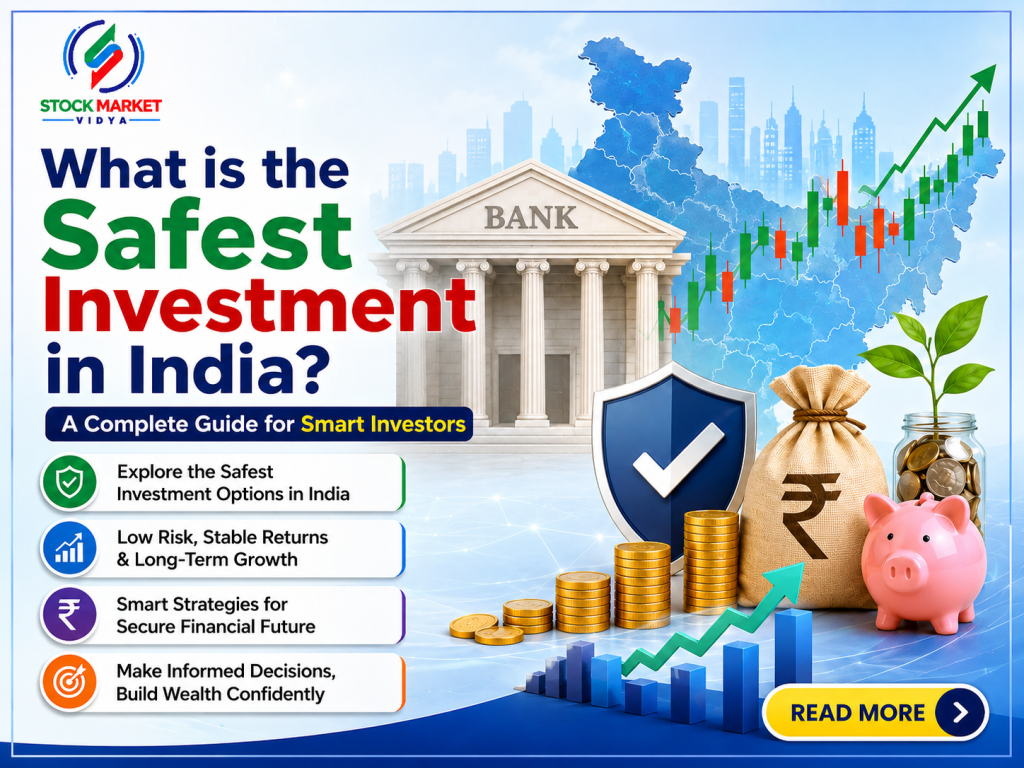
Every person who earns money wants one thing—their hard-earned savings should remain safe and also grow over time. Whether you are a student, salaried employee, business owner, or retiree, choosing the safest investment in India is one of the most important financial decisions.
Many people believe that keeping money in a savings account is the safest option. Others prefer Fixed Deposits, Gold, or Government Schemes. At the same time, many people avoid the stock market because they think it is risky. The truth is that risk depends more on knowledge than on the investment itself.
If you understand how financial markets work, learn risk management, and build the right investing habits, you can make better investment decisions with confidence.
This guide explains the safest investment options available in India, their advantages and limitations, and why financial education plays an important role before investing in any asset.
What Does “Safe Investment” Really Mean?
A safe investment is one where the possibility of losing your capital is comparatively low. However, safety does not always mean higher returns.
Before choosing an investment, ask yourself:
- Is my capital protected?
- Will the returns beat inflation?
- Can I withdraw money whenever required?
- Does this investment suit my financial goals?
- How much risk can I comfortably handle?
The best investment is one that matches your financial objectives, investment period, and risk tolerance.

Top Safest Investment Options in India
1. Fixed Deposits (FD)
Fixed Deposits remain one of the most popular investment choices in India.
They offer:
- Stable returns
- Low investment risk
- Fixed interest rates
- Easy availability through banks and financial institutions
FDs are suitable for conservative investors, although returns may not always beat inflation over long periods.
2. Public Provident Fund (PPF)
PPF is backed by the Government of India and is considered among the safest long-term investment options.
Benefits include:
- Government-backed security
- Tax advantages
- Compounding growth
- Long-term wealth creation
It is ideal for retirement planning and disciplined savings.
3. National Savings Certificate (NSC)
NSC is another government-backed savings scheme suitable for investors looking for fixed returns with tax benefits.
It is commonly used for medium-term financial planning.
4. Sovereign Gold Bonds (SGB)
Instead of purchasing physical gold, many investors prefer Sovereign Gold Bonds.
Advantages include:
- Government backing
- No storage concerns
- Interest income
- Gold price appreciation potential
This is considered a safer way to invest in gold.
5. Employee Provident Fund (EPF)
For salaried employees, EPF provides one of the safest retirement investment options.
Regular contributions help create a retirement corpus while earning attractive interest.
6. Debt Mutual Funds
Debt mutual funds invest mainly in fixed-income securities.
Compared to equity investments, they generally carry lower risk and may suit investors seeking relatively stable returns.
However, understanding the fund’s portfolio and duration is important before investing.
7. Blue-Chip Stocks
Many people are surprised to see stocks listed among safer investments.
While the stock market experiences short-term fluctuations, investing in fundamentally strong, well-established companies for the long term has historically helped many investors build wealth.
The key difference is investing with knowledge instead of emotions.
Is the Stock Market Safe?
This is one of the most common questions asked by beginners.
The answer is simple.
The stock market is not a gambling platform, but investing without knowledge can become risky.
Successful investors do not depend on luck.
They rely on:
- Research
- Fundamental Analysis
- Technical Analysis
- Risk Management
- Trading Psychology
- Investment Discipline
These skills help investors make informed decisions rather than emotional ones.
Why Knowledge is the Safest Investment
Imagine two people investing the same amount.
One buys shares based on social media tips.
The other studies company fundamentals, understands charts, manages risk, and follows a disciplined investment strategy.
Who has a better chance of long-term success?
Obviously, the second investor.
This is why financial education is often considered the safest investment you can make.
Knowledge stays with you regardless of market conditions.
Common Mistakes That Make Safe Investments Risky
Even safe investments can become risky because of poor financial decisions.
Some common mistakes include:
Investing Without Research
Never invest simply because someone recommends a stock or scheme.
Understand where your money is going.
Chasing High Returns
If an investment promises unusually high returns with no risk, think carefully before investing.
Always verify the authenticity of such opportunities.
Ignoring Inflation
Keeping all your money in low-return investments may reduce purchasing power over time.
A balanced investment strategy is important.
Emotional Decisions
Fear during market corrections and greed during market rallies often lead to poor investment choices.
Learning trading psychology helps investors remain disciplined.
How Beginners Can Start Investing Safely
If you are new to investing, follow these simple steps:
Start by creating an emergency fund.
Understand your financial goals.
Learn the basics of the stock market.
Begin with small investments.
Diversify your portfolio.
Review your investments regularly.
Continue improving your financial knowledge.
Learning first and investing later is always a better approach.
Why Stock Market Education Matters
Thousands of people search online every month for:
- where to learn stock market trading in Nagpur
- how to learn stock market trading in India
- stock market course for beginners
- share market course near me
- stock market course with practical training
This growing interest shows that people want to understand investing before risking their money.
Professional training helps beginners understand:
- Market basics
- Risk management
- Trading discipline
- Investment planning
- Technical Analysis
- Fundamental Analysis
- Option Trading
- Futures & Options
- Portfolio management
- Real market behaviour
Proper education reduces avoidable mistakes and builds confidence.
Learn Stock Market the Right Way with Stock Market Vidya Nagpur
If you are searching for the best share market classes in Nagpur, Stock Market Vidya Nagpur has been helping students, professionals, business owners, and aspiring traders learn the stock market through practical and structured training.
The institute is led by Mr. Prashant Sarode, a NISM and NSE Certified Trainer with years of experience in stock market education. His teaching style focuses on simplifying complex market concepts into practical lessons that beginners can easily understand.
Students receive step-by-step guidance on important topics such as:
- Basics of the Indian stock market
- Fundamental Analysis
- Technical Analysis
- Chart Reading
- Price Action
- Candlestick Patterns
- Risk Management
- Trading Psychology
- Intraday Trading
- Swing Trading
- Positional Trading
- Option Trading
- Futures & Options
- Capital Protection Strategies
- Wealth Creation through disciplined investing
Whether you are completely new to investing or already have some market experience, learning from an experienced trainer helps you build confidence and make informed financial decisions.
Why Students Choose Stock Market Vidya
Many learners searching for the share market course in Nagpur, stock market course in Nagpur, or share market training in Nagpur prefer Stock Market Vidya because of its practical approach to learning.
Some key advantages include:
- Training by Mr. Prashant Sarode, NISM and NSE Certified Trainer
- Beginner-friendly learning environment
- Practical stock market training
- Easy-to-understand explanations using real market examples
- Focus on trading psychology and disciplined investing
- Guidance on risk management techniques
- Learning suitable for students, working professionals, homemakers, entrepreneurs, and retired individuals
- Well-designed stock market course for beginners
- Concepts explained from basic to advanced level
If you are looking for technical analysis course in Nagpur, intraday trading course in Nagpur, option trading course in Nagpur, futures and options training Nagpur, professional stock trading course, or trading strategies course India, the curriculum is designed to help learners understand both theory and practical market application.
People searching for the best institute to learn trading in Nagpur, stock market learning institute Nagpur, share market institute in Nagpur, best trading institute in Nagpur, stock market education Nagpur, share market classes in Nagpur, stock market training institute in Nagpur, stock market training Nagpur, trading classes in Nagpur, share trading course in Nagpur, best share market course for beginners in Nagpur, trading classes near Wardha Road Nagpur, and stock market classes near Sonegaon Nagpur can explore the learning programs offered by Stock Market Vidya.
Visit Stock Market Vidya Nagpur
If you are serious about understanding investments and building financial knowledge, visit Stock Market Vidya Nagpur.
Trainer: Mr. Prashant Sarode (NISM and NSE Certified Trainer)
Website:www.StockMarketVidya.com
Mobile: 9822718163, 8421893845
Location: “Swamikrupa”, 86, Kannamwar Nagar, Opposite Sonegaon Police Station, Near Hotel Pride, Wardha Road, Nagpur – 440025
Location & Google Maps Directions:https://maps.app.goo.gl/Kof5Z6LQsxq4BqLt6
Conclusion
There is no single investment that is perfect for everyone. Fixed Deposits, PPF, Government Schemes, Gold, Debt Funds, and fundamentally strong stocks all have their place in a well-planned portfolio.
The safest investment is not simply about choosing the lowest-risk product—it is about making informed decisions based on knowledge, planning, and discipline.
Before investing your hard-earned money, invest in your financial education. Understanding how markets work, managing risk wisely, and staying disciplined can help you make better investment decisions throughout your life.
Learning from experienced professionals like Mr. Prashant Sarode, a NISM and NSE Certified Trainer at Stock Market Vidya Nagpur, can help you develop practical market knowledge and build greater confidence as an investor. Whether your goal is long-term investing or understanding trading concepts, quality education is one of the strongest foundations for your financial journey.
Frequently Asked Questions (FAQs) – What is the Safest Investment in India?
1. What is the safest investment in India?
The safest investment in India depends on your financial goals and risk tolerance. Popular low-risk options include Public Provident Fund (PPF), Fixed Deposits (FDs), National Savings Certificate (NSC), Employee Provident Fund (EPF), and Sovereign Gold Bonds (SGBs). These investments are considered safer because they offer relatively stable returns and, in many cases, government backing.
2. Which investment is 100% safe in India?
No investment is completely risk-free. However, government-backed schemes such as PPF, NSC, Sukanya Samriddhi Yojana (SSY), and RBI-backed investments are among the safest because they are supported by the Government of India.
3. Is a Fixed Deposit (FD) safer than investing in the stock market?
Yes, Fixed Deposits generally have lower risk than the stock market because they provide fixed returns. However, stock market investments have the potential to generate higher long-term returns when made with proper knowledge, research, and risk management.
4. Is the stock market a safe investment for beginners?
The stock market can be safe for beginners if they first learn the basics of investing, understand risk management, and invest for the long term. Investing without knowledge or following random tips increases the risk of losses.
5. What is the best investment option for beginners in India?
Beginners can consider starting with:
- Public Provident Fund (PPF)
- Fixed Deposits
- Index Mutual Funds
- SIP in Mutual Funds
- Blue-chip company stocks after learning the basics
The right choice depends on individual financial goals.
6. Which investment gives both safety and good returns?
There is no investment that offers the highest safety and the highest returns together. Government schemes provide more safety, while equity investments may provide better long-term growth. A balanced portfolio often combines both.
7. Can I lose money in safe investments?
Even relatively safe investments may carry some risks, such as inflation reducing the real value of returns or interest rate changes affecting earnings. Understanding these factors helps in making better investment decisions.
8. Why is financial education important before investing?
Financial education helps you understand:
- Different investment options
- Risk management
- Portfolio diversification
- Market behavior
- Long-term wealth creation
Knowledge reduces the chances of making emotional or uninformed investment decisions.
9. What is the safest way to invest in the stock market?
The safest approach includes:
- Investing for the long term
- Choosing fundamentally strong companies
- Diversifying your portfolio
- Avoiding emotional trading
- Learning technical and fundamental analysis
- Following proper risk management
10. Is SIP safer than investing directly in stocks?
Systematic Investment Plans (SIPs) help reduce market timing risk by investing a fixed amount regularly. While mutual funds are subject to market risks, SIPs are considered a disciplined and convenient way to build wealth over time.
11. Which government investment scheme is best for long-term savings?
Popular long-term government-backed investment schemes include:
- Public Provident Fund (PPF)
- National Pension System (NPS)
- Sukanya Samriddhi Yojana (SSY)
- Employees’ Provident Fund (EPF)
Each scheme is designed for different financial objectives.
12. Is gold a safe investment in India?
Gold is often considered a safe-haven asset during economic uncertainty. Instead of physical gold, many investors prefer Sovereign Gold Bonds because they provide additional benefits such as interest income and eliminate storage concerns.
13. How much money should I invest to start safely?
You can begin investing with a small amount. Many mutual fund SIPs start from ₹500 per month, while stock market investing depends on the share price of the companies you choose. The key is to invest according to your financial capacity.
14. How can I learn stock market investing before investing my money?
The best approach is to learn from a structured stock market education program. Understanding market fundamentals, technical analysis, risk management, trading psychology, and investment discipline helps beginners make informed decisions.
15. Where can I learn stock market investing in Nagpur?
If you are searching for the best share market classes in Nagpur, Stock Market Vidya Nagpur offers practical stock market education under Mr. Prashant Sarode, NISM and NSE Certified Trainer. Students learn topics such as Fundamental Analysis, Technical Analysis, Risk Management, Option Trading, Futures & Options, Trading Psychology, and practical market concepts through structured training.
Stock Market Vidya Nagpur
- Website:www.stockmarketvidya.com
- Mobile: 9822718163, 8421893845
- Location:Swamikrupa, 86, Kannamwar Nagar, Opposite Sonegaon Police Station, Near Hotel Pride, Wardha Road, Nagpur – 440025
- Google Maps:https://maps.app.goo.gl/Kof5Z6LQsxq4BqLt6
-
How to Read an Annual Report as a Stock Investor: A Beginner’s Guide
Buying a stock only because someone recommended it on social media or television can be risky. A smart investor tries to understand the business before investing money. One of the best documents available for this purpose is the company’s annual report. But many beginners feel confused when they open a 200-page or 300-page annual report.…
-

10 Smart Questions to Ask Before Your First Stock Investment
Buying your first stock can feel exciting. You open a trading app, search for a company name, see the share price moving up, and think, “Should I buy this stock?” But successful investing should not begin with excitement or a random tip from social media. It should begin with questions. Before investing your hard-earned money,…
-

How to Research a Stock Before Buying It: A Beginner’s Guide for Indian Investors
Buying a stock should not be like buying something because a friend recommended it, a social media post called it a “multibagger”, or its price suddenly started moving upward. A better approach is simple: research first, decide later. For beginners, stock research means understanding the company, its business, financial performance, valuation, industry, management and future…