
A Practical Options Trading Guide by Stock Market Vidya, Nagpur
When traders hear the word options, many immediately think of fast profits, high risk, and unpredictable outcomes. But experienced traders know that options trading is not just about predicting direction. In fact, some of the most consistent option strategies work when the market goes nowhere.
One such powerful non-directional strategy is the Short Strangle.
In real market conditions, indices like NIFTY and BANK NIFTY often spend weeks moving sideways, confusing both buyers and sellers. This is exactly where a Short Strangle shines—not by chasing movement, but by benefiting from lack of movement.
In this detailed guide by Stock Market Vidya, Nagpur, we will break down the Short Strangle strategy in a sideways market in the simplest possible way, exactly how it is taught in professional share trading classes in Nagpur under the guidance of Mr. Prashant Sarode, NISM Certified Trainer.
Understanding the Market First: What Is a Sideways Market?
Before jumping into the strategy, let’s first understand the environment where Short Strangle works best.
A sideways market is a phase where:
- Prices move within a defined range
- No strong uptrend or downtrend is visible
- Buyers and sellers are equally strong
- Volatility is usually moderate to low
- Option premiums slowly decay with time
In Indian markets, sideways conditions are extremely common:
- Before major events
- After big rallies
- During consolidation phases
- When news flow is limited
Professional traders trained through structured share market training in Nagpur learn to identify these phases early instead of forcing directional trades.
Why Options Sellers Love Sideways Markets
Options buyers need movement.
Options sellers need time decay.
In a sideways market:
- Options lose value daily due to theta decay
- Implied volatility often contracts
- Time works in favor of the seller
This is why income-based option strategies are heavily focused on selling options rather than buying them.
The Short Strangle is one of the most popular strategies taught in advanced modules of any professional stock market course.
What Is a Short Strangle Strategy?
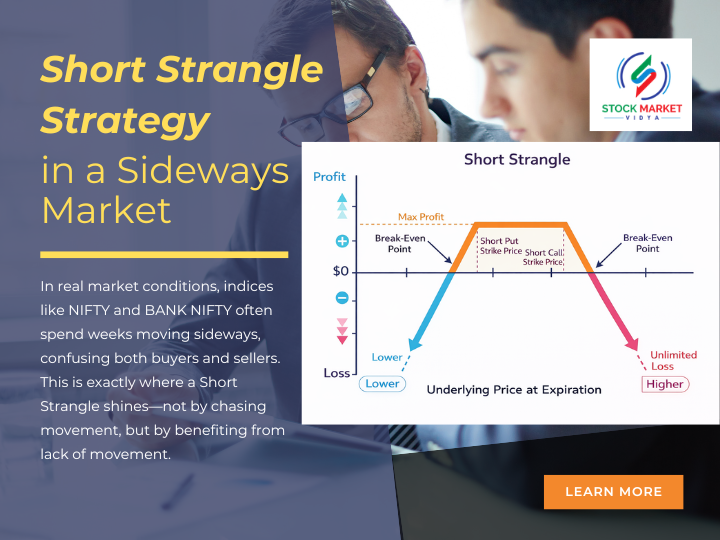
A Short Strangle is an options selling strategy where:
- You sell one Out-of-the-Money Call option
- You sell one Out-of-the-Money Put option
- Both options have the same expiry
- The strike prices are placed on both sides of the current market price
The trader earns profit when:
- The market stays within the selected range
- Both options expire worthless or lose value
- Time decay and volatility contraction help the seller
This strategy is non-directional, meaning you don’t need to predict whether the market will go up or down.
Why Short Strangle Is Ideal for Sideways Markets
Short Strangle performs best when:
- The market lacks strong momentum
- Volatility is not rising sharply
- Prices oscillate within a known range
- Expiry is approaching gradually
This makes it a favourite strategy among professional traders, especially those trained through structured share market classes rather than random tips.
Core Logic Behind the Short Strangle
The logic is simple yet powerful:
- Markets spend more time consolidating than trending
- Extreme movements are less frequent
- Option premiums decay faster as expiry nears
- Selling far OTM options gives a margin of safety
Instead of predicting direction, you are predicting stability.
This mindset shift is one of the first lessons taught in professional share market course in Nagpur.
Step-by-Step Explanation of Short Strangle
Let’s break the strategy in a classroom-style explanation.
Step 1: Identify a Sideways Market
You must confirm that:
- No strong trend is present
- Support and resistance are clearly visible
- Price is trading between these levels consistently
Tools commonly used:
- Range highs and lows
- VWAP
- Moving averages flattening
- Price action near previous zones
Step 2: Select the Underlying Instrument
In India, Short Strangle is commonly applied on:
- NIFTY
- BANK NIFTY
- FINNIFTY
- Highly liquid index options
Beginners are advised to start with indices as they offer:
- Better liquidity
- Lower manipulation
- Predictable volatility behavior
This approach is strongly emphasized in Best share market classes in Nagpur.
Step 3: Choose the Call Option to Sell
- Select an Out-of-the-Money Call
- Strike should be above resistance
- Premium should still offer reasonable value
- Delta should ideally be low
The goal is to sell a call that the market is unlikely to reach before expiry.
Step 4: Choose the Put Option to Sell
- Select an Out-of-the-Money Put
- Strike should be below support
- Enough distance from current price
- Premium must justify the risk
You are creating a range within which the market should remain.
Step 5: Net Premium Collection
Your profit zone is:
- Total premium received
- Reduced by any adjustments if required
- Max profit occurs when both options expire worthless
This income-based thinking is a core concept taught in advanced stock market training programs.
Risk Involved in Short Strangle (And Why Education Matters)
Let’s be honest—Short Strangle is not a low-risk strategy.
Risks include:
- Unlimited risk on either side
- Sudden volatility spikes
- Event-based breakouts
- News-driven trends
This is why Short Strangle should never be traded blindly.
Professional traders manage risk using:
- Adjustments
- Hedging
- Stop-loss rules
- Position sizing
These aspects are deeply covered in structured share market training in Nagpur, not through shortcuts.
Margin Requirement in Short Strangle
Short Strangle requires:
- Higher margin than single option selling
- Margin depends on strikes, volatility, and broker
- Portfolio margin benefits may apply
Understanding margin behavior is critical and often ignored by self-learners.
A well-designed stock market course teaches traders to optimize capital usage without overexposure.
Adjustment Techniques for Short Strangle
This is where professionals separate themselves from beginners.
Common adjustment approaches include:
- Shifting the untested side
- Converting to Iron Condor
- Adding hedges when volatility expands
- Booking partial profits early
Short Strangle is not a “set and forget” strategy.
It is a dynamic strategy that requires monitoring and decision-making.
Ideal Time to Deploy Short Strangle
Best periods include:
- After big directional moves
- During weekly expiry with stable ranges
- When IV is relatively high and expected to fall
- When no major economic event is scheduled
Timing plays a huge role, which is why learning from experienced mentors in Best share market classes in Nagpur makes a difference.
Psychological Discipline Required
Short Strangle tests:
- Patience
- Emotional control
- Discipline
- Risk tolerance
Traders often panic during temporary spikes, exit early, or over-adjust unnecessarily.
Professional share trading classes in Nagpur focus heavily on mindset, not just strategy rules.
Who Should Use Short Strangle?
This strategy is suitable for:
- Traders with basic options knowledge
- Traders who understand risk management
- Traders who can monitor positions
- Traders trained through structured programs
It is not recommended for absolute beginners without proper education.
Why Learn Options Strategies from Stock Market Vidya, Nagpur
Stock Market Vidya, Nagpur, led by Mr. Prashant Sarode (NISM Certified Trainer), focuses on:
- Concept-based learning
- Indian market-specific strategies
- Realistic expectations from trading
Whether you are searching for:
- share market course near me
- share market course in Nagpur
- stock market training with honesty
This institute emphasizes skill development, not shortcuts.
Final Thoughts: Short Strangle as a Professional Income Strategy
The Short Strangle strategy proves one powerful truth:
You don’t need the market to move to make money—sometimes you just need it to stay calm.
When applied correctly:
- It benefits from time decay
- It works beautifully in sideways markets
- It builds consistency for disciplined traders
But like every advanced trading strategy, it demands:
- Education
- Risk control
- Experience
If you are serious about mastering such professional strategies, structured learning from trusted share market classes is the right path.
Contact Stock Market Vidya, Nagpur
Mobile: 9822718163, 8421893845
Website: www.stockmarketvidya.com
Frequently Asked Questions (FAQs) – Short Strangle Strategy
1. What is a Short Strangle strategy in options trading?
A Short Strangle is an options selling strategy where a trader sells one Out-of-the-Money Call option and one Out-of-the-Money Put option of the same expiry. The strategy works best when the market stays within a limited range and does not show strong directional movement.
2. Why is Short Strangle suitable for a sideways market?
In a sideways market, prices move within a range and option premiums lose value due to time decay. Short Strangle benefits from this decay because both sold options gradually reduce in value, helping the trader earn consistent income.
3. Is Short Strangle a directional or non-directional strategy?
Short Strangle is a non-directional strategy. You do not need to predict whether the market will go up or down. You only expect the market to remain within a defined range until expiry.
4. Which market instruments are best for Short Strangle in India?
Short Strangle is commonly used in index options such as NIFTY and BANK NIFTY because of their high liquidity, better price discovery, and controlled volatility. These instruments are widely taught in professional share trading classes in Nagpur.
5. What is the main source of profit in Short Strangle?
The main source of profit is time decay (theta). As expiry approaches, option premiums decrease, allowing the option seller to retain the premium collected if the market remains stable.
6. Is Short Strangle risky for beginners?
Yes, Short Strangle carries unlimited risk on both sides if the market makes a sharp move. Beginners should first learn proper risk management and adjustments through structured share market training in Nagpur before trading this strategy.
7. How much capital is required to trade Short Strangle?
Short Strangle requires a relatively higher margin compared to single option selling. The exact margin depends on the strikes selected, volatility, and broker rules. Learning margin optimization is an important part of any stock market course.
8. What happens if the market breaks the range?
If the market breaks the expected range, one side of the Short Strangle can start losing money. In such cases, traders use adjustment techniques like shifting strikes, hedging, or converting the position into a safer structure.
9. Can Short Strangle be adjusted during the trade?
Yes, Short Strangle is an adjustable strategy. Traders can manage risk by adjusting the untested side, adding protection, or reducing exposure. These adjustment techniques are usually taught in advanced share market classe
10. When is the best time to deploy a Short Strangle?
The best time is when the market shows consolidation after a strong move, volatility is stable or expected to fall, and there are no major news or events scheduled before expiry.
11. Is Short Strangle suitable for weekly or monthly expiry?
Short Strangle can be used in both weekly and monthly expiry. Weekly expiry is preferred by active traders, while monthly expiry is often used by positional traders trained through professional share market training programs.
12. How important is volatility for Short Strangle?
Volatility plays a key role. Short Strangle works better when implied volatility is high at entry and expected to decrease. Rising volatility after entry can increase risk.
13. Can Short Strangle be traded without monitoring?
No, Short Strangle requires regular monitoring. Sudden market moves can happen at any time, so disciplined supervision and timely decisions are essential.
14. What skills are required to trade Short Strangle successfully?
A trader needs strong understanding of options pricing, volatility behavior, risk management, and emotional discipline. These skills are developed through structured share trading classes in Nagpur rather than self-guessing.
15. Why should traders learn Short Strangle from Stock Market Vidya, Nagpur?
Stock Market Vidya, Nagpur, led by Mr. Prashant Sarode (NISM Certified Trainer), focuses on concept clarity, practical examples, and real Indian market conditions. Traders searching for the Best share market classes in Nagpur gain hands-on learning and disciplined trading approaches.