
When the Market Goes Quiet, Smart Traders Get Active
Many traders believe that profits come only when markets move sharply up or down. But experienced options traders know a secret — some of the most consistent opportunities come when the market does almost nothing.
This is where the Short Straddle strategy shines.
In Indian markets, especially indices like NIFTY and BANK NIFTY, sideways phases appear frequently. Prices move within a range, volatility drops, and direction becomes confusing. For beginners, such markets feel frustrating. For trained traders, they are full of possibilities.
At Stock Market Vidya, Nagpur, under the guidance of Mr. Prashant Sarode, traders are taught how to read these silent markets and apply professional option selling strategies like the Short Straddle with clarity and discipline.
Understanding a Sideways Market Before Trading it
Before jumping into the strategy, it’s important to understand what a sideways market actually looks like.
A sideways market is a phase where:
- Price moves within a limited range
- No clear higher highs or lower lows
- Breakouts fail repeatedly
- Volatility slowly declines
- Option premiums start melting
This phase usually appears:
- Before major events
- After a strong trending move
- During low-volume sessions
- When buyers and sellers are balanced
In such conditions, directional strategies struggle, but non-directional strategies like Short Straddle thrive.
What Is a Short Straddle Strategy?
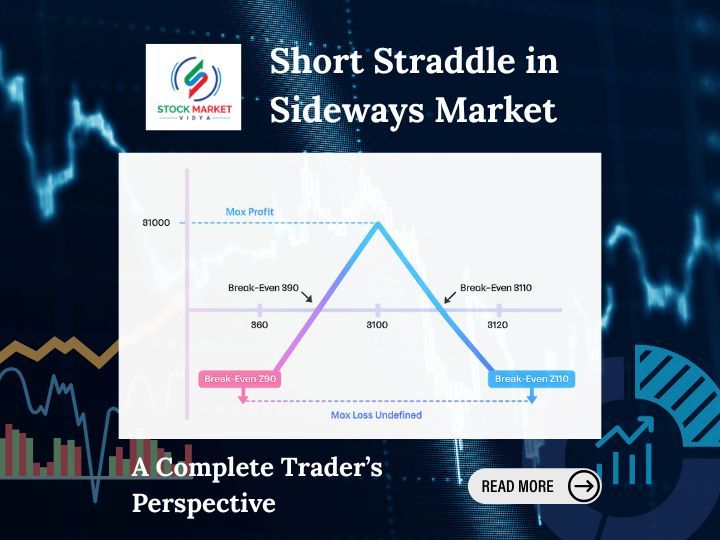
A Short Straddle is an options selling strategy where:
- A trader sells At-The-Money (ATM) Call Option
- And sells At-The-Money (ATM) Put Option
- Both are of the same strike price
- Both belong to the same expiry
The strategy assumes:
- Market will stay near the current price
- Large price movement is unlikely
- Volatility may fall or remain stable
Instead of predicting direction, the trader focuses on time decay and volatility behavior.
This approach is widely used by professional traders and is an important part of advanced learning in share market training in Nagpur.
Why Short Straddle is Ideal for Sideways Markets
Short Straddle works beautifully when:
- Market is range-bound
- No major news or event is expected
- Volatility is already high and expected to cool down
- Support and resistance levels are clearly visible
In sideways markets:
- Call option loses value because price is not rising
- Put option loses value because price is not falling
- Time decay works in favor of the seller every day
This is why this strategy is considered a premium-decay focused setup, not a directional bet.
How Short Straddle Actually Works (Step-by-Step Logic)
Let’s understand the logic without numbers or charts.
- The market opens near a level where buyers and sellers are equally strong
- You identify the ATM strike price
- You sell a Call option at this strike
- You sell a Put option at the same strike
- As long as the price remains within a reasonable range, both options lose value
- The trader benefits from:
- Time decay
- Falling volatility
- Lack of direction
This concept is deeply emphasized in professional stock market course modules because it changes how traders think about price movement.
Role of Time Decay in Short Straddle
Time decay is the heartbeat of this strategy.
Every passing day:
- Option value reduces
- Especially for ATM options
- Theta accelerates near expiry
Short Straddle sellers benefit when:
- Market stays calm
- Days pass without breakout
- Price oscillates near the strike
This is why experienced mentors in Best share market classes in Nagpur stress on expiry selection and timing, not just strategy name.
Volatility: The Silent Partner in Short Straddle
Volatility decides whether this strategy feels comfortable or stressful.
Ideal volatility conditions:
- Volatility is relatively high
- Expected to reduce or stay flat
- No major economic or policy events lined up
When volatility drops:
- Option premiums shrink faster
- Profit potential improves
Understanding volatility behavior is a core part of share trading classes in Nagpur, because option selling without volatility awareness is incomplete.
Risk Involved in Short Straddle (Reality Check)
Short Straddle is powerful, but it is not casual trading.
Main risks include:
- Sudden breakout on either side
- Unexpected news or global cues
- Sharp volatility expansion
- Emotional over-confidence
If the market moves strongly:
- Loss can increase rapidly
- Adjustment becomes necessary
This is why structured learning through share market classes is crucial before attempting this strategy with real capital.
Importance of Market View & Zone Selection
Short Straddle is not placed randomly.
Trained traders analyze:
- Support and resistance zones
- Previous day high and low
- Open interest buildup
- Price acceptance area
- Option chain behavior
When the market is stuck between strong zones, Short Straddle becomes a logical choice.
This analytical thinking is developed through systematic stock market training, not by shortcuts.
Adjustments: The Professional Edge
Professional traders don’t panic — they adjust.
Possible adjustments include:
- Shifting one side if market drifts
- Converting into a defined-risk structure
- Reducing quantity
- Exiting partially to manage pressure
These decision-making skills are refined in mentoring environments like share market course in Nagpur, where market behavior is discussed.
Why Beginners Should Learn This Strategy Properly
Short Straddle is often misunderstood as:
- “Easy money strategy”
- “Daily income trick”
- “No movement profit setup”
In reality, it demands:
- Discipline
- Position sizing
- Emotional control
- Clear exit planning
That’s why Stock Market Vidya focuses on concept clarity, not just strategy names, helping traders build long-term confidence.
Learning Short Straddle at Stock Market Vidya, Nagpur
At Stock Market Vidya, this strategy is taught with:
- Real market examples
- Explanation of option behavior
- Risk awareness
- Mindset training
- Focus on consistency, not excitement
Under Mr. Prashant Sarode (NISM Certified Trainer), students learn how strategies fit into overall market structure, not as isolated tricks.
This approach makes the institute one of the trusted names for:
- share trading classes in Nagpur
- share market training in Nagpur
- Best share market classes in Nagpur
Connect with Stock Market Vidya
If you want to understand how professional traders earn in sideways markets, structured learning is the smartest step.
Institute: Stock Market Vidya, Nagpur
Contact: 9822718163 | 8421893845
Website: www.stockmarketvidya.com
Whether you are searching for a share market course near me or aiming to upgrade your skills through a practical stock market course, learning strategies like Short Straddle with the right guidance makes all the difference.
Frequently Asked Questions – Short Straddle in Sideways Market
1. What is a Short Straddle strategy in options trading?
A Short Straddle is an option selling strategy where a trader sells an At-The-Money Call option and an At-The-Money Put option of the same strike and expiry. This strategy works best when the market remains sideways and does not show strong movement in either direction.
2. Why is Short Straddle suitable for a sideways market?
In a sideways market, prices move within a limited range. During such phases, option premiums lose value due to time decay. Since a Short Straddle benefits from premium erosion, it becomes highly effective when the market stays range-bound.
3. Is Short Straddle a directional or non-directional strategy?
Short Straddle is a non-directional strategy. Traders do not need to predict whether the market will go up or down. Instead, they focus on the market staying near a particular price level.
4. Who should use the Short Straddle strategy?
This strategy is best suited for traders who:
- Have basic to intermediate knowledge of options
- Understand market volatility
- Can monitor trades actively
- Have learned option selling concepts through proper share market training
Beginners are advised to learn it under expert guidance before applying it in live markets.
5. What role does time decay play in Short Straddle?
Time decay is the biggest advantage of Short Straddle. As each day passes, the value of both Call and Put options decreases if the market remains stable. This natural decay works in favor of the option seller.
6. How important is volatility in Short Straddle trading?
Volatility is extremely important. Short Straddle performs well when volatility is high and expected to fall or remain stable. Sudden increases in volatility can put pressure on the position, which is why volatility analysis is a key part of professional stock market training.
7. Can Short Straddle be used in stock options or only index options?
Short Straddle can be used in both stock options and index options. However, most traders prefer index options like NIFTY or BANK NIFTY due to better liquidity and smoother price behavior.
8. What happens if the market breaks out sharply?
If the market moves strongly in one direction, losses can increase. That’s why experienced traders use proper risk management, position sizing, and timely adjustments. Learning these skills is an important part of structured share trading classes in Nagpur.
9. Is Short Straddle suitable for intraday trading?
Yes, Short Straddle can be used for intraday trading, especially on expiry days or during low-volatility sessions. However, intraday execution requires speed, discipline, and clear market understanding.
10. How much capital is required for Short Straddle trading?
Capital requirement depends on the instrument traded, lot size, and margin rules. Since it is an option selling strategy, margin requirements are higher compared to option buying. This is why capital planning is emphasized in professional share market classes.
11. Do traders need to monitor Short Straddle continuously?
Yes, active monitoring is recommended. Since the strategy is sensitive to sudden market moves, traders should keep an eye on price action, volatility, and news during market hours.
12. Can Short Straddle be adjusted if the market starts moving?
Yes, experienced traders often make adjustments such as shifting positions or reducing exposure. Adjustment techniques are taught in detail during advanced stock market courses to help traders manage risk effectively.
13. Is Short Straddle risky for beginners?
It can be risky if traded without knowledge. That’s why beginners are encouraged to first understand option behavior, market structure, and risk management through proper share market training in Nagpur before applying it live.
14. How is Short Straddle taught at Stock Market Vidya, Nagpur?
At Stock Market Vidya, the strategy is explained with real-market logic, examples, and practical insights. Under the guidance of Mr. Prashant Sarode (NISM Certified Trainer), students learn not just the strategy, but also when and why to use it.
15. Where can I learn option selling strategies like Short Straddle in Nagpur?
You can learn option selling strategies through Stock Market Vidya, a reputed institute offering share trading classes in Nagpur, share market training in Nagpur, and professional-level stock market course programs.Contact: 9822718163 | 8421893845
Website:www.stockmarketvidya.com