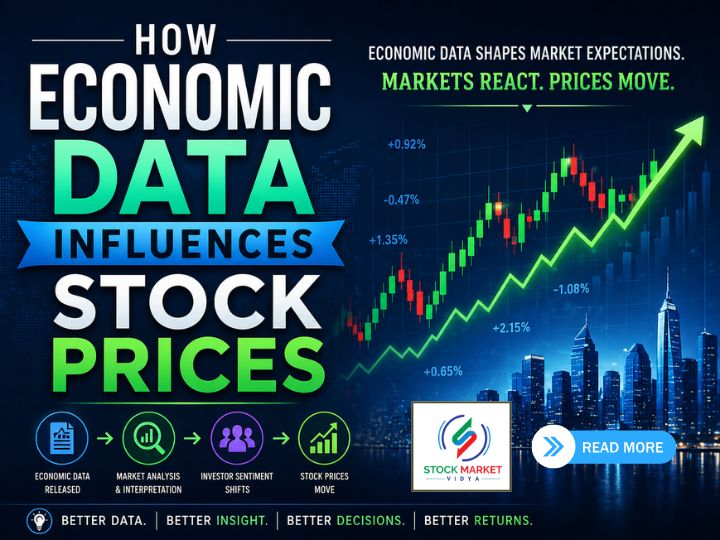

Understanding the stock market is not just about charts and numbers—it is about understanding the economy behind those numbers. Many beginners focus only on price movements, but experienced traders and investors know one important truth: economic data drives stock prices.
If you are serious about share market learning and want to build strong trading discipline, then understanding how economic data impacts the market is a must. Whether you are doing a stock market course or learning on your own, this knowledge gives you a powerful edge.
Let’s break this topic in a simple Indian English style so that even beginners can understand easily.
1. What is Economic Data in Simple Terms?
Economic data means the official numbers released by government and financial institutions that show the condition of the economy.
These include:
- Inflation rate
- Interest rates
- GDP (Gross Domestic Product)
- Employment data
- Industrial production
- Consumer spending
These data points are called economic indicators, and they directly affect investor sentiment and stock prices.
For anyone doing stock market training or share market classes, understanding these indicators is the foundation of fundamental analysis basics.
2. Why Stock Market Depends on Economic Data
The stock market reflects the future expectations of companies. And companies depend on the economy.
2.1 Business Growth Depends on Economy
When the economy grows:
- Companies earn higher profits
- Sales increase
- Expansion becomes easier
This leads to higher stock prices.
2.2 Investor Confidence Changes with Data
If economic data is positive:
- Investors feel confident
- More money flows into the market
If data is negative:
- Fear increases
- Selling pressure rises
This is where trading psychology plays a big role. Markets move not just on facts, but on emotions driven by those facts.
3. Impact of Inflation on Stock Market
Inflation means the rise in prices of goods and services.
3.1 Moderate Inflation is Good
- Indicates growing demand
- Businesses earn more
- Stock prices may rise
3.2 High Inflation is Dangerous
- Input costs increase
- Profit margins reduce
- Consumers spend less
As a result:
- Stock prices may fall
For anyone learning market trends analysis, inflation is one of the most important indicators to track.
4. Interest Rates and Stock Prices
Interest rates are decided by the central bank (in India, RBI).
4.1 When Interest Rates Increase
- Loans become expensive
- Businesses reduce expansion
- Consumers spend less
Result:
- Stock market may fall
4.2 When Interest Rates Decrease
- Borrowing becomes cheaper
- Investment increases
- Consumption rises
Result:
- Stock market may rise
This is why traders in any stock market course always track RBI policy announcements carefully.
5. GDP and Stock Market Movement
GDP (Gross Domestic Product) shows the total economic output of a country.
5.1 Rising GDP
- Strong economy
- Higher corporate earnings
- Positive sentiment
Stock market tends to go up.
5.2 Falling GDP
- Weak economy
- Lower demand
- Reduced profits
Stock market may go down.
Understanding GDP helps you connect how stock market works with real-world economic activity.
6. Employment Data and Market Reaction
Employment data shows how many people have jobs.
6.1 High Employment
- People earn more
- Spending increases
- Companies grow
Stock prices usually rise.
6.2 High Unemployment
- Less income
- Lower demand
- Business slowdown
Stock prices may fall.
This is a key concept taught in stock market education India programs.
7. Consumer Spending and Stock Market
Consumer spending drives the economy.
7.1 Higher Spending
- Companies earn more
- Retail, FMCG, and auto sectors grow
- Stock prices increase
7.2 Lower Spending
- Sales decline
- Profit reduces
- Stocks may fall
If you are doing share market learning, tracking consumption trends is very important.
8. Industrial Production and Market Trends
Industrial production shows how much factories are producing.
8.1 Increase in Production
- Strong demand
- Business growth
- Positive market sentiment
8.2 Decrease in Production
- Weak demand
- Economic slowdown
- Negative sentiment
This data is widely used in fundamental analysis basics.
9. Role of Global Economic Data
Today’s stock market is global.
9.1 US Economy Impact
- US inflation and interest rates affect Indian markets
- Global investors shift money
9.2 Crude Oil Prices
- Higher oil prices increase costs in India
- Impacts inflation and markets
For advanced stock market training, global data analysis is very important.
10. Economic Data and Trading Psychology
Markets don’t move only on data—they move on reaction to data.
10.1 Positive Data but Market Falls
- Already priced in
- Profit booking starts
10.2 Negative Data but Market Rises
- Expectations were worse
- Relief rally happens
This is where trading discipline becomes important. Emotional trading leads to losses.
11. How Traders Use Economic Data
Professional traders don’t ignore economic data.
11.1 Before Trading
- Check major data releases
- Avoid high volatility periods
11.2 During Trading
- Watch market reaction
- Follow trend, not emotion
11.3 After Trading
- Analyze mistakes
- Improve strategy
This structured approach is taught in quality share market classes.
12. Investors vs Traders Approach
12.1 Investors
- Focus on long-term economic growth
- Use GDP, inflation, and industry data
12.2 Traders
- Focus on short-term reactions
- Use news-based volatility
Both need stock market education to succeed.
13. Common Mistakes Beginners Make
13.1 Ignoring Economic Data
Many beginners only follow tips and charts.
13.2 Overreacting to News
Every news is not important.
13.3 Lack of Discipline
Without trading discipline, losses increase.
If you are searching for how to learn trading, avoid these mistakes early.
14. How to Learn Economic Data Analysis
14.1 Start with Basics
Learn:
- Inflation
- Interest rates
- GDP
14.2 Combine with Technical Analysis
Charts + data = better decisions
14.3 Join Proper Training
A structured stock market course helps you understand real market behavior.
Many learners today prefer best share market classes in Nagpur or similar institutes for practical knowledge.
15. Real-Life Example for Better Understanding
Suppose:
- Inflation increases sharply
- RBI increases interest rates
What happens?
- Loans become costly
- Companies reduce expansion
- Investors become cautious
Result:
- Stock market may fall
This is how economic data connects directly to price movement.
About Stock Market Vidya
Stock Market Vidya is one of the oldest and most trusted institutes for stock market training in Nagpur, established in 2004 with the aim of making stock market education simple and practical for everyone.
The institute focuses on real learning instead of only theory, helping students understand how the stock market works in real life.
Key Highlights of Stock Market Vidya
- 20+ years of strong presence in stock market education
- 6000+ students trained successfully
- Beginner to advanced level structured training
- Practical + live market learning approach (Strictly through SIMULATORS only)
- Courses available for students, job professionals, housewives, traders, and investors
The institute believes in honest teaching and realistic expectations, not fake promises or shortcuts in trading.
Benefits of Joining Stock Market Vidya Classes
Joining a professional share market course is very important if you want to avoid common beginner mistakes. Here are the major benefits:
1. Complete Stock Market Knowledge (Basic to Advanced)
You will learn:
- Fundamental analysis
- Technical analysis
- Futures & options trading
- Option chain analysis & strategies
- Intraday & swing trading
All topics are covered in a structured format within a short duration course.
2. Practical Learning with Live Market Through Simulators Only
Most beginners fail because they only learn theory.
At Stock Market Vidya:
- You practice in live market conditions
- Learn real-time decision making
- Understand actual trading psychology
This builds confidence and removes fear.
3. Step-by-Step Learning Structure
The course is divided into clear stages:
- Week 1: Basics & Fundamental Analysis
- Week 2: Derivatives (F&O)
- Week 3: Technical Analysis
- Week 4: Practical Trading & Strategies
This structured approach helps beginners learn easily.
4. Focus on Trading Discipline & Risk Management
The institute strongly focuses on:
- Capital protection
- Risk management
- Avoiding emotional trading
This is one of the biggest advantages compared to random online learning.
5. Suitable for Everyone
Whether you are:
- Student
- Job holder
- Businessman
- Housewife
You can easily start learning with zero background.
6. Multi-Language Teaching (Easy Understanding)
Classes are conducted in:
- Marathi
- Hindi
- Simple English
So even non-finance background students can understand easily.
7. Career & Income Opportunities
After completing the course, you can:
- Start trading
- Do part-time income
- Become full-time trader
- Manage personal investments
- Helpful for jobs
- Start your own Business
Many students have already started their journey successfully.
About Prashant Sarode
Prashant Sarode is the founder and lead trainer of Stock Market Vidya, Nagpur.
Experience & Background
- Active in stock market since 2002
- 25+ years of trading experience
- 20+ years of teaching experience
- Trained 6000+ students across different programs
He is known for his simple teaching style and practical approach, which helps beginners understand complex market concepts easily.
Teaching Style & Approach
1. Practical & Real Market Focus
He teaches using:
- Live charts
- Real examples
- Market-based strategies
2. No False Promises
- Focus on learning, not shortcuts
- Emphasis on discipline and patience
3. Personal Guidance
- Direct interaction with students
- Individual doubt solving
- Real trading mindset development
NISM/NSE Certified Trainer – What It Means
National Institute of Securities Markets (NISM) is a certification body established by SEBI.
Being a NISM Certified Trainer means:
- The trainer has cleared official certification exams
- Has verified knowledge of stock market concepts
- Meets industry-level standards
Benefits of Learning from NISM Certified Trainer
- Authentic and structured knowledge
- Industry-recognized concepts
- Better understanding of rules and regulations
- Professional trading approach
At Stock Market Vidya, learning under a NISM certified expert like Mr. Prashant Sarode ensures trustworthy and quality education.
Why Choose Stock Market Vidya Over Others?
- Oldest institute in Central India
- Strong practical training approach
- Experienced trainer with real market exposure
- Focus on discipline, not shortcuts
- Transparent and honest teaching system
Conclusion: Master the Market by Understanding the Economy
If you truly want success in the stock market, don’t just focus on buying and selling. Focus on understanding the economy behind the market.
Economic data acts like a roadmap:
- It tells where the economy is going
- It helps predict market direction
- It improves decision-making
Whether you are a beginner or experienced trader, combining:
- stock market training
- trading psychology
- economic data analysis
will take your journey to the next level.
In simple words:
Charts show what is happening. Economic data explains why it is happening.
And when you understand both, you become a smarter and more confident market participant.