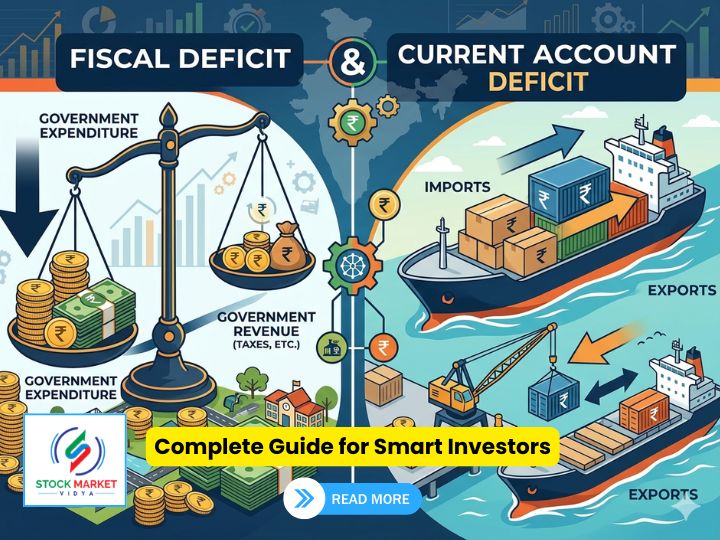

When you start learning about the stock market, you often hear terms like GDP, inflation, fiscal deficit, and current account deficit. Many beginners feel these are complicated economic concepts. But the truth is, if you want to succeed in stock market trading and investing, understanding these concepts is very important.
In this detailed guide, we will explain Fiscal Deficit & Current Account Deficit in simple Indian English. You will also learn how these factors impact the stock market, trading psychology, and your investment decisions.
This article is specially designed for learners of Stock Market Vidya Nagpur, where practical knowledge meets real market understanding under the guidance of Prashant Sarode stock market trainer (NISM/NSE Certified Trainer).
Understanding the Basics: Why These Deficits Matter
Before jumping into definitions, let’s understand one simple thing.
A country works like a household.
- If income is less and expenses are more → problem
- If imports are more than exports → problem
These problems are called deficits in economics.
The two most important deficits are:
- Fiscal Deficit
- Current Account Deficit
Both directly affect the stock market, investor sentiment, and trading decisions.
What is Fiscal Deficit?
Simple Meaning
Fiscal Deficit means:
When the government spends more money than it earns
Formula (Simple Understanding)
Fiscal Deficit = Total Government Expenses – Total Government Income
Example for Easy Understanding
Suppose:
- Government earns ₹100
- Government spends ₹130
Then fiscal deficit = ₹30
This extra ₹30 is usually borrowed.
Why Government Runs Fiscal Deficit?
The government spends on:
- Infrastructure (roads, railways, airports)
- Defence
- Healthcare
- Education
- Subsidies
Sometimes income is not enough, so borrowing becomes necessary.
How Fiscal Deficit Impacts Stock Market
Now this is important for traders and investors.
1. High Fiscal Deficit = Negative Signal
- Government borrowing increases
- Interest rates may go up
- Inflation risk increases
👉 Stock market may become volatile
2. Low Fiscal Deficit = Positive Signal
- Strong economy
- Controlled spending
- Stable inflation
👉 Investors feel confident → Market may rise
Practical Example for Traders
If you are doing stock market trading and government announces a high fiscal deficit:
- Banking stocks may fall
- Interest rate sensitive stocks may react
- Market may become uncertain
This is why stock market education is important.
What is Current Account Deficit (CAD)?
Simple Meaning
👉 When a country imports more goods and services than it exports
Formula (Basic Idea)
Current Account Deficit = Imports – Exports
Example
- India imports oil, electronics, gold
- Exports services, IT, goods
If imports > exports → CAD occurs
Why Current Account Deficit Happens?
India is a growing country, so:
- High demand for crude oil
- High import of electronics
- Growing consumption
This leads to higher imports.
Impact of Current Account Deficit on Stock Market
1. High CAD = Weak Currency
- Rupee may fall
- Import cost increases
- Inflation rises
Stock market may react negatively
2. Low CAD = Strong Economy
- Better export performance
- Stable currency
- Positive investor sentiment
Market becomes stable
Fiscal Deficit vs Current Account Deficit (Clear Understanding)
Let’s simplify:
- Fiscal Deficit → Government’s financial problem
- Current Account Deficit → Country’s international trade problem
Both are important indicators for:
- Investors
- Traders
- Economists
How These Deficits Affect Trading Psychology
This is where most beginners make mistakes.
1. Fear-Based Trading
When news says:
- Fiscal deficit increasing
- Rupee falling
Beginners panic and sell stocks.
2. Smart Traders Stay Calm
Professional traders:
- Analyse data
- Understand long-term impact
- Avoid emotional decisions
This is called trading discipline.
3. Importance of Trading Mindset
Your success depends on:
- How you react to news
- How you manage risk
- How you control emotions
That is why learning from experts is important.
Role of Stock Market Education in Understanding Economy
Many traders fail because:
- They only follow tips
- They don’t understand economic indicators
- They ignore macro factors
But successful traders:
- Understand fiscal deficit
- Track current account deficit
- Study global markets
Learn Practical Trading at Stock Market Vidya Nagpur
If you really want to understand stock market deeply, theory alone is not enough.
You need practical training.
About Stock Market Vidya
Stock Market Vidya is one of the leading institutes for:
- Stock market course
- Share market training
- Practical trading knowledge
It is known for simplifying complex topics like:
- Fiscal deficit
- Current account deficit
- Market psychology
About Prashant Sarode02-/ (NISM/NSE Certified Trainer)
Prashant Sarode stock market trainer is a highly experienced mentor in the field of stock market education.
His Key Highlights:
- NISM/NSE Certified Trainer
- Deep knowledge of Indian stock market
- Practical teaching approach
- Focus on real trading strategies
He teaches students:
- How to read market news
- How to analyse economic indicators
- How to develop trading discipline
Why Join Stock Market Vidya Share Market Classes?
If you are serious about learning, here are the benefits:
1. Practical Learning Approach
You don’t just learn theory.
You understand:
- Real market movements
- Live trading examples
- Economic impact on stocks
2. Strong Focus on Trading Psychology
Most courses ignore mindset.
But here you learn:
- How to control fear and greed
- How to build confidence
- How to take calculated risks
3. Beginner to Advanced Training
Whether you are:
- Beginner
- Investor
- Trader
The course is designed for all levels.
4. Local Advantage in Nagpur
If you are searching:
stock market course in Nagpur
share market classes near me
Then Stock Market Vidya Nagpur is a strong option.
5. Learn Economic Concepts in Simple Way
Topics like:
- Fiscal deficit
- Current account deficit
- Inflation
Are explained in very easy language.
How Smart Traders Use These Concepts
Let’s understand practical usage.
Example 1: Budget Announcement
When government announces budget:
- Fiscal deficit target matters
- If higher → market may fall
- If controlled → market may rise
Example 2: Oil Prices Increase
- India imports oil
- CAD increases
- Rupee weakens
IT stocks may benefit
Oil companies may struggle
Example 3: Global Economic Impact
Global events affect:
- Imports
- Exports
- Currency
Smart traders track these changes.
If someone asks:
“What is fiscal deficit in simple words?”
Answer:
Fiscal deficit means when government spends more than it earns.
“What is current account deficit?”
Answer:
It means a country imports more than it exports.
“How does fiscal deficit affect stock market?”
Answer:
High fiscal deficit can create inflation and market uncertainty.
Long-Term Investor vs Short-Term Trader View
Investors
- Focus on long-term impact
- Look at economic growth
Traders
- Focus on short-term volatility
- Trade based on news
Common Mistakes Beginners Make
- Ignoring economic data
- Following random tips
- Overtrading during news
- Lack of trading discipline
How to Avoid These Mistakes
- Learn from experts
- Practice regularly
- Stay updated with economy
- Build strong mindset
Final Thoughts
Understanding Fiscal Deficit & Current Account Deficit is not just for economists.
It is essential for:
- Traders
- Investors
- Students of stock market
These concepts help you:
- Understand market direction
- Make better trading decisions
- Avoid emotional mistakes
Start Your Stock Market Learning Journey
If you want to build a strong foundation in:
- Stock market trading
- Trading psychology
- Economic analysis
Then learning from a trusted institute is important.
👉 Stock Market Vidya Nagpur
👉 Website: www.stockmarketvidya.com
👉 Mobile: 9822718163 / 8421893845
Under the guidance of Prashant Sarode stock market trainer (NISM/NSE Certified Trainer), you can develop real market skills that help you grow confidently in your trading journey.
Frequently Asked Questions (FAQs) on Fiscal Deficit & Current Account Deficit
1. What is fiscal deficit in simple words?
Fiscal deficit means when the government spends more money than it earns. To fill this gap, the government borrows money from different sources like banks or foreign institutions.
2. Why is fiscal deficit important for stock market traders?
Fiscal deficit is important because it affects inflation, interest rates, and overall economic stability. High fiscal deficit can create uncertainty in the stock market, while a controlled deficit builds investor confidence.
3. What is current account deficit (CAD)?
Current account deficit happens when a country imports more goods and services than it exports. It shows the imbalance in international trade.
4. How does current account deficit affect the Indian economy?
A high current account deficit can weaken the Indian Rupee, increase inflation, and create pressure on the economy. This can also impact stock market performance.
5. What is the difference between fiscal deficit and current account deficit?
Fiscal deficit is related to government income and expenditure, while current account deficit is related to a country’s imports and exports.
6. How does fiscal deficit impact interest rates?
When fiscal deficit increases, the government borrows more money. This can lead to higher interest rates, which may negatively affect businesses and stock market growth.
7. Can fiscal deficit be beneficial for the economy?
Yes, in some cases. If the government uses borrowed money for development like infrastructure and job creation, it can boost economic growth in the long term.
8. Why does India often have a current account deficit?
India imports large quantities of crude oil, gold, and electronics. Since imports are higher than exports, current account deficit occurs frequently.
9. How does CAD affect stock market trading decisions?
Traders track CAD because it affects currency value, inflation, and market sentiment. A rising CAD can create volatility, which traders use for short-term opportunities.
10. What happens if fiscal deficit becomes too high?
If fiscal deficit becomes too high, it can lead to inflation, increased debt burden, reduced investor confidence, and possible market corrections.
11. How do professional traders use this information?
Professional traders analyse economic indicators like fiscal deficit and CAD to predict market trends and make informed trading decisions instead of reacting emotionally.
12. Is fiscal deficit announced in the Union Budget?
Yes, the government announces fiscal deficit targets every year during the Union Budget. This announcement is closely watched by investors and traders.
13. How does current account deficit affect the rupee?
A high current account deficit increases demand for foreign currency, which can weaken the Indian Rupee against the US Dollar.
14. What is a healthy level of fiscal deficit?
A moderate fiscal deficit (usually around 3% to 6% of GDP for India) is considered manageable. Too high or too low can create economic imbalance.
15. How can beginners understand these concepts better?
Beginners can learn easily by joining structured stock market courses and share market classes where economic concepts are explained in a practical and simple way.
16. Why is stock market education important for understanding deficits?
Without proper stock market education, traders may misinterpret economic news and take wrong decisions. Learning helps in understanding real market impact.
17. How does inflation connect with fiscal deficit?
When fiscal deficit increases, government spending rises, which can increase money supply and lead to inflation.
18. Do global events affect current account deficit?
Yes, global factors like oil prices, currency exchange rates, and international trade policies directly impact the current account deficit.
19. What role does trading psychology play in such economic news?
Trading psychology helps traders stay calm during economic announcements. Instead of panic buying or selling, disciplined traders analyse data and act logically.
20. Where can I learn practical stock market concepts in Nagpur?
You can learn practical trading, economic analysis, and trading discipline at Stock Market Vidya Nagpur, guided by Prashant Sarode stock market trainer (NISM/NSE Certified Trainer). This helps you build a strong foundation in stock market learning and real trading skills.