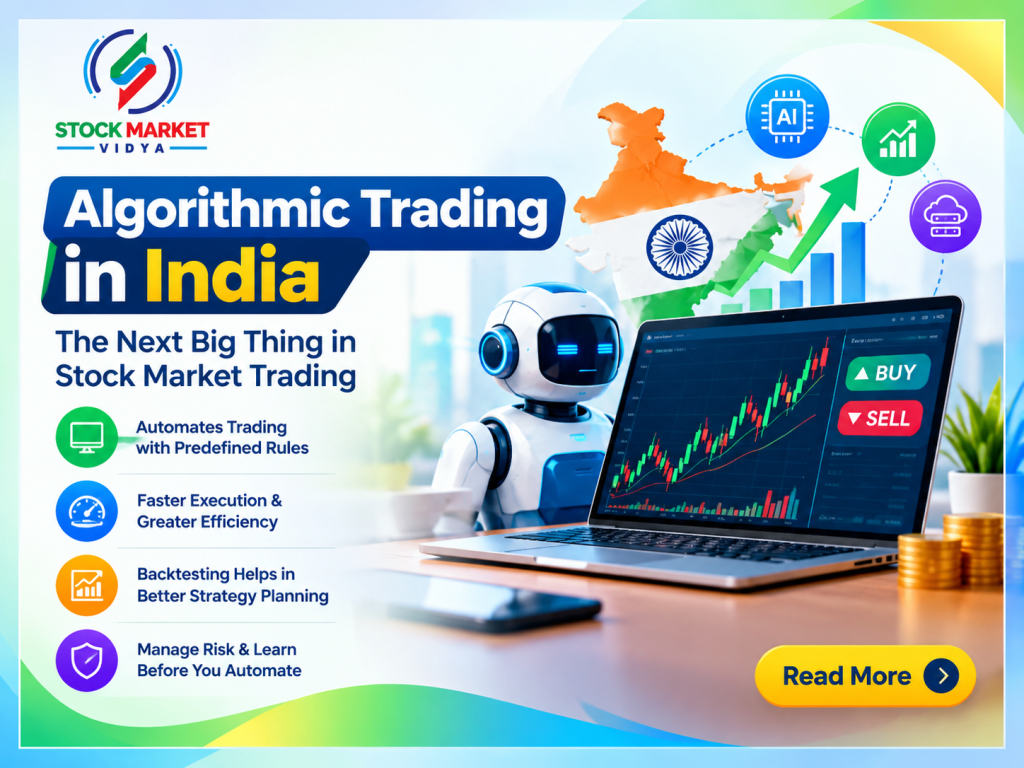

Imagine this.
You have a trading strategy. You have clearly defined when to enter, when to exit and how much risk you are ready to take. But instead of watching the market continuously and placing every order manually, a computer follows your rules and executes the trade.
This is the basic idea behind algorithmic trading, commonly called algo trading.
As technology, market data and automation become more important in financial markets, algorithmic trading is becoming an important area for Indian traders and investors to understand.

What Is Algorithmic Trading?
Algorithmic trading means using computer-based rules to identify trading opportunities and execute orders.
Instead of making decisions based only on emotions or market noise, an algorithm follows predefined conditions.
A strategy may use moving averages, price action, volume, RSI, MACD, breakouts, futures and options data or other market conditions.
The computer then monitors these conditions according to the programmed rules.
Why Is Algo Trading Growing in India?
Indian stock markets have become highly technology-driven.
Traders today have access to real-time market data, advanced charting platforms, APIs, automated strategies and backtesting tools.
This creates an opportunity for traders who understand both market analysis and technology.
But speed alone does not create a successful strategy.
A poor strategy can simply lose money faster when automated.
That is why learning, testing and risk management remain essential.
Algo Trading Is Not a Magic Money-Making Machine
Algorithmic trading does not automatically make a strategy profitable.
Markets change. Volatility changes. Transaction costs and slippage matter. A strategy that performed well historically may behave differently in the future.
Therefore, successful algorithmic trading requires much more than writing a program.
A systematic approach can be:
Strategy → Backtesting → Risk Management → Execution → Monitoring → Continuous Learning
Algorithmic Trading vs Manual Trading
Manual trading depends heavily on human decision-making.
Algorithmic trading converts predefined rules into an automated process.
The major advantage is consistency. Human traders can experience fear, greed, hesitation and revenge trading. A properly designed algorithm follows its programmed conditions.
However, the person creating the algorithm still needs strong trading psychology, market knowledge and risk management skills.
Benefits of Algorithmic Trading
Less Emotional Decision-Making
Algorithms follow predefined rules instead of reacting emotionally to every market movement.
Faster Execution
Computer systems can monitor conditions and execute predefined instructions quickly.
Strategy Backtesting
Traders can study how a rule-based strategy behaved using historical market data before considering live implementation.
Better Trading Discipline
Clearly defined rules can reduce random decision-making and unnecessary changes to a trading plan.
Multiple Conditions
An automated system can monitor several predefined conditions according to its design.
What Should Beginners Learn Before Algo Trading?
If you are completely new to the market, directly starting with automation may not be the best approach.
A better learning path is:
Stock Market Basics → Fundamental Analysis → Technical Analysis → Trading Psychology → Risk Management → Trading Strategies → Backtesting → Automation
Understanding the market first makes it easier to understand why a strategy works and how its rules can potentially be automated.
Can Algo Trading Be Used for Intraday and Options Trading?
Algorithmic systems can be designed for different trading approaches, including intraday trading, short-term strategies, futures, options, technical indicators and systematic strategies.
However, derivatives involve substantial risk, and automation does not remove that risk.
Anyone learning intraday or options trading should understand position sizing, risk-reward, volatility, transaction costs and disciplined execution.
Why Stock Market Learning Still Matters
Technology may change trading, but market knowledge remains the foundation.
Whether you trade manually or use automation, you should understand:
- How markets work
- Technical analysis
- Fundamental factors
- Risk-reward
- Position sizing
- Trading psychology
- Market volatility
- Trading costs
- Futures and options
- Trading discipline
This is why practical stock market training can be valuable.
The objective should not simply be learning how to place an order. It should be understanding why a trade is considered, what risk is involved and how the strategy should be evaluated.
Learn Stock Market Trading in Nagpur with Stock Market Vidya
Stock Market Vidya Nagpur is a Share Market Training Institute in Nagpur run by Mr. Prashant Sarode, NISM and NSE Certified Trainer.
The institute focuses on structured stock market education covering areas such as fundamental analysis, technical analysis, option chain analysis, futures and options, intraday trading concepts, short-term trading, long-term investing concepts, trading strategies, risk management and trading psychology.
Learn from Mr. Prashant Sarode – NISM and NSE Certified Trainer
Mr. Prashant Sarode is the trainer behind Stock Market Vidya and is a NISM and NSE Certified Trainer.
NISM is the National Institute of Securities Markets and is associated with securities-market education and certification in India.
For people comparing the best institute to learn trading in Nagpur, the trainer’s knowledge, teaching approach, course structure and practical learning should all be considered.
Who Can Benefit?
Beginners: Build a strong foundation in stock market concepts.
Working Professionals: Learn market concepts in a structured manner alongside their professional responsibilities.
Existing Traders: Strengthen their understanding of technical analysis, options, strategies and risk management.
Students: Develop foundational knowledge of financial markets and modern trading technologies.
The Future of Algo Trading
The future of trading will likely involve a combination of human knowledge, data, technology and automation.
Artificial intelligence, machine learning, APIs, quantitative analysis and automated execution are becoming increasingly relevant to financial-market education and technology.
But the human trader will still matter.
Someone needs to develop the idea, test the strategy, understand the risks and evaluate whether the system remains suitable when market conditions change.
The future may not be humans versus algorithms.
It may be humans using algorithms intelligently.
Start with Knowledge Before Automation
Algorithmic trading could become an increasingly important part of India’s evolving financial markets. But automation should come after education.
For learners searching for a share market institute in Nagpur, stock market training institute in Nagpur, technical analysis course in Nagpur or stock market learning institute Nagpur, Stock Market Vidya offers a structured place to begin that journey.
Stock Market Vidya – Nagpur
Trainer: Mr. Prashant Sarode – NISM Certified Trainer
Mobile: 9822718163 / 8421893845
Website:www.stockmarketvidya.com
Learn the market. Understand the strategy. Build discipline. Then explore automation.
Frequently Asked Questions About Algorithmic Trading in India
1. What is algorithmic trading in India?
Algorithmic trading is a method of buying or selling financial instruments using computer-based rules. The system can analyse predefined market conditions and place orders according to the programmed strategy.
2. Is algorithmic trading legal in India?
Yes, algorithmic trading is permitted in India, subject to applicable SEBI regulations and exchange requirements. Traders should understand the rules applicable to their trading setup before using automated strategies.
3. How does algo trading work?
Algo trading works by converting a trading strategy into predefined rules. When the required conditions are met, the system can generate signals or execute orders according to those rules.
4. Is algorithmic trading suitable for beginners?
Beginners should first understand stock market basics, technical analysis, risk management and trading psychology. After developing a proper foundation, they can gradually explore algorithmic trading and strategy automation.
5. Can I learn algorithmic trading without knowing coding?
Yes. A person can first learn the concepts of algorithmic trading, strategy development, backtesting and risk management without being an advanced programmer. Coding knowledge can become useful when developing or customising automated systems.
6. What are the benefits of algorithmic trading?
Some potential benefits include faster execution, systematic decision-making, reduced emotional interference, automated monitoring and the ability to backtest predefined strategies.
7. Does algo trading guarantee profits?
No. Algorithmic trading cannot guarantee profits. A poorly designed strategy can produce losses, and even a strategy that worked historically may not perform similarly in changing market conditions.
8. Can algo trading be used for intraday trading?
Yes, algorithmic strategies can be designed for intraday trading. However, traders need to carefully consider volatility, execution, brokerage, slippage and risk management.
9. Can algorithmic trading be used for options trading?
Yes. Algo strategies can be developed around options and other derivatives. However, options trading involves significant risk, so traders should understand option pricing, volatility, position sizing and risk management before using automated strategies.
10. What should I learn before starting algo trading?
A good foundation includes stock market basics, technical analysis, trading psychology, risk management, trading strategies, backtesting and market execution. These concepts can help you understand the logic behind an automated strategy.
11. Is technical analysis useful for algorithmic trading?
Yes. Technical indicators and price-based conditions can be converted into systematic rules. Moving averages, RSI, MACD, breakouts, volume and other indicators can form part of an algorithmic strategy.
12. What is backtesting in algorithmic trading?
Backtesting means testing a trading strategy against historical market data. It helps traders study how a strategy would have behaved under previous market conditions. However, historical performance does not guarantee future results.
13. Can algorithmic trading reduce trading emotions?
An automated system can reduce emotional interference during execution because it follows predefined rules. However, emotions can still influence the trader while designing, modifying or stopping a strategy.
14. Where can I learn stock market trading in Nagpur?
People looking for stock market training in Nagpur can explore local institutes that provide structured education in market fundamentals, technical analysis, trading strategies and risk management. Stock Market Vidya Nagpur, led by Mr. Prashant Sarode, NISM and NSE Certified Trainer, is one option for learners to consider.
15. What does Stock Market Vidya Nagpur teach?
Stock Market Vidya focuses on stock market education covering areas such as fundamental analysis, technical analysis, option chain analysis, futures and options, intraday trading concepts, short-term trading, long-term investing concepts, trading strategies and risk management.
16. Who is Mr. Prashant Sarode?
Mr. Prashant Sarode is the trainer behind Stock Market Vidya Nagpur and is a NISM and NSE Certified Trainer. His training focuses on helping learners develop a structured understanding of the Indian stock market.
17. Is Stock Market Vidya suitable for beginners?
Yes. Beginners looking for a stock market course for beginners in Nagpur can start by learning basic market concepts and gradually develop knowledge of technical analysis, trading strategies, risk management and other advanced topics.
18. What types of stock market courses can learners look for in Nagpur?
Learners may explore courses covering stock market basics, technical analysis, intraday trading, options trading, futures and options, investment concepts and practical trading strategies. The right course depends on the learner’s existing knowledge and objectives.
19. How can I find the best share market course for beginners in Nagpur?
Compare the trainer’s credentials, curriculum, practical learning approach, course structure and topics covered. Beginners should preferably choose a programme that teaches market fundamentals and risk management rather than focusing only on trading signals.
20. How can I contact Stock Market Vidya Nagpur?
You can contact Stock Market Vidya Nagpur on 9822718163 or 8421893845. Visit StockMarketVidya.com to learn more about the institute and its stock market education programmes.
-
How to Read an Annual Report as a Stock Investor: A Beginner’s Guide
Buying a stock only because someone recommended it on social media or television can be risky. A smart investor tries to understand the business before investing money. One of the best documents available for this purpose is the company’s annual report. But many beginners feel confused when they open a 200-page or 300-page annual report.…
-

10 Smart Questions to Ask Before Your First Stock Investment
Buying your first stock can feel exciting. You open a trading app, search for a company name, see the share price moving up, and think, “Should I buy this stock?” But successful investing should not begin with excitement or a random tip from social media. It should begin with questions. Before investing your hard-earned money,…
-

How to Research a Stock Before Buying It: A Beginner’s Guide for Indian Investors
Buying a stock should not be like buying something because a friend recommended it, a social media post called it a “multibagger”, or its price suddenly started moving upward. A better approach is simple: research first, decide later. For beginners, stock research means understanding the company, its business, financial performance, valuation, industry, management and future…