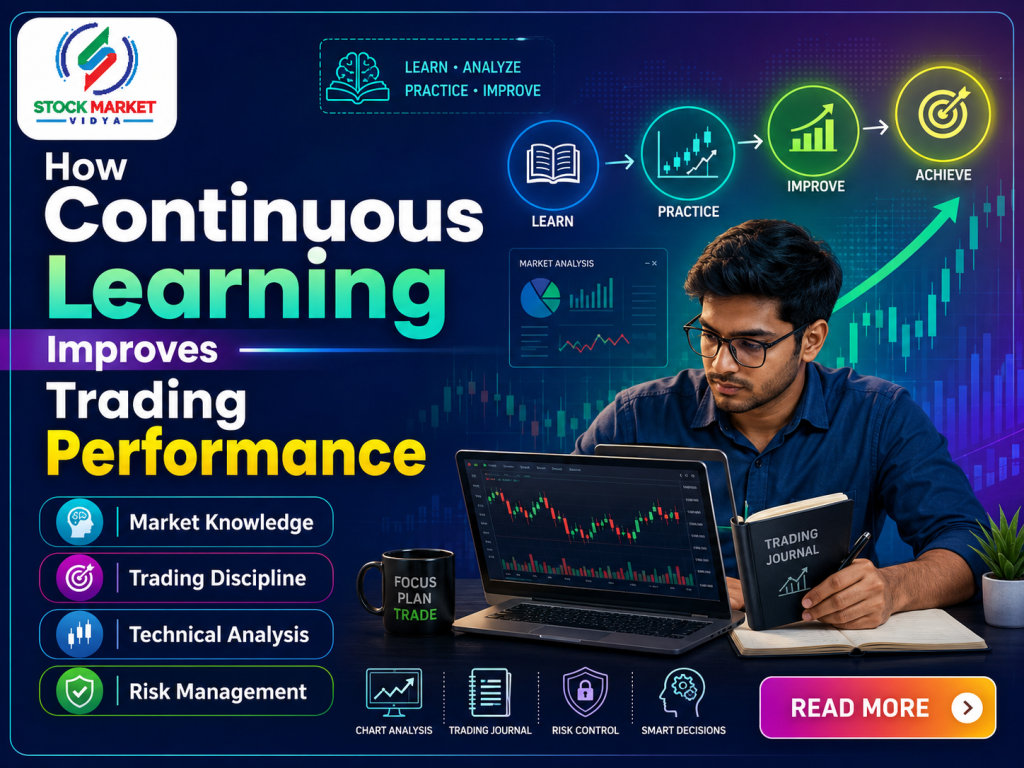

The stock market does not remain the same every day. New market conditions, changing investor behaviour, economic events, company results and evolving trading techniques can influence prices. This is why learning about the stock market should not stop after completing one course.
Continuous learning is one of the most important habits a trader can develop. It helps improve market understanding, trading discipline, decision-making and risk management.

For a beginner asking how to learn stock market trading in India, the answer is not simply to learn a few indicators or strategies. Good trading education is an ongoing process involving knowledge, practice, observation and self-improvement.
Why Does Continuous Learning Matter in Trading?
Imagine two traders.
Trader A learns one strategy and uses the same approach in every market condition.
Trader B regularly studies charts, market behaviour, trading psychology, risk management and new developments. Trader B also reviews previous trades to understand mistakes.
Over time, Trader B is more likely to develop better decision-making habits because learning is connected with actual market experience.
Continuous learning does not mean that a trader will automatically make profits. Instead, it helps traders understand the market better and make more informed decisions.
SEBI’s research on individual traders in equity derivatives highlights the importance of understanding trading behaviour and profitability before participating actively in this segment.
1. Learning Improves Market Understanding
A trader needs to understand why the market is moving, not only whether prices are moving up or down.
Continuous stock market learning can help you understand:
- Fundamental analysis
- Technical analysis
- Price action
- Market trends
- Support and resistance
- Volume
- Indicators
- Option chains
- Futures and options
- Risk management
- Trading psychology
For example, suppose a stock suddenly falls 5%. A beginner may immediately think that the stock is cheap and buy it.
An educated trader may first ask:
Why did the stock fall? Is the fall connected to company news, market weakness, technical breakdown or temporary volatility?
That extra thinking can lead to better decisions.
2. Continuous Learning Builds Trading Discipline
Trading discipline is not developed by reading one book or attending one class.
It develops through repeated practice.
A disciplined trader follows a defined process before entering a trade:
Market analysis → Trading setup → Entry → Stop-loss → Position size → Target → Exit
Without discipline, traders may enter trades because of fear, greed, tips or social-media recommendations.
Continuous learning reminds traders to follow their trading plan rather than emotions.
This is particularly important for intraday and derivatives trading, where decisions can happen very quickly.
3. Trading Psychology Becomes Stronger
Many traders know technical analysis but still struggle with trading psychology.
Why?
Because knowing a strategy and following that strategy under pressure are two different things.
Continuous learning helps traders recognise common psychological problems such as:
- Fear of missing out
- Revenge trading
- Overtrading
- Greed
- Fear after a loss
- Taking profits too early
- Holding losing positions for too long
- Increasing trade size after a loss
For example, after losing ₹2,000, a trader may immediately take another trade with a larger position to recover the money.
This is emotional trading.
A continuous learner studies such behaviour and gradually develops better control over decisions.
4. Technical Analysis Skills Improve With Practice
Technical analysis is not something that becomes perfect after learning a few indicators.
Charts need regular observation.
A trader can continue improving knowledge of:
- Candlestick patterns
- Trendlines
- Moving averages
- RSI
- MACD
- Bollinger Bands
- Pivot levels
- Volume analysis
- Price action
- Chart patterns
The real improvement comes when a trader learns to combine technical information with market context.
For example, an RSI signal alone may not provide enough information. A trader may also consider trend, support or resistance, volume and overall market conditions.
This practical approach is more useful than blindly following an indicator.
5. Market Conditions Keep Changing
A strategy that works well in a trending market may behave differently during a sideways market.
Similarly, high-volatility conditions can create different challenges from a low-volatility environment.
This is why traders should keep learning about different market conditions.
Continuous education helps traders ask important questions:
Is the market trending?
Is it moving sideways?
Is volatility increasing?
Is there a major event approaching?
Does my strategy suit the current market environment?
These questions can improve the quality of trading decisions.
6. Learning From Your Own Trades Is Extremely Valuable
One of the simplest methods of continuous learning is maintaining a trading journal.
After every trade, record:
- Why did I enter?
- What was my setup?
- Where was my stop-loss?
- Did I follow my trading plan?
- What happened after entry?
- Why did I exit?
- What mistake did I make?
- What can I improve?
After 30 or 50 trades, patterns may become visible.
For example, you may discover that most losses happen when you trade without confirmation or when you enter after a large price movement.
That information can help you improve your trading process.
7. Continuous Learning Improves Risk Management
A good trader does not focus only on finding profitable trades.
Risk management is equally important.
Learning about position sizing, stop-losses, risk-reward ratios and capital protection can help traders manage downside risk more carefully.
This is especially important for futures and options because derivatives can involve significant risk.
SEBI’s published research has repeatedly examined individual participation and profitability in the equity derivatives segment, showing why traders should approach derivatives with proper knowledge and risk awareness.
What Should Traders Keep Learning?
A practical learning roadmap can include:
Stage 1 – Basics:
Understand shares, exchanges, demat accounts, orders, indices and investing.
Stage 2 – Analysis:
Learn fundamental analysis and technical analysis.
Stage 3 – Trading:
Study intraday trading, swing trading and different trading setups.
Stage 4 – Derivatives:
Understand futures, options, option chains, volatility and strategies.
Stage 5 – Psychology:
Develop emotional control and trading discipline.
Stage 6 – Review:
Maintain a trading journal and analyse your performance.
This creates a continuous learning cycle rather than treating education as a one-time activity.
Learn Continuously at Stock Market Vidya Nagpur
Stock Market Vidya Nagpur is a share market training institute run by Mr. Prashant Sarode, NISM & NSE Certified Trainer.
The institute focuses on helping learners understand the stock market through structured education and practical concepts rather than depending only on theoretical information.
Students looking for a share market course in Nagpur, stock market course in Nagpur, trading classes in Nagpur or a share trading course in Nagpur can explore the learning programs offered by Stock Market Vidya.
What Can You Learn at Stock Market Vidya?
The learning approach can be useful for beginners as well as individuals who want to strengthen their existing market knowledge.
Important areas include:
- Fundamental analysis
- Technical analysis
- Price and chart analysis
- Trading strategies
- Intraday trading concepts
- Options and option-chain analysis
- Futures and options
- Risk management
- Trading psychology
- Market discipline
- Practical market understanding
Why Choose Practical Stock Market Training?
Watching random trading videos online can provide information, but many beginners struggle to create a proper learning sequence.
A structured stock market course with practical training can help learners move step-by-step from basic concepts towards more advanced topics.
The benefit of classroom learning is not simply collecting information. It is developing a process for analysing the market, asking questions, practising concepts and understanding mistakes.
For someone searching where to learn stock market trading in Nagpur, Stock Market Vidya offers a local learning environment focused on stock market education.
Learn From Mr. Prashant Sarode
Mr. Prashant Sarode is the trainer behind Stock Market Vidya Nagpur and is presented as an NISM& NSE Certified Trainer.
NISM, the National Institute of Securities Markets, is an institution established by SEBI that conducts certification examinations covering various areas of the securities market.
Learning from an experienced trainer can help students understand complicated market concepts in a simpler and more practical manner.
For learners looking for the best institute to learn trading in Nagpur, the trainer’s knowledge, teaching approach and practical orientation are important factors to consider.
Continuous Learning Is a Trader’s Long-Term Habit
The biggest difference between a learner and a non-learner is not how much they know today. It is how willing they are to improve tomorrow.
Markets change.
Strategies need testing.
Trading psychology needs attention.
Risk management needs discipline.
And every trade can provide a learning opportunity.
Therefore, instead of asking only “Which is the best trading strategy?”, traders should also ask:
“How can I become a better trader every month?”
That mindset can make continuous learning a powerful part of stock market education.
Start Your Stock Market Learning Journey
Stock Market Vidya Nagpur provides structured share market education for individuals who want to understand trading and the stock market systematically.
Whether you are a beginner exploring a share market course near me, a working professional looking for trading knowledge, or someone wanting to improve existing skills, continuous learning can help you build a stronger foundation.
Stock Market Vidya
Trainer: Mr. Prashant Sarode – NISM & NSE Certified Trainer
Mobile: 9822718163 / 8421893845
Location: Nagpur, Maharashtra
For course information, admissions and directions, visit StockMarketVidya.com and contact the institute directly.
Frequently Asked Questions
1. Why is continuous learning important for stock market trading?
Continuous learning helps traders improve their market knowledge, trading discipline, risk management and decision-making. Since market conditions keep changing, regular learning helps traders adapt their approach.
2. Can continuous learning improve trading performance?
Yes. Continuous learning can improve a trader’s understanding of technical analysis, market behaviour, trading psychology and risk management. However, learning alone does not guarantee trading profits.
3. What should a beginner learn first in the stock market?
A beginner should start with basic stock market concepts, fundamental analysis, technical analysis, risk management and trading psychology before moving towards advanced trading strategies.
4. How can I learn stock market trading in India?
You can learn through structured courses, books, educational resources, market observation and practical training. Joining a structured share market course in Nagpur can also help beginners learn concepts in a systematic manner.
5. What are the benefits of joining Stock Market Vidya Nagpur?
Stock Market Vidya Nagpur provides structured stock market education covering areas such as fundamental analysis, technical analysis, trading strategies, options, futures, risk management and trading psychology.
6. Who is Mr. Prashant Sarode?
Mr. Prashant Sarode is the trainer associated with Stock Market Vidya Nagpur and is an NISM & NSE Certified Trainer. He provides stock market education with a focus on understanding market concepts and practical learning.
7. Is Stock Market Vidya suitable for beginners?
Yes. Beginners can learn the basic concepts of the stock market and gradually progress towards technical analysis, trading strategies, options and other advanced topics through structured learning.
8. What is the importance of trading psychology?
Trading psychology helps traders manage emotions such as fear, greed, FOMO and revenge trading. Developing emotional discipline can help traders follow their trading plan more consistently.
9. Why should traders maintain a trading journal?
A trading journal helps traders record their entries, exits, reasons for taking trades, mistakes and outcomes. Reviewing this information can help identify repeated mistakes and improve trading discipline.
10. Can technical analysis be learned by beginners?
Yes. Beginners can learn technical analysis step-by-step, starting with charts, trends, support and resistance, candlestick patterns and volume before studying indicators and advanced strategies.
11. What is practical stock market training?
Practical stock market training focuses on applying concepts to real market situations. It may include chart analysis, trade planning, risk management, market observation and reviewing trading decisions.
12. Why is risk management important in trading?
Risk management helps traders control potential losses and protect their trading capital. Position sizing, stop-loss planning and appropriate risk-reward assessment are important parts of responsible trading.
13. Should traders keep learning after completing a stock market course?
Yes. Completing a course should be viewed as the beginning of the learning journey. Traders can continue improving through market observation, trade analysis, reading, practice and regular review.
14. Can working professionals learn stock market trading?
Yes. Working professionals can learn stock market concepts by following a structured learning schedule and gradually developing knowledge of investing, technical analysis, trading psychology and risk management.
15. Where can I find share market classes in Nagpur?
Learners looking for share market classes in Nagpur, trading classes in Nagpur or a stock market training institute in Nagpur can explore Stock Market Vidya Nagpur and contact the institute for current course details.
16. Does Stock Market Vidya cover options trading?
Stock Market Vidya’s learning areas include options and option-chain concepts. Learners interested in an option trading course in Nagpur can contact the institute for the latest course curriculum.
17. What is the benefit of learning futures and options?
Learning futures and options can help traders understand derivatives, contracts, option chains, strategies, risk and market behaviour. Because derivatives involve significant risk, proper education and risk management are important.
18. How do I choose the best share market course for beginners in Nagpur?
Look for a course that provides a structured curriculum, experienced instruction, practical market education, risk-management concepts and trading psychology rather than focusing only on profit-making strategies.
19. Where can I learn stock market trading in Nagpur?
If you are searching for where to learn stock market trading in Nagpur, Stock Market Vidya Nagpur is one local option. The institute is run by Mr. Prashant Sarode, an NISM& NSE Certified Trainer.
20. How can I contact Stock Market Vidya Nagpur?
You can contact Stock Market Vidya Nagpur on 9822718163 or 8421893845 for course information, batch details and other enquiries. You can also visit StockMarketVidya.com for more information.
-

How to Read an Annual Report as a Stock Investor: A Beginner’s Guide
Buying a stock only because someone recommended it on social media or television can be risky. A smart investor tries to understand the business before investing money. One of the best documents available for this purpose is the company’s annual report. But many beginners feel confused when they open a 200-page or 300-page annual report.…
-

10 Smart Questions to Ask Before Your First Stock Investment
Buying your first stock can feel exciting. You open a trading app, search for a company name, see the share price moving up, and think, “Should I buy this stock?” But successful investing should not begin with excitement or a random tip from social media. It should begin with questions. Before investing your hard-earned money,…
-

How to Research a Stock Before Buying It: A Beginner’s Guide for Indian Investors
Buying a stock should not be like buying something because a friend recommended it, a social media post called it a “multibagger”, or its price suddenly started moving upward. A better approach is simple: research first, decide later. For beginners, stock research means understanding the company, its business, financial performance, valuation, industry, management and future…