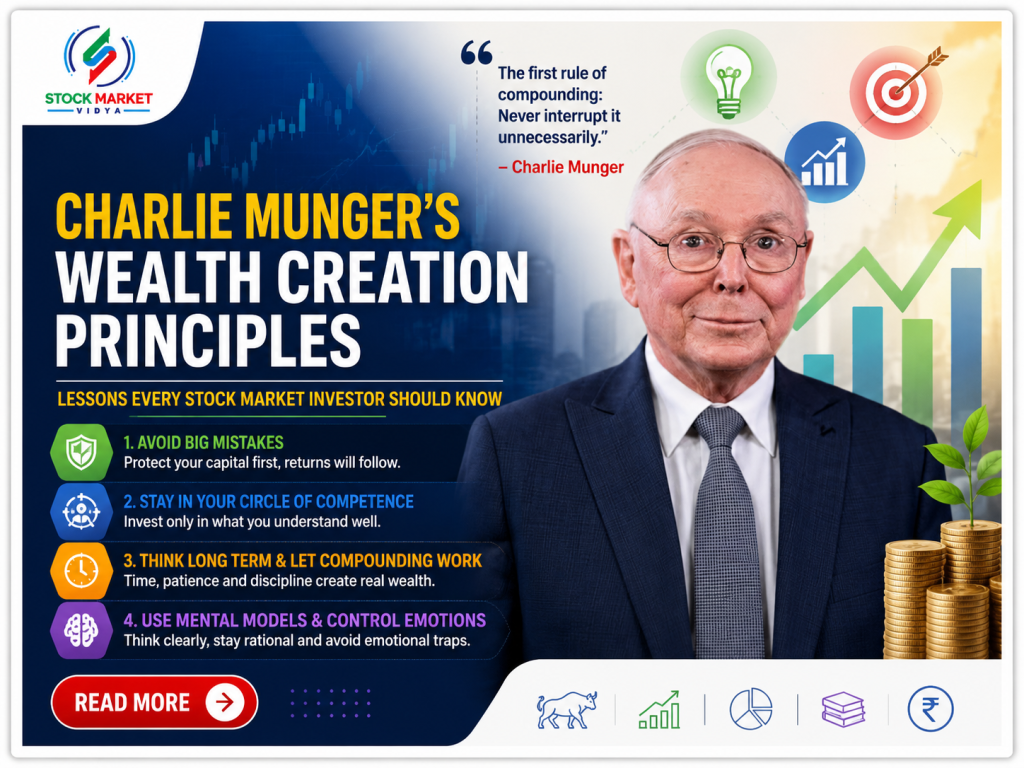

Building wealth in the stock market is not only about finding the next multibagger stock. It is also about learning how to think, how to control emotions, how to manage risk and how to make better decisions repeatedly.
Few investors explained this idea as clearly as Charlie Munger, the longtime investment partner of Warren Buffett and vice chairman of Berkshire Hathaway.
Munger believed that successful investing requires more than financial formulas. Investors need patience, discipline, rational thinking and the ability to avoid obvious mistakes.
For someone learning the share market, these lessons are extremely useful. Whether you are a beginner exploring a stock market course for beginners, an investor building a long-term portfolio or a trader studying technical analysis and trading psychology, Munger’s principles can improve the way you approach the market.

Who Was Charlie Munger?
Charlie Munger was an American investor, businessman and thinker who became widely respected for his contribution to the investment philosophy associated with Berkshire Hathaway.
His approach was not based on constantly buying and selling stocks. Instead, he emphasised rational decision-making, business quality, patience, understanding human behaviour and avoiding unnecessary mistakes.
One of his most important ideas was that investors should develop a collection of mental models rather than depend on one method of analysis.
This is particularly relevant today because investors have access to enormous amounts of market information. More information does not automatically create better decisions. Better thinking does.
Principle 1: Avoiding Big Mistakes Is More Important Than Chasing Big Profits
Many new traders ask:
“Which stock can give me the highest return?”
Munger’s philosophy encourages a different question:
“What can permanently damage my capital?”
This is a powerful change in thinking.
Suppose an investor has ₹5 lakh. Instead of taking unnecessary risks to make ₹50,000 quickly, the investor should first think about how to protect the ₹5 lakh.
This connects directly with risk management in stock market trading.
Whether you are doing intraday trading, swing trading or long-term investing, protecting capital should remain important.
A good trading discipline often starts with learning what not to do.
Principle 2: Stay Inside Your Circle of Competence
Munger strongly supported understanding your own limits.
You do not need to understand every industry, every company or every trading strategy.
If you understand banking businesses better than biotechnology companies, concentrate on what you can analyse properly.
For a beginner, this is an important lesson.
Do not buy a stock simply because:
- Someone posted about it on social media.
- A friend made money from it.
- A television expert mentioned it.
- The price is rising rapidly.
- You are afraid of missing out.
Instead, ask:
“Do I understand what I am buying and why I am buying it?”
This simple question can prevent many emotional decisions.
Principle 3: Think Long Term
One major difference between investing and gambling is the time horizon.
Munger believed that quality investments can become powerful when given sufficient time.
Consider a company that steadily increases its earnings, maintains a strong competitive position and reinvests capital intelligently.
An investor who stays invested for many years may benefit from the combination of business growth and compounding.
This is why long-term investing should be studied alongside short-term trading.
The stock market is not only about today’s price movement. It is also about understanding how businesses can create value over time.
Principle 4: Understand the Power of Compounding
Compounding is one of the strongest wealth creation concepts in finance.
Imagine investing ₹1 lakh and earning an average return of 12% annually. If returns remain invested, the capital can grow significantly over a long period.
The important lesson is not to chase unrealistic returns every month.
Instead, focus on:
reasonable returns + time + discipline + reinvestment.
This principle is useful for anyone learning how to learn stock market trading in India, because it shifts attention from quick profits to sustainable wealth creation.
Principle 5: Use Mental Models
Munger was famous for his idea of using a broad collection of mental models.
Instead of looking at an investment from only one angle, think about it from several perspectives.
For example, before investing in a company, you could consider:
Business: What does the company actually do?
Financials: Is revenue and profit growth healthy?
Competition: Does the company have a strong competitive advantage?
Management: Are the people running the business capable and trustworthy?
Valuation: Is the current price reasonable?
Risk: What could go wrong?
This multi-angle approach can make investment research more logical.
It is also why proper stock market education should cover more than chart patterns.
Principle 6: Invert the Problem
One of Munger’s most useful thinking techniques was inversion.
Instead of asking only:
“How can I make money?”
ask:
“How can I lose money?”
For example:
- Buying without understanding the company
- Using excessive leverage
- Taking oversized positions
- Trading emotionally
- Ignoring stop-loss rules
- Following tips blindly
- Overtrading after a loss
- Investing money needed for essential expenses
Once you identify possible mistakes, you can create rules to avoid them.
This is extremely valuable for developing a strong trading psychology.
Principle 7: Control Your Emotions
Markets move quickly. Human emotions move even faster.
Fear can make an investor sell too early. Greed can encourage excessive risk. Fear of missing out can lead to buying at inflated prices.
A disciplined trader understands that not every market movement requires action.
Sometimes the best decision is to do nothing.
This is particularly important for people attending live market trading classes. Seeing prices move in real time can create emotional pressure. Practical training should therefore teach decision-making, not merely buy and sell signals.
Principle 8: Be Patient
Patience is often underestimated in the stock market.
A beginner may expect results within weeks. A serious investor understands that wealth creation can take years.
Munger’s approach encourages investors to wait for attractive opportunities rather than constantly participate in the market.
This idea applies to both investing and trading.
A trader can wait for a high-quality setup.
An investor can wait for an attractive valuation.
In both cases, patience is a form of discipline.
Principle 9: Keep Learning
The financial markets continuously change.
New technologies, businesses, regulations and investment products appear regularly.
Therefore, stock market learning should not stop after opening a Demat account.
Investors can continue learning:
- Fundamental analysis
- Technical analysis
- Price action
- Risk management
- Trading psychology
- Options
- Futures
- Portfolio management
- Market cycles
This is where structured education can make a difference.
How These Principles Help Indian Stock Market Learners
Munger’s principles are not a shortcut to market profits. They are a framework for becoming a more rational market participant.
For an Indian learner searching for a share market course near me, the important question should not simply be the course fee.
Ask:
Does the training explain how the market works?
Does it teach risk management?
Does it explain technical and fundamental analysis?
Does it develop trading discipline?
Does it provide practical exposure to market situations?
These questions are more useful than simply looking for a course promising quick returns.
Learn Stock Market Concepts at Stock Market Vidya Nagpur
For people searching for share market training in Nagpur, Stock Market Vidya provides structured market education under the guidance of Mr. Prashant Sarode, NISM Certified Trainer.
Stock Market Vidya – StockMarketVidya.com
Stock Market Vidya Nagpur focuses on helping learners understand the stock market through concepts, analysis and practical learning.
The institute is suitable for people who want to understand the market systematically rather than depend only on market tips.
Students can explore areas such as fundamental analysis, technical analysis, option chain analysis, futures and options strategies, intraday trading, short-term trading and long-term investing.
Why Mr. Prashant Sarode’s NISM Certification Matters
Mr. Prashant Sarode is the trainer associated with Stock Market Vidya and is described by the institute as an NISM Certified Trainer.
NISM is the National Institute of Securities Markets, established by SEBI, and it conducts certification examinations for different areas of the securities market. NISM also maintains a Skills Registry for verification of NISM certifications.
This professional background adds an important educational dimension to stock market training.
At the same time, students should understand that an NISM certification is not a promise of investment returns. NISM itself states that it conducts certification examinations and does not directly provide preparation training for candidates.
The real purpose of learning should be to build knowledge, discipline and decision-making ability.
What Can You Learn at Stock Market Vidya?
Someone searching for the best share market classes in Nagpur may have different learning goals.
A beginner may want to understand the basics.
A working professional may want to learn investment and trading alongside a job.
An experienced participant may want to improve technical analysis or options strategies.
Stock Market Vidya’s structured learning approach can help learners explore areas such as:
- Stock market fundamentals
- Fundamental analysis
- Technical analysis
- Option chain analysis
- Futures and options
- Hedging strategies
- Intraday trading
- Short-term trading
- Long-term investing
- Trading psychology
- Risk management
Why Practical Stock Market Training Can Be Valuable
Reading books and watching online videos can provide knowledge, but practical learning helps connect concepts with actual market situations.
A stock market course with practical training can help students understand how different concepts are applied.
For example, knowing what RSI means is different from understanding when an RSI signal may be unreliable.
Knowing what a stop-loss is differs from having the discipline to follow it.
Knowing an options strategy is different from understanding its risk when market conditions change.
This gap between theory and application is why practical stock market training can be useful.
Where to Learn Stock Market Trading in Nagpur?
If you are asking, “Where to learn stock market trading in Nagpur?”, start by comparing the quality of the curriculum, trainer credentials, practical exposure and learning approach.
Students looking for a stock market training institute in Nagpur, share market institute in Nagpur, best trading institute in Nagpur or stock market education Nagpur can explore Stock Market Vidya.
The institute can also be considered by learners searching for trading classes near Wardha Road Nagpur, stock market classes near Sonegaon or Somalwada Nagpur and related local searches.
The goal should not be to find someone who tells you what to buy tomorrow.
The goal should be to learn how to think before buying or selling.
That is perhaps one of the strongest lessons we can take from Charlie Munger.
Charlie Munger’s Real Wealth Creation Lesson
Munger’s investment philosophy can be reduced to a simple idea:
Make better decisions, avoid unnecessary mistakes, stay patient and let time work in your favour.
You do not need to predict every market movement.
You do not need to trade every day.
You do not need to follow every market trend.
You need a process.
You need knowledge.
You need discipline.
And you need the patience to allow good decisions to compound.
For anyone beginning their journey through share market classes in Nagpur, these principles are worth remembering.
The market will always provide another opportunity. Your job is to be prepared when it arrives.
Start Your Stock Market Learning Journey in Nagpur
Stock Market Vidya Nagpur is a Share Market Training Institute in Nagpur led by Mr. Prashant Sarode (NISM Certified Trainer).
Contact: 9822718163 / 8421893845
Google Maps Directions:Find Stock Market Vidya on Google Maps
Stock Market Vidya Nagpur focuses on developing market understanding so that learners can approach the stock market with greater knowledge, preparation and discipline.
Frequently Asked Questions (FAQs)
1. What are Charlie Munger’s main wealth creation principles?
Charlie Munger’s main principles include long-term thinking, disciplined investing, avoiding major mistakes, understanding businesses, staying within your circle of competence, using mental models, controlling emotions and allowing compounding to work over time. His philosophy focuses more on making sensible decisions consistently than on chasing quick stock market profits.
2. How did Charlie Munger create wealth?
Charlie Munger created wealth through long-term investing, business ownership and the power of compounding. He focused on high-quality businesses, strong management, competitive advantages and sensible valuations. He also believed that avoiding poor investment decisions was as important as finding profitable opportunities.
3. What can Indian investors learn from Charlie Munger?
Indian investors can learn the importance of patience, research, risk management and disciplined decision-making. Instead of following stock tips or market rumours, investors can study a company’s business, financial performance, management, competition and valuation before investing.
4. What is Charlie Munger’s approach to stock market investing?
Munger’s approach was based on rational thinking and long-term ownership of quality businesses. He preferred understanding what he was buying rather than frequently trading based on short-term price movements. His approach highlights business quality, competitive advantage, management quality, valuation and the ability to compound capital.
5. Why is avoiding mistakes important in stock market investing?
Avoiding large mistakes is important because a major loss can significantly reduce your capital and make recovery difficult. For example, losing 50% of your investment requires a 100% gain just to return to the original amount. This is why risk management and capital protection are important parts of stock market learning.
6. What does Charlie Munger mean by the circle of competence?
The circle of competence means understanding your own areas of knowledge and staying within them. Investors do not need to understand every company or industry. They can focus on businesses they understand well and avoid investments where they cannot properly evaluate the risks and opportunities.
7. What are mental models according to Charlie Munger?
Mental models are useful frameworks for understanding situations and making better decisions. Munger believed investors should use ideas from different fields such as economics, psychology, mathematics and business. In stock market investing, multiple mental models can help an investor analyse a company from different perspectives.
8. How does compounding help create wealth?
Compounding occurs when your returns generate additional returns over time. For example, if your investment earns returns and those returns remain invested, future growth can happen on a larger capital base. This is why patience and a long investment horizon are important for long-term wealth creation.
9. Is Charlie Munger’s investment philosophy useful for beginners?
Yes. Beginners can learn valuable lessons from Munger’s philosophy even without having advanced financial knowledge. Understanding businesses, controlling emotions, avoiding excessive risk, investing patiently and developing financial discipline can provide a strong foundation for stock market learning.
10. What is the connection between Charlie Munger’s principles and trading psychology?
Munger’s philosophy strongly connects with trading psychology because successful market participation requires emotional control. Fear, greed, overconfidence and fear of missing out can influence decisions. Developing discipline can help traders avoid impulsive decisions and follow a clearly defined trading plan.
11. Should beginners follow Charlie Munger’s investment strategy exactly?
Beginners should learn from Munger’s principles rather than blindly copy his individual investments. Every investor has different financial goals, risk tolerance, knowledge and time horizon. His principles such as patience, rational thinking, risk awareness and long-term learning can be adapted to an individual’s circumstances.
12. Can Charlie Munger’s principles be used for stock market trading?
Many of his decision-making principles can be useful for traders, particularly risk management, emotional discipline, avoiding unnecessary decisions and understanding one’s limitations. However, long-term value investing and short-term trading are different approaches, so traders should also learn technical analysis, position sizing and trading strategies.
13. How can stock market education help investors apply these principles?
Structured stock market education can help learners understand fundamental analysis, technical analysis, risk management, trading psychology, derivatives and market behaviour. Practical learning can make it easier to connect financial concepts with real market situations.
14. Where can I learn stock market trading in Nagpur?
People looking for where to learn stock market trading in Nagpur can explore Stock Market Vidya Nagpur, a share market training institute associated with Mr. Prashant Sarode, NISM Certified Trainer. The institute provides structured learning covering areas such as fundamental analysis, technical analysis, options and trading concepts.
15. What can I learn at Stock Market Vidya Nagpur?
Stock Market Vidya provides stock market education covering areas such as fundamental analysis, technical analysis, option chain analysis, futures and options, trading strategies, intraday trading, short-term trading and long-term investing. The learning approach is designed to help students develop market knowledge and practical understanding.
16. Is Stock Market Vidya suitable for stock market beginners?
Stock Market Vidya can be considered by people looking for a stock market course for beginners in Nagpur. Beginners can first develop an understanding of market fundamentals before progressing towards technical analysis, trading strategies, options and other advanced concepts.
17. Who is Mr. Prashant Sarode?
Mr. Prashant Sarode is the trainer associated with Stock Market Vidya Nagpur and is identified by the institute as an NISM Certified Trainer. His role is focused on providing structured stock market education and helping learners understand different aspects of trading and investing.
18. What is NISM certification?
NISM stands for the National Institute of Securities Markets. It was established by SEBI and conducts certification examinations for various areas of the securities market. NISM certification is designed to assess knowledge and competency relevant to different securities-market functions.
19. Why choose Stock Market Vidya for share market training in Nagpur?
Learners searching for the best share market classes in Nagpur can consider factors such as trainer credentials, course curriculum, practical exposure and the subjects covered. Stock Market Vidya focuses on structured stock market learning under Mr. Prashant Sarode, NISM Certified Trainer, with topics covering investing, trading, technical analysis and derivatives.
20. How can I contact Stock Market Vidya Nagpur?
You can contact Stock Market Vidya Nagpur at 9822718163 or 8421893845. You can also visit StockMarketVidya.com to learn more about its stock market courses and training programs.
-
How to Read an Annual Report as a Stock Investor: A Beginner’s Guide
Buying a stock only because someone recommended it on social media or television can be risky. A smart investor tries to understand the business before investing money. One of the best documents available for this purpose is the company’s annual report. But many beginners feel confused when they open a 200-page or 300-page annual report.…
-

10 Smart Questions to Ask Before Your First Stock Investment
Buying your first stock can feel exciting. You open a trading app, search for a company name, see the share price moving up, and think, “Should I buy this stock?” But successful investing should not begin with excitement or a random tip from social media. It should begin with questions. Before investing your hard-earned money,…
-

How to Research a Stock Before Buying It: A Beginner’s Guide for Indian Investors
Buying a stock should not be like buying something because a friend recommended it, a social media post called it a “multibagger”, or its price suddenly started moving upward. A better approach is simple: research first, decide later. For beginners, stock research means understanding the company, its business, financial performance, valuation, industry, management and future…